The more I read of Davidson, the more I get the impression that to him, Agrarianism meant a balance life. He didn't say it very well, all the time, but as I read more and more of what he wrote, he doesn't have a beef with machines per se. He has a problem with a messianic faith in machines. He doesn't have a problem with industry per se, he has a problem with a messianic faith in industrialism to relieve all our woes.
Davidson seems to hold on to Agrarianism as the best way to bring everything back into balance. A clear harmony between the life of the land and the life of the city seems to be in view with him. Now if I can just prove it.
Saturday, August 23, 2008


Tuesday, August 19, 2008
The Fertile Crescent
The first chapter of this book was devoted to the period we sometimes refer to as “prehistory.” This means that there are no contemporary records from that period. The period itself took place before people wrote things down about it. Contemporary records are other writings that can complement the history record we have. If you were to write a biography of Winston Churchill and you used his own diary and documents that he wrote for official business, they would be considered contemporary records. If you mentioned that he began working at the Office of the Admiralty in 1911 and you used either of these sources, you would have contemporary records for the assertion. There are no lists of anything from before the Flood and no catalogs of animals on the ark. The only source of information we have is the book of Genesis and other works that parallel the account given there. For instance, the Babylonian Epic of Gilgamesh, presents a parallel flood narrative that can be instructive if given the proper place.
However, after the Tower of Babel, we begin a new phase of history. Many history books, even those written by Christians, begin here. This is partly because writing about the period prior to this takes a lot of speculation, even if we follow the book of Genesis completely. It is difficult to know exactly when and where things took place. After the Tower of Babel, we have better knowledge of these things. We can focus our attention on a specific region and location, the Fertile Crescent.
The Fertile Crescent is known as the birthplace of civilization. Civilization is a very difficult word to define. It has typically been used to describe a city-dwelling culture. This is an unsatisfactory definition. We will not present a full-blown definition here, but we will begin to construct a definition in which civilization has to do with the transmission of culture from one generation to the next. For now, we will accept part of the traditional definition and acknowledge that civilization involves cities. Cities first spring up in the Fertile Crescent, a band of irrigated land stretching from the Persian Gulf in modern Iraq, up through the Tigris and Euphrates River valleys of Assyria and down through Palestine into Lower Egypt (see map below).
It is easy to see why civilization first began to develop in this region once we begin to understand the region. The Fertile Crescent is made up of river valleys. The basic geography of the Fertile Crescent is important to understand.
Rivers are formed when water runs down out of mountains on its way to sea. The Fertile Crescent is surrounded by mountains. To the north in Turkey and Armenia we find the Causasus and Taurus ranges. To the west we have the Zagros range. Deep in the south of central Africa the Ruwenzori range feeds the Nile River. Mountains also run through Palestine, the ranges of Lebanon and Hermon are particularly important. As water runs out of mountains it inevitably picks up sediment from the mountain and carries it down to the sea. However, as water flows rapidly it often overflows its traditional bed and lays this sediment down along its path. This sediment is often mineral-rich and suitable for growing.
The more important information though is the human side of this equation. All the sediment in the world would do nothing valuable if it were not for people. We learned from the Bible that after the Flood, Noah’s descendants traveled down the river valley and settled in the land of Shinar (cf. Gen. 11:1). Here they built the Tower of Babel and here God’s judgment came upon them. Humanity was forced to travel more and we see various groups of people develop different patterns of civilization all around the region of the Fertile Crescent.
In the immediate Persian Gulf area we find the Sumerians and the Akkadians, who we will look at carefully soon. To the east we find the Egyptians settled in the Nile River valley. Between both of these major groups we find a whole host of smaller groups filling in the lands. This first unit of this book will focus mostly on this region of the Fertile Crescent. The Fertile Crescent represents the foundational geography we will be concerned with for a while.
However, after the Tower of Babel, we begin a new phase of history. Many history books, even those written by Christians, begin here. This is partly because writing about the period prior to this takes a lot of speculation, even if we follow the book of Genesis completely. It is difficult to know exactly when and where things took place. After the Tower of Babel, we have better knowledge of these things. We can focus our attention on a specific region and location, the Fertile Crescent.
The Fertile Crescent is known as the birthplace of civilization. Civilization is a very difficult word to define. It has typically been used to describe a city-dwelling culture. This is an unsatisfactory definition. We will not present a full-blown definition here, but we will begin to construct a definition in which civilization has to do with the transmission of culture from one generation to the next. For now, we will accept part of the traditional definition and acknowledge that civilization involves cities. Cities first spring up in the Fertile Crescent, a band of irrigated land stretching from the Persian Gulf in modern Iraq, up through the Tigris and Euphrates River valleys of Assyria and down through Palestine into Lower Egypt (see map below).
It is easy to see why civilization first began to develop in this region once we begin to understand the region. The Fertile Crescent is made up of river valleys. The basic geography of the Fertile Crescent is important to understand.
Rivers are formed when water runs down out of mountains on its way to sea. The Fertile Crescent is surrounded by mountains. To the north in Turkey and Armenia we find the Causasus and Taurus ranges. To the west we have the Zagros range. Deep in the south of central Africa the Ruwenzori range feeds the Nile River. Mountains also run through Palestine, the ranges of Lebanon and Hermon are particularly important. As water runs out of mountains it inevitably picks up sediment from the mountain and carries it down to the sea. However, as water flows rapidly it often overflows its traditional bed and lays this sediment down along its path. This sediment is often mineral-rich and suitable for growing.
The more important information though is the human side of this equation. All the sediment in the world would do nothing valuable if it were not for people. We learned from the Bible that after the Flood, Noah’s descendants traveled down the river valley and settled in the land of Shinar (cf. Gen. 11:1). Here they built the Tower of Babel and here God’s judgment came upon them. Humanity was forced to travel more and we see various groups of people develop different patterns of civilization all around the region of the Fertile Crescent.
In the immediate Persian Gulf area we find the Sumerians and the Akkadians, who we will look at carefully soon. To the east we find the Egyptians settled in the Nile River valley. Between both of these major groups we find a whole host of smaller groups filling in the lands. This first unit of this book will focus mostly on this region of the Fertile Crescent. The Fertile Crescent represents the foundational geography we will be concerned with for a while.
Monday, August 18, 2008
Home ... where you least expect it
In researching the life and career of Donald Davidson and the Agrarians I have found many interesting notes about my own home, Middle Tennessee. For instance, Donald Davidson great-great-grandfather, Andrew Davidson put down roots near Shelbyville, TN after his first family was murdered by Shawnee Indians in Virginia. Donald's father spent some time in Winchester, TN (my hometown) at a teacher preparatory school I never knew existed.
Allen Tate's family often came down to Estill Springs for a family vacation. Apparently it used to be quite the wealthy Nashvillian hang out. Several of these men spent time in or around Sewanee and the University of the South. Tate edited the Sewanee Review for a while, as did Andrew Nelson Lytle. Lytle actually retired to Monteagle and died there in 1995.
This has been one of the interesting and exciting things about this research. It has given me a new glimpse of the home I grew up in and yet never really appreciated.
Allen Tate's family often came down to Estill Springs for a family vacation. Apparently it used to be quite the wealthy Nashvillian hang out. Several of these men spent time in or around Sewanee and the University of the South. Tate edited the Sewanee Review for a while, as did Andrew Nelson Lytle. Lytle actually retired to Monteagle and died there in 1995.
This has been one of the interesting and exciting things about this research. It has given me a new glimpse of the home I grew up in and yet never really appreciated.
The Tower of Babel
After the flood subsided, Genesis tells us that Noah and his children left the ark and made a sacrifice to God on the top of the mountain. There God made a covenant with Noah. This covenant is important because it parallels very closely the original covenant made with Adam. In both covenants God tells humanity to “be fruitful and multiply, and fill the earth” (Gen. 9:1; cf. Gen. 1:28). This tells us that the command to control the earth and subdue it (cf. Gen. 1:28) is still in force after the fall. It also sets us an interesting context for the next significant event in human history, the Tower of Babel.
Before we get to the Tower of Babel though, we should notice the tenth chapter of Genesis. It is traditionally called the Table of Nations. In this portion of Scripture, God gives us a catalog of all the major Mediterranean nations descended from Noah and his sons. It is a fascinating study to see that the Greeks, the Arabs, and others are all carefully cataloged in the Bible for us.
The general location of Babel is pretty easy to deduce. Genesis tells us that after a while the descendants of Noah traveled east and dwelt in the land of Shinar. Shinar is the biblical term for Mesopotamia (lit. the land between the rivers). This means that Noah’s descendants came to live between the Tigris and Euphrates Rivers. It was here that they decided to dwell and to raise the mighty tower to heaven.
Most archaeologists, whether they accept the biblical narrative or not, identify the structure of the Tower of Babel with the Sumerian ziggurat. The ziggurat was a structure utilized often throughout Sumeria. We have several archaeological examples of these structures. It is not necessary for us to settle on this explanation at this time. The far more important issue, historically, surrounds the reasons why the tower was built and what the effects were rather than what it looked like. It is enough to understand the general geography of the Tower of Babel.
When God made His covenant with Noah, which was a renewal of the original covenant with Adam, He instructed Noah again to “be fruitful and multiply, populate the earth abundantly and multiply in it” (Gen. 9:7 NASB). Part of the command here is to move and spread out. However, we can see an unwillingness to obey the command of God in the Tower of Babel event because the people had not moved around. They had stayed exactly where their forefathers had dwelt. There was an inherent disobedience in the descendants of Noah here. The building of the tower was just the physical manifestation of the internal sin of this disobedience. The people even state this. “Come, let us build ourselves a city, and a tower whose top is in the heavens; let us make a name for ourselves, lest we be scattered abroad over the face of the whole earth” (Gen. 11:4).
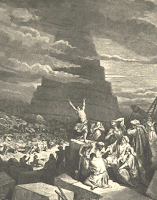 The tower is constructed to reach heaven. Historians tell us that many primitive religions see high places as the dwelling place of divinity. We will find this to be generally true whether we are discussing Sumeria or Greece. Why is this? Scripture is consistent in maintaining that God is “high and lifted up” (Is. 6:1). Since we are all made in the image of God and have the knowledge of God imprinted on our hearts, it is by constant suppression that we pretend we do not know God. This is the substance of Paul’s argument in Romans 1:18-32. His conclusion to this argument is that all humanity is “without excuse” (Rom. 1:21) and are subject to the judgment of God because they ignored their responsibilities before Him. Since all men know God it is reasonable to expect them to counterfeit true worship. True worship of God is according to His commands. Counterfeit worship flows from the heart of man and is directed at what he wants God to be like, whether this be an impersonal force or a buddy. Also at the heart of the tower is the desire from the garden to “be like God” (Gen. 3:5).
The tower represents a combination of sinful attitudes and actions on the part of humanity. It is our refusal to obey God in His commands. It is our attempt at counterfeit worship rather than authentic worship. It is also our attempt to be God. Thus the judgment of the Tower of Babel is instructive.
God communicates clearly why He acts. Do not miss how important it is that God communicates His will and reasons to us in the Bible. Many religions have gods that supposedly act in human history. However, few, if any, will give their rationale for acting in issues such as divine judgment. Here and in the Flood, we are not left to our own devices to determine why God chose to do what He did. He tells us, “Indeed the people are one and they all have one language, and this is what they begin to do; now nothing that they propose to do will be withheld from them. Come, let Us go down and there confuse their language, that they may not understand one anothers speech” (Gen. 11:6-7).
Much about history can be learned is episodes such as the Tower of Babel. Of course, the obvious piece of information is that we get all of the different languages from this event. Why do Egyptians speak differently from Greeks or Native Americans? Simply because God confused their language. The variety of languages in the world is not the result of random and cultural forces alone, it is a direct result of the God of heaven and earth acting judiciously on His creation.
The distribution of peoples can also be traced to this event. Many of the languages cataloged have families, (i.e.) they are similar. We can surmise that some of the languages created in the Tower of Babel judgment were similar and allowed the people to live in close proximity to each other. Others, however, were very different and thus people moved far away. From this, languages continued to develop and an entire history of language exists to consider the relationships they have to each other. Language is a fascinating thing and its history is incredible.
Before we get to the Tower of Babel though, we should notice the tenth chapter of Genesis. It is traditionally called the Table of Nations. In this portion of Scripture, God gives us a catalog of all the major Mediterranean nations descended from Noah and his sons. It is a fascinating study to see that the Greeks, the Arabs, and others are all carefully cataloged in the Bible for us.
The general location of Babel is pretty easy to deduce. Genesis tells us that after a while the descendants of Noah traveled east and dwelt in the land of Shinar. Shinar is the biblical term for Mesopotamia (lit. the land between the rivers). This means that Noah’s descendants came to live between the Tigris and Euphrates Rivers. It was here that they decided to dwell and to raise the mighty tower to heaven.
Most archaeologists, whether they accept the biblical narrative or not, identify the structure of the Tower of Babel with the Sumerian ziggurat. The ziggurat was a structure utilized often throughout Sumeria. We have several archaeological examples of these structures. It is not necessary for us to settle on this explanation at this time. The far more important issue, historically, surrounds the reasons why the tower was built and what the effects were rather than what it looked like. It is enough to understand the general geography of the Tower of Babel.
When God made His covenant with Noah, which was a renewal of the original covenant with Adam, He instructed Noah again to “be fruitful and multiply, populate the earth abundantly and multiply in it” (Gen. 9:7 NASB). Part of the command here is to move and spread out. However, we can see an unwillingness to obey the command of God in the Tower of Babel event because the people had not moved around. They had stayed exactly where their forefathers had dwelt. There was an inherent disobedience in the descendants of Noah here. The building of the tower was just the physical manifestation of the internal sin of this disobedience. The people even state this. “Come, let us build ourselves a city, and a tower whose top is in the heavens; let us make a name for ourselves, lest we be scattered abroad over the face of the whole earth” (Gen. 11:4).
 The tower is constructed to reach heaven. Historians tell us that many primitive religions see high places as the dwelling place of divinity. We will find this to be generally true whether we are discussing Sumeria or Greece. Why is this? Scripture is consistent in maintaining that God is “high and lifted up” (Is. 6:1). Since we are all made in the image of God and have the knowledge of God imprinted on our hearts, it is by constant suppression that we pretend we do not know God. This is the substance of Paul’s argument in Romans 1:18-32. His conclusion to this argument is that all humanity is “without excuse” (Rom. 1:21) and are subject to the judgment of God because they ignored their responsibilities before Him. Since all men know God it is reasonable to expect them to counterfeit true worship. True worship of God is according to His commands. Counterfeit worship flows from the heart of man and is directed at what he wants God to be like, whether this be an impersonal force or a buddy. Also at the heart of the tower is the desire from the garden to “be like God” (Gen. 3:5).
The tower represents a combination of sinful attitudes and actions on the part of humanity. It is our refusal to obey God in His commands. It is our attempt at counterfeit worship rather than authentic worship. It is also our attempt to be God. Thus the judgment of the Tower of Babel is instructive.
God communicates clearly why He acts. Do not miss how important it is that God communicates His will and reasons to us in the Bible. Many religions have gods that supposedly act in human history. However, few, if any, will give their rationale for acting in issues such as divine judgment. Here and in the Flood, we are not left to our own devices to determine why God chose to do what He did. He tells us, “Indeed the people are one and they all have one language, and this is what they begin to do; now nothing that they propose to do will be withheld from them. Come, let Us go down and there confuse their language, that they may not understand one anothers speech” (Gen. 11:6-7).
Much about history can be learned is episodes such as the Tower of Babel. Of course, the obvious piece of information is that we get all of the different languages from this event. Why do Egyptians speak differently from Greeks or Native Americans? Simply because God confused their language. The variety of languages in the world is not the result of random and cultural forces alone, it is a direct result of the God of heaven and earth acting judiciously on His creation.
The distribution of peoples can also be traced to this event. Many of the languages cataloged have families, (i.e.) they are similar. We can surmise that some of the languages created in the Tower of Babel judgment were similar and allowed the people to live in close proximity to each other. Others, however, were very different and thus people moved far away. From this, languages continued to develop and an entire history of language exists to consider the relationships they have to each other. Language is a fascinating thing and its history is incredible.
Saturday, August 16, 2008
On iTunes Now...
The radio program Echoes tuned me into a great artist who distributes his work on the internet. General Fuzz has several albums worth of stuff that you can download. I enjoy his most recent compositions the most, but find all of it good.
Check him out.

Check him out.

Davidson on Education
In an essay written in 1935 to document and explain the history of the book, I'll Take My Stand, Donald Davidson indicates that he and the other Agrarians wrote the book to Southerners as Southerners. He laments that perhaps, this was presumptuous. The Agrarians and the critics of the book did not even use the primary terms (Agrarianism and Industrialism) in the same way. Later he makes the following statement:
It was first of all a book for mature Southerners of the late nineteen-twenties, in the so-called New South - Southerners who, we trusted, were not so far gone in modern education as to require, for the act of comprehension, coloured charts, statistical tables, graphs, and journalistic monosullables, but were prepared to use intelligence and memory.Wouldn't it be nice to have people like that? He didn't and I doubt we will either for a long time. But that is one of the things a good classical education seeks to remedy. The act of interacting with primary sources, as much as possible, helps build the kind of person who can use his intelligence and memory. Sure we use maps and sometimes charts to help us colect similar types of information. I think Davidson went a little too far. However, the modern education system, including modern journalism (which is supposed to be a primary agent of continuing education for adults) has reduced all learning to statistics, graphs, and monosyllables.
Thursday, August 14, 2008
The Process
I have been down to Clemson University several times in the past two weeks. I have registered for my final class, a Master's Research class. I have paid for said class (Thanks, Dad!). I have spoken to advisors in the department and managed to get all the appropriate forms signed and turned in. I have raided the library more times than I'd like to think. My limit on books is 200. I'm not sure how close I am on that.
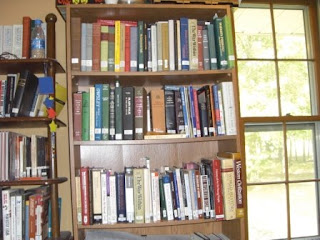 This is just one part of a bookcase. The stuff you can see is in front of my books.
I have photocopied, scanned, and printed more articles than I ever thought I would. Here are some of them on my
 desk
desk
 and floor
The process is to begin to read as much as I can about Davidson and figure out what exactly I can say about him or ideas that he had that hasn't been said before. With my Senior Thesis at UTC, I did this by looking at how B.B. Warfield and Charles Hodge both used the philosophy of Thomas Reid, called Common Sense Realism. Stuff had been written on Reid, Warfield, and Hodge, but no one brought it together and said what I tried to say.
At this point I have read two biographies of Davidson, several books on the Agrarian movement, and a ton of Davidson's own writings. I am coming close to something. I can feel it. I just hope it happens before school starts. My ability to read for seven hours at a time reduces severely at that point. If I have a thesis statement by that point, however, then I have about 45 days to write at least 90 pages on my topic. If I make it to October 15 with a draft, I should be home free from there.

I have photocopied, scanned, and printed more articles than I ever thought I would. Here are some of them on my
 desk
desk
The process is to begin to read as much as I can about Davidson and figure out what exactly I can say about him or ideas that he had that hasn't been said before. With my Senior Thesis at UTC, I did this by looking at how B.B. Warfield and Charles Hodge both used the philosophy of Thomas Reid, called Common Sense Realism. Stuff had been written on Reid, Warfield, and Hodge, but no one brought it together and said what I tried to say.
At this point I have read two biographies of Davidson, several books on the Agrarian movement, and a ton of Davidson's own writings. I am coming close to something. I can feel it. I just hope it happens before school starts. My ability to read for seven hours at a time reduces severely at that point. If I have a thesis statement by that point, however, then I have about 45 days to write at least 90 pages on my topic. If I make it to October 15 with a draft, I should be home free from there.
Tuesday, August 12, 2008
Paternalism in Southern History
I find it very interesting that, in Southern historiography, no white southerner can have any concern for an African-American without it being paternalistic. There is no room for generosity, love, compassion, or genuine fellowship. Every attempt by a white southerner to reach out to the African-American is dubbed "paternalism" which means that they are reaching down, not out.
To a large degree I suppose we have brought this on ourselves, but it ticks me off.
To a large degree I suppose we have brought this on ourselves, but it ticks me off.
Saturday, August 9, 2008
Metaphysical Poetry
“About the beginning of the seventeenth century appeared a race of writers that may be termed metaphysical poets.”
Samuel Johnson first used the term “metaphysical poets” in a disparaging way in his Lives of the Poets in 1744. He faulted these writers for using their wit to construct false conceits, tying dissimilar ideas together in a violent fashion. He acknowledged that many of these poets were “men of learning” and that they occasionally hit on truth, saying “their learning instructs, and their subtlety surprises; but the reader commonly thinks his improvement dearly bought, and, though he sometimes admires, is seldom pleased.”
By the end of the seventeenth century the poetry studied in this guide had fallen out of favor and was largely ignored for nearly two centuries. Poets like T.S. Eliot recovered the genius of the metaphysical poets and stated that the metaphysical poets were merely “engaged in the task of trying to find the verbal equivalent for states of mind and feeling. And this means both that they are more mature, and that they wear better, than later poets of certainly not less literary ability.” He noted that English poetry changed significantly after John Milton (1608-1674) and John Dryden (1631-1700) and that poets lost the technique of feeling the experiences that create poetry. In Eliot’s opinion, it is a lost art to convert heterogeneous experiences into poetry, and this is what the metaphysical poets did.
The poets that are generally labeled “metaphysical” are men like John Donne, Andrew Marvell, George Herbert, Henry Vaughan, Abraham Crowley, Edward Herbert, Richard Crashaw and a host of other poets generally living during the seventeenth century (1600’s). From time-to-time sonnets of men like William Shakespeare will be slipped in. As Eliot noted, it was an organic transition from the dramatists of the sixteenth century that gave rise to the conceits of the seventeenth century poets. What makes a poem “metaphysical”? The poets we are concerned with wrote about a broad range of topics, both secular and sacred. However, their poetry is very much characterized by wit. Wit is different from humor, which is what we generally associate the word with today. Humor is more-or-less immediately funny. Wit requires a second glance or reconsideration before it is realized. Wit “suggests intellectual brilliance and ingenuity, verbal deftness, as in an epigram.”
An epigram is a short poem with a witty twist at the end. The form of the epigram comes from Rome, but has been well-developed by English-speaking authors as well. It may be the best way to illustrate the use of wit that is central to metaphysical poetry. Consider the epigrams reproduced below:
Little strokes
Fell great oaks.— Benjamin Franklin
Here lies my wife: here let her lie!
Now she's at rest — and so am I.— John Dryden
Another major characteristic of metaphysical poetry is use of the conceit. A conceit is a “fairly elaborate figurative device of a fanciful kind which often incorporates metaphor, simile, hyperbole or oxymoron and which is intended to surprise and delight by its wit and ingenuity.To put it more simply, a conceit is a comparison of two things which are really nothing alike. Probably one of the best examples comes from John Donne’s poem “A Valediction: forbidding Mourning.” In this poem Donne compares the love he shares with his wife to a drafter’s compass:
Our two souls therefore, which are one,
Though I must go, endure not yet
A breach, but an expansion,
Like gold to aery thinness beat.
If they be two, they are two so
As stiff twin compasses are two ;
Thy soul, the fix'd foot, makes no show
To move, but doth, if th' other do.
Using this conceit, Donne explains that his going will do nothing more than expand the circumference of their unified love. It cannot diminish the love they share, for their souls are joined as the compass is joined. One leg of the compass provides a footing, an anchor; while the other moves away if needs be, but always they are connected at the center.
Samuel Johnson first used the term “metaphysical poets” in a disparaging way in his Lives of the Poets in 1744. He faulted these writers for using their wit to construct false conceits, tying dissimilar ideas together in a violent fashion. He acknowledged that many of these poets were “men of learning” and that they occasionally hit on truth, saying “their learning instructs, and their subtlety surprises; but the reader commonly thinks his improvement dearly bought, and, though he sometimes admires, is seldom pleased.”
By the end of the seventeenth century the poetry studied in this guide had fallen out of favor and was largely ignored for nearly two centuries. Poets like T.S. Eliot recovered the genius of the metaphysical poets and stated that the metaphysical poets were merely “engaged in the task of trying to find the verbal equivalent for states of mind and feeling. And this means both that they are more mature, and that they wear better, than later poets of certainly not less literary ability.” He noted that English poetry changed significantly after John Milton (1608-1674) and John Dryden (1631-1700) and that poets lost the technique of feeling the experiences that create poetry. In Eliot’s opinion, it is a lost art to convert heterogeneous experiences into poetry, and this is what the metaphysical poets did.
The poets that are generally labeled “metaphysical” are men like John Donne, Andrew Marvell, George Herbert, Henry Vaughan, Abraham Crowley, Edward Herbert, Richard Crashaw and a host of other poets generally living during the seventeenth century (1600’s). From time-to-time sonnets of men like William Shakespeare will be slipped in. As Eliot noted, it was an organic transition from the dramatists of the sixteenth century that gave rise to the conceits of the seventeenth century poets. What makes a poem “metaphysical”? The poets we are concerned with wrote about a broad range of topics, both secular and sacred. However, their poetry is very much characterized by wit. Wit is different from humor, which is what we generally associate the word with today. Humor is more-or-less immediately funny. Wit requires a second glance or reconsideration before it is realized. Wit “suggests intellectual brilliance and ingenuity, verbal deftness, as in an epigram.”
An epigram is a short poem with a witty twist at the end. The form of the epigram comes from Rome, but has been well-developed by English-speaking authors as well. It may be the best way to illustrate the use of wit that is central to metaphysical poetry. Consider the epigrams reproduced below:
Little strokes
Fell great oaks.— Benjamin Franklin
Here lies my wife: here let her lie!
Now she's at rest — and so am I.— John Dryden
Another major characteristic of metaphysical poetry is use of the conceit. A conceit is a “fairly elaborate figurative device of a fanciful kind which often incorporates metaphor, simile, hyperbole or oxymoron and which is intended to surprise and delight by its wit and ingenuity.To put it more simply, a conceit is a comparison of two things which are really nothing alike. Probably one of the best examples comes from John Donne’s poem “A Valediction: forbidding Mourning.” In this poem Donne compares the love he shares with his wife to a drafter’s compass:
Our two souls therefore, which are one,
Though I must go, endure not yet
A breach, but an expansion,
Like gold to aery thinness beat.
If they be two, they are two so
As stiff twin compasses are two ;
Thy soul, the fix'd foot, makes no show
To move, but doth, if th' other do.
Using this conceit, Donne explains that his going will do nothing more than expand the circumference of their unified love. It cannot diminish the love they share, for their souls are joined as the compass is joined. One leg of the compass provides a footing, an anchor; while the other moves away if needs be, but always they are connected at the center.
Friday, August 8, 2008
Going for the Gold, or the hat, or the paper, or something...
I just found out I am about 90 some-odd pages away from my M.A. in History. I thought I had a language requirement hanging over my head but I talked to the director of the Language department and they said I was clear. So now, with all my coursework done I just have to write my thesis.
I met with my advisor yesterday about this and we talked through the timetable. Unless I can graduate this semester (Fall 2008) I will have to wait until August 2009. But my advisor is going on a sabbatical beginning this Spring and will be gone until August 2009. To graduate this semester I have to have a draft of the thing on his desk in September (i.e. 30 days).
I'd like to be done. But I'm not sure I can do this whole thing in 30 days. I think I'm going to give it a try though.
So the saga of the M.A. for Mr. Sisk continues. Mr. Sisk, who is writing a masters thesis on Donald Davidson's attempt to counter modernity through Agrarianism, Distributism, and Regionalism. Donald Davidson who was hopelessly modern but hated modernity (which he identified with nothing more than industrialism).
I have typed a single page with "90 Pages" written on it and taped it above my monitor. That way I will remember for the next 30 days that I have nothing more important (in my spare time) than an essay of 90 pages on Modernism and the futile reaction of one little man from Vanderbilt University.
Follow the continuing saga here, if you wish. Maybe even support me if you can.
I met with my advisor yesterday about this and we talked through the timetable. Unless I can graduate this semester (Fall 2008) I will have to wait until August 2009. But my advisor is going on a sabbatical beginning this Spring and will be gone until August 2009. To graduate this semester I have to have a draft of the thing on his desk in September (i.e. 30 days).
I'd like to be done. But I'm not sure I can do this whole thing in 30 days. I think I'm going to give it a try though.
So the saga of the M.A. for Mr. Sisk continues. Mr. Sisk, who is writing a masters thesis on Donald Davidson's attempt to counter modernity through Agrarianism, Distributism, and Regionalism. Donald Davidson who was hopelessly modern but hated modernity (which he identified with nothing more than industrialism).
I have typed a single page with "90 Pages" written on it and taped it above my monitor. That way I will remember for the next 30 days that I have nothing more important (in my spare time) than an essay of 90 pages on Modernism and the futile reaction of one little man from Vanderbilt University.
Follow the continuing saga here, if you wish. Maybe even support me if you can.
Subscribe to:
Posts (Atom)