Showing posts with label Great Books. Show all posts

Friday, August 6, 2021

for man is a giddy thing (Much Ado V.4.106)

 At the close of William Shakespeare's play, Much Ado About Nothing, one of the main characters, Benedick, who has throughout the play been opposed to marriage but has been converted by the trickery and machinations of his friends, speaks the conclusion to the play and utters this phrase: 

In brief, since I do purpose to marry, I will think nothing to any purpose that the world can say against it; and therefore never flout at me for what I have said against it, for man is a giddy thing, and this is my conclusion. (Much Ado, V.4.103-106)

Man is a giddy thing. A dictionary entry defines the adjective giddy as "having a sensation of whirling and a tendency to fall or stagger; dizzy" (https://languages.oup.com/google-dictionary-en/). What is Shakespeare telling us when he has Benedick describe himself, but not just himself, in these terms? Here, I belie,ve is one of those Meta-Shakespeare quotes where the bard makes a statement that outside the context of the play has as much meaning as it does in context. 

For Benedick, his statement is part apology for his changed opinion on the state of marriage. Having stated at previous points in the play that he is "a professed tyrant to their sex" (I.1.160), that marriage is akin to thrusting "thy neck into a yoke" (I.1.191). At another point proclaiming that "I will live a bachelor" (I.1.234). He states that if ever he changes his mind, "let me be vilely painted, and in such great letters as they write 'Here is good horse to hire ... Here you may see Benedick the married man'" (I.1.251-254). 

Benedick's position is clear, yet his friend and lord, Don Pedro, proposes to unmask Benedick's false abhorrence of love and to knit his heart to Beatrice, who, while not being as forecful about never marrying anyone, clearly has a complicated relationship with Benedick. It appears that the two were involved at some level previously. Early in the play, Beatrice remarks that "You [Benedick] always end with a Jade's trick. I know you of old" (I.1.138). Later, after the masquerade ball in which Beatrice spoke harshly to Benedick (whether she knew it was him or not is a matter of debate), Don Pedro tells her "you have lost the heart of Signor Benedick." She replies, "Indeed, my lord, he lent it me awhile, and I gave him use for it - a double heart for his single one. Marry, once before he won it of me with false dice; therefore your grace may well say I have lost it" (II.1.261-266). 

Don Pedro and others devise a plan to make Benedick and Beatrice believe that the other secretly loves them, thus bringing "Signor Benedick and Lady Beatrice into a mountain of affection th' one with th' other" (II.1.346). 

It is this trick played out that changes the heart of Benedick and Beatrice both and gives them leave to love each other. The conclusion to this is that after promising to marry each other, Benedick must explain his previous behavior. Man is a giddy thing. Man is changeable. Man is not surefooted on this earth. Man can change his mind and must when circumstances insist. "When I said I would die a bachelor, I did not think I should live till I were married" (II.3.230), Benedick states when first his mind is altered to new possibilities. 

When all else has been accomplished and he and Beatrice are forced to see themselves rightly, Benedick's best explanation for the change in himself is that "Man is a giddy thing." 


Tuesday, October 1, 2013

The Epic of Gilgamesh - Part Two

This is the continuation of a post I did last week on the Epic of Gilgamesh where I laid down some introductory remarks on epics and other literary formula. You can read it here.

The Story - Part One

The Epic of Gilgamesh is a great tale of heroism, adventure, mortality, and friendship. It begins in Uruk, where Gilgamesh was king. The epic introduces this king as someone who is a purely tyrannical monarch. He is descended from the gods, and is even 1/3 god (however that works out). The epic explains that Gilgamesh is a mean-spirited king who takes whatever man's wife or daughter he sees fit at whatever time. He forces men to work to death to build the walls of his great city. He is not a idealized pastoral king or shepherd of the land. The people cry out to gods to remove the burden of Gilgamesh from them. 

The gods hear this cry and decide to make a man as strong as Gilgamesh to kill the king. This will appease the crying of the people, they believe. So they create Enkidu. Enkidu is made out in the wilderness. He is a hairy beast of a man who roams with the wild animals and has nothing to do with mankind. This becomes a problem for the local hunters and farmers who rely upon hunting wild game to survive. They go to the city to report the wild man living in the wilderness to the priests and get their sagely advice. This advice is pretty interesting. 

The priests tell the farmer to take a temple prostitute out to the wilderness and let her initiate Enkidu into the ways of civilization through sex. 
There he is. Now, woman, make your breasts bare, have no shame, do not delay but welcome his love. Let him see you naked, let him possess your body. When he comes near uncover yourself and lie with him; teach him, the savage man, your woman's art, for when he murmurs love to you the wild beasts that shared his life in the hills will reject him. 
Sure enough, the harlot and Enkidu come together and have sex for six days and seven nights. However, 
when the gazelle saw him, they bolted away; when the wild creatures saw him they fled
The epic's commentary on all this is that "Enkidu had grown weak, for wisdom was in him, and the thoughts of a man were in his heart."
So Enkidu returns with the harlot to Uruk. To make a long story short (just kidding), when Enkidu and Gilgamesh meet each other, they engage in a massive combat even extending to the city walls. They cannot defeat each other and eventually bond over their mutual strength. They begin a great friendship that comprises the middle section of the epic.

Gilgamesh and Enkidu go off on great adventures. They hunt together, even hunting the great Humbaba. Humbaba was an ancient creature that lived in the Cedar Forest beyond the seventh mountain range. He was the guardian of this land and was placed there by the gods to be a terror to men. Gilgamesh and Enkidu slew this great beast and decapitated it. The gods do not take vengeance upon the heroes because they offer Humbaba's head as a sacrifice for their great victory.

In the sixth tablet of the epic, Gilgamesh has important dealings with the goddess Ishtar. Ishtar, becoming enamored of Gilgamesh and his mighty feats, decides to present him with an offer of marriage. One might think that marrying the goddess of love and fertility is a good idea, but Gilgamesh doesn't see it this way. Gilgamesh responds that he is not the first man the goddess has proposed to, nor does he expect to be the last. Gilgamesh points out that if he should accept the offer, he would have nothing to give the goddess as worship or gift.
Which of your lovers did you ever love for ever? What shepherd of yours has pleased you for all time? 
Then he begins to recount to her the fates of previous lovers and uses these stories to decline the goddesses offer of marriage. Ishtar becomes enraged and cries out for the death of Gilgamesh and Enkidu. She asks her father, Anu, to release the Bull of Heaven to take her vengeance on Gilgamesh for his petulance.

The Bull of Heaven is killed by Gilgamesh and Enkidu who then offer its heart to the sun god Shamash. In a moment of extreme impiety, Enkidu rips the thigh off the creatures corpse and hurls it at Ishtar. It is for this action that Enkidu is doomed to die.

The death of Enkidu begins the final stage of the epic saga and truly deserves it's own post. Stay tuned and the final portion of the narrative will be revealed. 

Thursday, September 26, 2013

The Epic of Gilgamesh - Part One

Not on the List

The Epic of Gilgamesh (c. 3500 BCE) did not make it into the list of great books compiled by Adler and Hutchins, but in my humble opinion, it should have. Therefore I am going to do a quick post about it and my recent reading of it, before I dig into Plato's dialogues (which are the first readings suggested). 

Epic

Epic is a term that has been so horribly misused in recent years, that it is almost impossible to properly explain what it does mean without first dealing with the multitude of concepts it does not mean. Epic has nothing to do with how awesome something is, or how awesomely bad something is. Both of these meanings are the standard understanding of the 30 and younger crowd these days. So let's get selfies gone wrong, crazy accidents, and hysterical tragedies out of our heads. 


Epic is a literary form that is most commonly associated with the great works of Homer, the Iliad and the Odyssey. However, as we will see, the idea behind the epic format fits pretty well with the Epic of Gilgamesh as well. 

Epic stories focus on a hero. Epic stories tell formative information about a nation or specific group of people that will form a nation.

Epics tend to have certain characteristics to their style. They tend to use a high style of narrative that is distinct from common prose. This high style may take the form of repeated epithets used to distinguish common things and people from the special ones. Homer always speaks of the rosy-fingered dawn coming. He always has a descriptive epithet on his tongue when he speaks of a god or goddess. Epics tend to use repeated formula to explain actions or commands. Part of this may have been due to ancient epics being an oral composition that had to be remembered in its entirety by the bard (no small feat when you imagine that a audiobook recording of the Iliad lasts for more than 20 hours)

We may thank the Homeric epics for the characteristic of the epic simile. Homer tended to use very drawn out and very complicated ways of describing events or people. Consider this simile from The Iliad, book 4:
As when rivers in winter spate running down from the mountains throw together at the meeting of streams the weight of their water out of the great springs behind in the hollow stream-bed,and far away in the mountains the shepherd hears their thunder;such, from the coming together of men, was the shock and the shouting.
Homer here compares the shouting of men going to war with water coming out of a mountain, forming a stream and eventually a river. It is certainly memorable - which may have been the main intent. Don't forget that the epics were likely sung or recited in some way.

Homer also typicaly included, as do other epics, great lists of things called Epic catalogs.

Some of the more typical literary characteristics, which are not confined to the Homeric corpus, are allusions and pleonasms. Wikipedia calls Allusion figure of speech that makes a reference to, or a representation of, people, places, events, literary work, myths, or works of art, either directly or by implication. Some examples cited by the article include the idea of 15 minutes of fame or a catch-22 situation. Both of these expressions allude to some other body of work or idea that they get their meaning from. Wikipedia calls Pleonasm simply using more words or word-parts that is necessary to for clear expression. It gives the phrases black darkness or burning fire as examples of this device.

Next time...

In my next post, we will look at the story of the Epic of Gilgamesh and determine what it has to offer the Great Conversation. 

Stay tuned.....


Sunday, September 8, 2013

An unofficial PhD

Who needs a PhD?

I mean, it would be nice to have those letters behind my name. It would be nice to indicate that I possessed the drive to become a Doctor of Philosophy about a particular subject. In my case, I imagine, history would have to be the area I would focus. I do have a Clemson University approved Masters degree in that subject. I'll admit, pursuing the advanced degree has called to me on several occasions and it has been fairly difficult to think of reasons not to do it. My wife jokes that I would be a professional student if I could. If I could just find someone to pay me to take university courses - now that would be a dream job, I think.

But I do come back to the question over time, do I need a PhD? What benefit would it give me in my current, or future endeavors? I am no longer a full-time faculty member of the school I had taught at since graduation from the University of TN in Chattanooga. I have resigned myself to the proposition that neither that school, nor any other than I would wish to teach at, could afford me the luxury of supporting my family on salary alone. That is simply a fact of private education.

What is a PhD?


A PhD, or Doctor of Philosophy, is a post-graduate degree indicating a love of the subject matter one chooses to pursue and a desire to better oneself personally and professionally. Originally, it came in to existence as part of the Liberal Arts, as can be seen here. However, today you can be awarded a PhD, or doctorate, of just about any discipline (e.g. Physics, Biology, Economics, Marketing, etc.).

How do you get one?


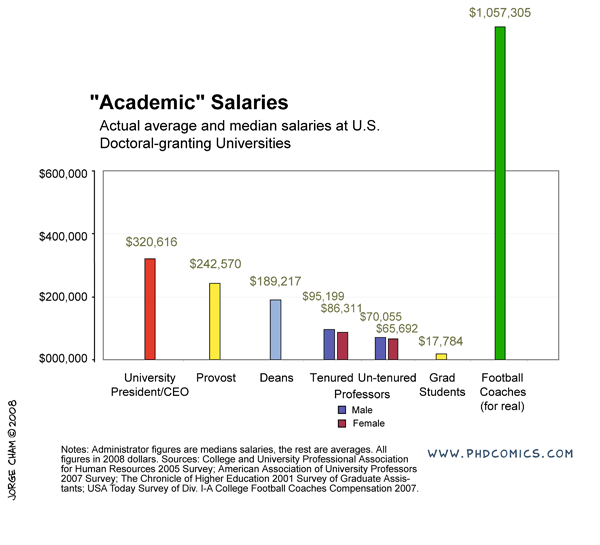
The PhD would traditionally be obtained through more coursework at the post-graduate level and intense, focused research on a specific topic about which a book-length essay, called a dissertation, would be written, presented, and then defended before a panel of peers. It would take a full-time student two years, at minimum, to complete this process, at least in the Liberal Arts subjects I am familiar with. I cannot pretend to speak for scientific or other fields. A PhD from Vanderbilt University, a place I have considered for further studies, would require 72 hours of graduate work, of which 24 semester hours would be in formal courses.1 This would run, as of today, $125,784 just in the fees for the courses. There is no way I could justify spending that. I know that there would be options of financial aid along the way that may offset a great amount of this, but it just isn't possible given my personal situation. For one thing, I would never receive a satisfactory return on that investment. While being a comic, the October 20, 2008 PhD Comics image relied on real documented sources to show what academic salaries look like.2 

As you can see, professors don't make a ton, and with other life expenses it would take about three generations to pay off the mortgage that would be a school bill for a PhD. 

I'm not whining


I know it sounds like it, but really I'm just establishing data that helped me mentally get to my real point. It isn't anyone's fault that I have made the educational, financial, and personal choices that I have. Well, I mean, it is my fault, not some external person coercing me into it. So I'm not whining about this, but rather establishing the rules of the system so I can work around it. 

A Plan


Given the realities documented above and the desire that I truly have to continue to better myself as a person, I have developed a plan to get an "unofficial PhD" in Western culture. Working off of my recent posts on Hutchins's Great Conversation essay for the Great Books of the Western World, I have decided to modify slightly and follow a reading plan over the next several years (likely ten) and read the list offered by Hutchins and Adler.  

I'm gong to start by finishing Hutchins's essay on the Great Conversation and then begin with Plato as suggested in the reading list. I hope to blog my way through each book, or excerpt, with impressions and thoughts. I will try to be as applicable as possible to the world we live in now. I learn best that way and I imagine others do as well.