Monday, December 14, 2015

Star Trek: Beyond and Independence Day: Resurrection

Two science fiction movies began to get attention in the past couple of days.

Fans have long been waiting for and jumping on bits of internet gossip surrounding a sequel to the 1996 science fiction action film, Independence Day. Rumors were flying in recent months about the cast. A recent article by Deadline: Hollywood claims that two scripts were written for the Independence Day sequel. One that would include Will Smith reprising his role as Steven Hiller and one that would not. When Smith decided not to take the role, they had a backup ready to roll.

This first trailer doesn't give a lot of information, other than the aliens are returning (may have stayed around anyway - based on the graveyard scene), David Levinson (Jeff Goldblum) has been preparing for this for some time by refitting Earth defenses from the wreckage of the last attack, and President Whitmore (Bill Pullman) is pretty haggard. I'm looking forward to this film, as I thoroughly enjoyed the original.


The trailer for the newest installment in the J.J. Abrams parallel timeline, reboot Star Trek series dropped today as well. Abrams is not directing this time, however. We have Justin Lin who is best-known for his work on 3 of the Fast and the Furious films. Star Trek: Beyond's first trailer shows quite a bit of story line and lets us see what happens when, as Eric Deggans puts it, the final frontier pushes back. Unlike some, I have really enjoyed this re imagining of the Star Trek franchise, mostly due to the essential unity in character. While their lives may have been different, Kirk, Spock, McCoy, and the rest all have essentially the same character traits and personalities that made the original show and movies what they were. I'm looking forward to this one as well.

Monday, December 7, 2015

2015 Bookroll

I took most of the year and read a single series by genre-jumper F. Paul Wilson. I ran across his Repairman Jack series near the end of 2014 (around the time Agnes was born) and was enthralled. Wilson wrote 20+ books around this central character and an epic adventure spanning millennia. He refers to it as The Secret History of the World. The idea intrigued me. His core material was the five-volume Adversary Cycle, one of which introduced Jack as a character. He then began filling in the gaps and writing more Jack books and other short stories that touched on the events of and themes of the core conflict between Rasalom and Glaeken. To that end, I spent much of the year engrossed in that long narrative. It was a lot of fun. If you enjoy mystery books with a central character (think Jack Ryan or Jack Reacher), you might want to try these out. I recommend reading the order from the Secret History of the World, linked above. 

Cold City - Jacks's first adventure begins
The Keep - set in WW2, this spin on the vampire will surprise you
Dark City - continuing Jack's progression to Repairman extraordinaire
Fear City - the conclusion of the early Jack years, finishes with a bang
The Tomb - the first Jack novel from the Adversary Cycle and the appearance of the Rakoshi
Legacies - Jack helps out an estate conflict and learns about free power
Reborn - The third Adversary cycle book chronicles the rebirth of Rasalom, thought to have been killed at the end of the Keep. 
Aftershock and Others - has a few stories that relate to the Secret History
Conspiracies - UFO hunters, Nichola Tesla, and a hole that leads to nowhere
All the Rage - a new drug made from Rakosh blood wreaks havoc in New York and Jack's own life
Hosts - When Jack's sister shows up in New York needing help, the reunion gets tricky when she calls on Jack accidentally. 
The Haunted Air - a house with a supernatural past is now the home of two "mediums." How will their little scheme play out when a real ghost shows up?
Gateways - When Jack's dad is the victim of a hit and run, he rushes to South Florida to help. Trouble follows him, or is it already there. 
Crisscross - The main story advances as a missing persons case for Jack. All the while a global conspiracy is hiding inside a Scientology-like church organization. 
Infernal - When Jack's brother needs help, Jacks ends up taking a trip to Puerto Rico. What he finds puts all he loves in danger. 
Harbingers - After rescuing a friends niece from some ritualistic weirdos, Jack runs afoul of a group of highly trained vigilantes, related to the twins he saw go down the hole in Monroe a few years ago. 
Bloodline - Jack's special talents may be more than coincidence. It might be in his blood to feel the Otherness. 
By the Sword - the appearance of mythical samurai sword keeps the events of the Secret History rushing toward their conclusion, especially when Glaeken shows up. 
Ground Zero - What if the terror attacks of 9/11 were orchestrated to bring about Rasalom's return?
The Touch - the third Adversary book follows a doctor who can heal with a touch. But it costs him too. 
Reprisal - The fourth Adversary book takes place in North Carolina and follows disgraced priest Bill Ryan as he is hounded by Rasalom, who will stop at nothing to even the score.
Fatal Error - Why would you want to crash the internet? To eliminate the noosphere, of course. 
The Dark at the End - While Jack can't engage Rasalom directly, his continued friendships with Weezy and Eddie reveal some interesting discoveries back in their childhood home. 
Nightworld - When holes begin to appear and things from the other side begin to emerge, you know the time has come to finish the Adversary Cycle and end the Jack storyline too. 

I also read most of The Writer's Journey by Christopher Vogler. 
I attended a lecture series by Brian Godawa with my fifteen-year old and read through some of his book, Hollywood Worldviews. 
I managed a read through Kevin DeYoung's book, What Does the Bible Really Teach about Homosexuality? 

As the year draws to a close, I am reading a few items. I'm re-reading Donald Kagan's The Peloponnesian War. I'm about halfway through One Shot, by Lee Child (the Jack Reacher book that formed the backbone of the Jack Reacher movie starring Tom Cruise). 

Grandpa's stamp of approval?

On Facebook, I follow a lot of folks from in and around the Reformed tradition. Some of them have stepped into the waters Anglicanism, following the issues around Federal Vision and whatnot. Recently, I saw the following on a Facebook post, " A good way to test whether your worship music is keeping the 5th commandment: would your grandpa know any of it?"

Now, I understand the argument that our worship music, and the rest of our worship, should be appropriate. What I don't get is the disdain for and ridicule of development and innovation. What seems to be advocated here is a chronological standard on music. If it isn't music (lyrics are not distinguished - so the poster must include tune, instrumentation, etc.) your grandpa would know then you are in danger of violating the 5th commandment.

Was the canon of music sealed along with that of Scripture? If so, where is the sheet music? I know no one who would suggest such a thing. There are those who insist that the Psalms are the only songs worthy of singing in public worship. But then these same individuals typically use music to accompany the Psalms that was written in the 16th and 17th centuries. How did this music get the "grandpa" stamp of approval?

As an aside - those who insist on singing the Psalms don't sing them as found in the Old Covenant text, but as reworded and rethought with references to the church and Christ.

Indeed, how does anything get the "grandpa" seal of approval? One quick glance at history will show the elders typically resist any change or innovation to the status quo.

Imagine if we applied this same 5th commandment test to a host of other issues. How about agriculture? If we applied this test rigorously we would not have any machines for agriculture because the medieval world seriously resisted the industrial revolution. How about science? We all know how strenuously the "grandpa's" of the world reacted to the learning of Copernicus, Galileo, Brahe, and Kepler.

Now I understand that all this begs the question of how we should think about and allow innovation. I don't have a good answer for this, which I'm sure seriously violates the "grandpa" principle. I'm just being a troublemaker. I'm pointing out the flaws in another system without proposing any alternatives or even endorsing an existing alternative. I have no rebuttal for this, as it is completely true.
I'm hoping that I'm not the only one thinking this way and that I'm not the only one turning this over in his mind. Maybe with a few of us carefully dissecting the issue, we can come to a thoughtful response.

Tuesday, November 12, 2013

The Epic of Gilgamesh - Part Three

This is part three of my series on the Epic of Gilgamesh. In Part One, we looked at the literary concepts of the epic and especially the idea of epic in literature. In Part Two, we began looking at the story up through the point where Enkidu dies. This third segment will finish the narrative and hopefully explore some of the reasons I feel this book belongs in the Great Books.

Mortality Defined

After Enkidu's death, Gilgamesh faces his own mortality, the idea that he will die, with great fear. He embarks on a journey, symbolic in many ways, to find the one person who has escaped the clutches of death, a man named Utnapishtim. 
This attempt to delay or get around mortality is one of the primary struggles of much of Western literature and philosophy. We see this writ large in the pages of such well-known works as Doctor Faustus. However, the theme hides behind many of the attempts to get around the prophecies of the ancient world as well. One need think only of the prophecy to the parents of Oedipus that he would kill his father and marry his mother. The attempt to kill Oedipus is an attempt by King Laius to preserve and extend his own fated death, to avoid his mortality. 
So we see that Gilgamesh's search for eternal life is not all that different from people today cryogenically freezing themselves for a future when their diseases will be cured. The science fiction movie, Prometheus, explores this same concept from a vantage point of setting up the Alien series of movies. 

The Search for Everlasting Life

Gilgamesh travels for many days to the mountains where Utnapishtim dwelt. He finally came to the dwelling of Utnapishtim who questioned the king as to his motives for seeking eternal life. At this point in the narrative is also found one of the most intriguing aspects of the Epic of Gilgamesh: a Babylonian Flood narrative.

The Flood

Utnapishtim tells Gilgamesh the circumstances of his gaining eternal life and surviving the flood that the gods sent to destroy all mankind. The Epic of Gilgamesh tells the story of the flood by indicating that the gods, specifically Enlil, were annoyed that mankind was being too loud and making it hard to sleep. Enlil proposes the destruction of the whole world because of this. The other gods, except Ea, seem to agree to this and allow him to play it out. Ea warns Utnapishtim of the coming flood and tells him to make a vessel (I am purposely avoiding the familiar term, ark, so as not to confuse readers of the Bible) to escape in. 
After Utnapishtim builds the vessel, the flood begins. Even the gods are terrified at the awesome destruction the flood wreaks and flee the realm of men. The immediately regret having caused such destruction. Ishtar, herself, realizes she has ordered the destruction of those that she brought forth and give her daily worship. 
The flood lasts for six days and six nights. Utnapishtim remains in his vessel for another seven days, letting various animals out to test the world to see if it was safe to leave the vessel. 
After seven days, Utnapishtim and his family leave the vessel and offer sacrifices to the gods. Smelling the sacrifice and wondering who, in the midst of all this destruction, could still remember and reverence the gods, several gods make their way to Utnapishtim's location. Many of the gods are so enamored by this sacrifice that they grant to Utnapishtim eternal life. Enlil, the god who started all of this anyway, is very upset that any men survivied. The other gods gang up on him and expel him from their number, temporarily anyway. 

Gilgamesh's interview with Utnapishtim

After hearing this story, Gilgamesh is still very intent on learning how he, who has not survived a flood and hasn't got the best track record at pleasing the gods, can gain eternal life. Utnapishtim tells him he must stay awake for a week and then he will be told how to live forever. Gilgamesh is eager for this and agrees immediately. And then proceeds to fall asleep as soon as Utnapishtim begins talking. Utnapishtim bakes a loaf of bread every day that Gilgamesh is asleep and ends up with five loaves when he finally wakes up. Gilgamesh suggests that he had just dozed off for a second, but then is shown the loaves of bread. Gilgamesh is humiliated but remains calm. He leaves Utnapishtim without the secret to eternal life.

A second chance at eternal life

As he is leaving, he is told that a flower grows at the bottom of a lake and is guarded by a serpent and is the key to eternal life. If he can retrieve it, he will gain what he seeks. Gilgamesh swims to the bottom of the lake, retrieves the flower, but loses it to the serpent. He returns to Uruk still a mortal. Though he has learned to embrace his mortality. 

The End of Gilgamesh

After returning from his journey, Gilgamesh continued to rule Uruk. However, his reign from that point is remembered with joy by his subjects rather than the fear they had at the beginning of the narrative. 

In the next installment, I will expound what I consider to the main Great Ideas covered in the Epic of Gilgamesh and why it belongs in a list of Great Books. 

Tuesday, October 1, 2013

The Epic of Gilgamesh - Part Two

This is the continuation of a post I did last week on the Epic of Gilgamesh where I laid down some introductory remarks on epics and other literary formula. You can read it here.

The Story - Part One

The Epic of Gilgamesh is a great tale of heroism, adventure, mortality, and friendship. It begins in Uruk, where Gilgamesh was king. The epic introduces this king as someone who is a purely tyrannical monarch. He is descended from the gods, and is even 1/3 god (however that works out). The epic explains that Gilgamesh is a mean-spirited king who takes whatever man's wife or daughter he sees fit at whatever time. He forces men to work to death to build the walls of his great city. He is not a idealized pastoral king or shepherd of the land. The people cry out to gods to remove the burden of Gilgamesh from them. 

The gods hear this cry and decide to make a man as strong as Gilgamesh to kill the king. This will appease the crying of the people, they believe. So they create Enkidu. Enkidu is made out in the wilderness. He is a hairy beast of a man who roams with the wild animals and has nothing to do with mankind. This becomes a problem for the local hunters and farmers who rely upon hunting wild game to survive. They go to the city to report the wild man living in the wilderness to the priests and get their sagely advice. This advice is pretty interesting. 

The priests tell the farmer to take a temple prostitute out to the wilderness and let her initiate Enkidu into the ways of civilization through sex. 
There he is. Now, woman, make your breasts bare, have no shame, do not delay but welcome his love. Let him see you naked, let him possess your body. When he comes near uncover yourself and lie with him; teach him, the savage man, your woman's art, for when he murmurs love to you the wild beasts that shared his life in the hills will reject him. 
Sure enough, the harlot and Enkidu come together and have sex for six days and seven nights. However, 
when the gazelle saw him, they bolted away; when the wild creatures saw him they fled
The epic's commentary on all this is that "Enkidu had grown weak, for wisdom was in him, and the thoughts of a man were in his heart."
So Enkidu returns with the harlot to Uruk. To make a long story short (just kidding), when Enkidu and Gilgamesh meet each other, they engage in a massive combat even extending to the city walls. They cannot defeat each other and eventually bond over their mutual strength. They begin a great friendship that comprises the middle section of the epic.

Gilgamesh and Enkidu go off on great adventures. They hunt together, even hunting the great Humbaba. Humbaba was an ancient creature that lived in the Cedar Forest beyond the seventh mountain range. He was the guardian of this land and was placed there by the gods to be a terror to men. Gilgamesh and Enkidu slew this great beast and decapitated it. The gods do not take vengeance upon the heroes because they offer Humbaba's head as a sacrifice for their great victory.

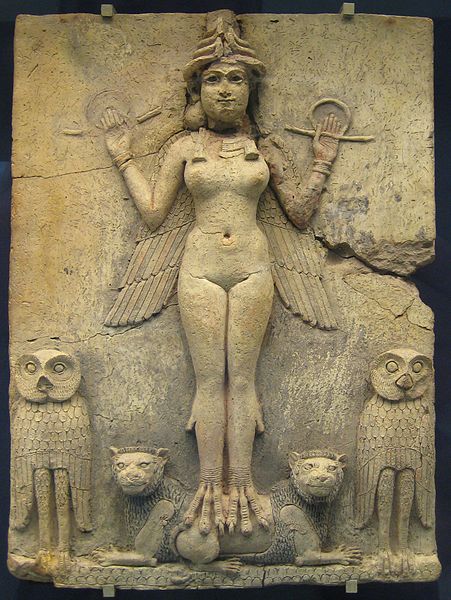
In the sixth tablet of the epic, Gilgamesh has important dealings with the goddess Ishtar. Ishtar, becoming enamored of Gilgamesh and his mighty feats, decides to present him with an offer of marriage. One might think that marrying the goddess of love and fertility is a good idea, but Gilgamesh doesn't see it this way. Gilgamesh responds that he is not the first man the goddess has proposed to, nor does he expect to be the last. Gilgamesh points out that if he should accept the offer, he would have nothing to give the goddess as worship or gift.
Which of your lovers did you ever love for ever? What shepherd of yours has pleased you for all time? 
Then he begins to recount to her the fates of previous lovers and uses these stories to decline the goddesses offer of marriage. Ishtar becomes enraged and cries out for the death of Gilgamesh and Enkidu. She asks her father, Anu, to release the Bull of Heaven to take her vengeance on Gilgamesh for his petulance.

The Bull of Heaven is killed by Gilgamesh and Enkidu who then offer its heart to the sun god Shamash. In a moment of extreme impiety, Enkidu rips the thigh off the creatures corpse and hurls it at Ishtar. It is for this action that Enkidu is doomed to die.

The death of Enkidu begins the final stage of the epic saga and truly deserves it's own post. Stay tuned and the final portion of the narrative will be revealed. 

Thursday, September 26, 2013

The Epic of Gilgamesh - Part One

Not on the List

The Epic of Gilgamesh (c. 3500 BCE) did not make it into the list of great books compiled by Adler and Hutchins, but in my humble opinion, it should have. Therefore I am going to do a quick post about it and my recent reading of it, before I dig into Plato's dialogues (which are the first readings suggested). 

Epic

Epic is a term that has been so horribly misused in recent years, that it is almost impossible to properly explain what it does mean without first dealing with the multitude of concepts it does not mean. Epic has nothing to do with how awesome something is, or how awesomely bad something is. Both of these meanings are the standard understanding of the 30 and younger crowd these days. So let's get selfies gone wrong, crazy accidents, and hysterical tragedies out of our heads. 


Epic is a literary form that is most commonly associated with the great works of Homer, the Iliad and the Odyssey. However, as we will see, the idea behind the epic format fits pretty well with the Epic of Gilgamesh as well. 

Epic stories focus on a hero. Epic stories tell formative information about a nation or specific group of people that will form a nation.

Epics tend to have certain characteristics to their style. They tend to use a high style of narrative that is distinct from common prose. This high style may take the form of repeated epithets used to distinguish common things and people from the special ones. Homer always speaks of the rosy-fingered dawn coming. He always has a descriptive epithet on his tongue when he speaks of a god or goddess. Epics tend to use repeated formula to explain actions or commands. Part of this may have been due to ancient epics being an oral composition that had to be remembered in its entirety by the bard (no small feat when you imagine that a audiobook recording of the Iliad lasts for more than 20 hours)

We may thank the Homeric epics for the characteristic of the epic simile. Homer tended to use very drawn out and very complicated ways of describing events or people. Consider this simile from The Iliad, book 4:
As when rivers in winter spate running down from the mountains throw together at the meeting of streams the weight of their water out of the great springs behind in the hollow stream-bed,and far away in the mountains the shepherd hears their thunder;such, from the coming together of men, was the shock and the shouting.
Homer here compares the shouting of men going to war with water coming out of a mountain, forming a stream and eventually a river. It is certainly memorable - which may have been the main intent. Don't forget that the epics were likely sung or recited in some way.

Homer also typicaly included, as do other epics, great lists of things called Epic catalogs.

Some of the more typical literary characteristics, which are not confined to the Homeric corpus, are allusions and pleonasms. Wikipedia calls Allusion a figure of speech that makes a reference to, or a representation of, people, places, events, literary work, myths, or works of art, either directly or by implication. Some examples cited by the article include the idea of 15 minutes of fame or a catch-22 situation. Both of these expressions allude to some other body of work or idea that they get their meaning from. Wikipedia calls Pleonasm simply using more words or word-parts that is necessary to for clear expression. It gives the phrases black darkness or burning fire as examples of this device.

Next time...

In my next post, we will look at the story of the Epic of Gilgamesh and determine what it has to offer the Great Conversation. 

Stay tuned.....


Monday, September 23, 2013

A Great Books Reading Plan

As originally published in 1952, the Great Books of the Western World set included a total of 54 volumes. The first volume being the introductory book-length essay by Richard M. Hutchins that we have reproduced over the past several weeks. If you have not read these, you may begin here. The second and third volumes of the set comprise the magnificent Syntopicon - an index to the great ideas. Mortimer Adler oversaw the creation of this volume and we have written about it here. The remaining 51 volumes of the set were arranged partially chronologically and partially by genre to cover the range of thought in history, literature, science, and philosophy from Homer to Sigmund Freud.

A Plan

No list of books is worth anything without a plan for getting through them. The editors of the Britannica Great Books of the Western World decided upon two primary approaches to reading the volumes they assembled. 

The Syntopicon

The first is the Syntopicon itself, covering what were considered to the 102 ideas most readily available to the reader trough a systematic and careful reading of the content of the books.  Therefore a primary and obvious approach to reading the Great Books would be to delve into the study of a topic which we are interested in. 

We might, for example, be interested in what the Western world has had to say about Love. We could begin by reading the introductory essay on the idea of Love in the Syntopicon and then begin working through the outline of topics for Love. These would include readings on the nature of love, the kinds of love, the morality of love, the social or political force of love, sympathy, or friendship, and divine love. Each of these topics would have several subtopics. Using this approach, a reader would be able to read about the Great Ideas topically. It would presume a level of reading that Mortimer Adler has discussed elsewhere as Syntopical reading. 

Ten Years Worth of Books

Another approach suggested by the editors involves the reading of the whole works or integral parts of the works at various points so that over time a full reading of the entire corpus might take place. The editorial staff suggest this method for a couple of reasons. First, not everyone interested in reading the Great Books has an interest in what the authors of the west have said about a particular topic, but about all topics. We want to know what Plato or Augustine said, not just what they said about this or that. A systematic reading of the Great Books allows us to discover this on our own time, as it were. A second reason for reading this way is that it spreads the reading over time and make sit more manageable, especially for adults who wish to discover this repository of learning anew.

A Whole Set?

Should a whole set of these books be bought now to accomplish this task? To this question I give a resounding no. There are several alternatives to the set of books that Encyclopedia Britannica published in 1952 that are available to us now. For one thing, the set was expanded in 1990 to include 6 extra volumes of material, bringing the total set to 60 books. This elaborates on ideas that Hutchins explored in his essay, notably that each generation must create it's list of books. Another reason not to go out and get the set as published is that most of these books are in the public domain and are readily available for reading on e-reader devices like the Kindle.

In the next post, I will begin to examine the first year of readings for the Great Books as suggested by the editors of this collection. 

Friday, September 20, 2013

The Great Conversation XI: A Letter to the Reader

While very dated, the content of Richard Hutchins's 1952 The Great Conversation, is very applicable to today. Here is the final section of this marvelous book-length essay. 

I IMAGINE you reading this far in this set of books for the purpose of discovering whether you should read further. I will assume that you have been persuaded of the necessity and possibility of reading these books in order to get a liberal education. But how about you? The Editors are not interested in general propositions about the desirability of reading the books; they want them read. They did not produce them as furniture for public or private libraries. 

We say that these books contain a liberal education and that everybody ought to try to get one. You say either that you have had one, that you are not bright enough to get one, or that you do not need one. 

You cannot have had one. If you are an American under the age of ninety, you can have acquired in the educational system only the faintest glimmerings of the beginnings of liberal education. Ask yourself what whole great books you read while you were in school, college, or university. Ask yourself whether you and your teachers saw these books as a Great Conversation among the finest minds of Western history, and whether you obtained an understanding of the tradition in which you live. Ask yourself whether you mastered the liberal arts. I am willing to wager that, if you read any great books at all, you read very few, that you read one without reference to the others, in separate courses, and that for the most part you read only excerpts from them. 

As for me, I was educated in two very "liberal" colleges. Apart from Shakespeare, who was scattered through my education, I read one of the books in this set, Goethe's Faust, and part of another, a few of the dialogues of Plato, as part of my formal education. I do not remember that I ever heard the name of Thomas Aquinas or Plotinus, when I was in college. I am not even sure that I heard of Karl Marx. I heard of many of the great scientific writers, but avoided association with them on the ground that they were too difficult for me I gloried in the possession of an "unmathematical" mind and I did not need to read them, because I was not going to be a scientist. 

But suppose that you have in some way hammered out for yourself the kind of education that colleges ought to give. If you have done so, you belong to a rare and small species, rare and small, but not unknown. If you have read all these books, read them again. What makes them great is, among other things, that they teach you something every time you read them. Every time, you see something you had not seen before; you understand something you had missed; no matter how hard your mind worked before, it works again. 

And this is the point: every man's mind ought to keep working all his life long; every man's imagination should be touched as often as possible by the great works of imagination; every man ought to push toward the horizons of his intellectual powers all the time. It is impossible to have "had" a liberal education, except in a formal, accidental, immaterial sense. Liberal education ought to end only with life itself. 

I must reiterate that you can set no store by your education in childhood and youth, no matter how good it was. Childhood and youth are no time to get an education. They are the time to get ready to get an education. The most that we can hope for from these uninteresting and chaotic periods of life is that during them we shall be set on the right path, the path of realizing our human possibilities through intellectual effort and aesthetic appreciation. The great issues, now issues of life and death for civilization, call for mature minds. 

There is a simple test of this. Take any great book that you read in school or college and have not read since. Read it again. Your impression that you understood it will at once be corrected. Think what it means, for instance, to read Macbeth at sixteen in contrast to reading it at thirty-five. We can understand Macbeth as Shakespeare meant us to understand it only when we have had some experience, vicarious or otherwise, of marriage and ambition. To read great books, if we read them at all, in childhood and youth and never read them again is never to understand them. 

Can you ever understand them? There is a sense in which nobody can. That is why the Great Conversation never ends. Jean Cocteau said that each great work in Western thought arises as a contradiction of one that precedes it. This is not the result of the perversity or vanity of these writers. Nobody can make so clear and comprehensive and accurate a statement of the basic issues of human life as to close the discussion. Every statement calls for explanation, correction, modification, expansion, or contradiction.

There is, too, the infinite suggestiveness of great books. They lead us to other books, other thoughts, other questions. They enlarge the fund of ideas we have and relate themselves to those we possess. Since the suggestiveness of great books is infinite, we cannot get to the end of them. We cannot say we understand these books in the sense that we are finished with them and what they have to teach us. 

The question for you is only whether you can ever understand these books well enough to participate in the Great Conversation, not whether you can understand them well enough to end it. And the answer is that you can never know until you try. We have built up around the "classics" such an atmosphere of pedantry, we have left them so long to the scholarly dissectors, that we think of them as incomprehensible to the ordinary man to whom they were originally addressed. At the same time our education has undergone so drastic a process of dilution that we are ill-equipped, even after graduation from a respectable college, to tackle anything much above the level of the comic book. 

The decay of education in the West, which is felt most profoundly in America, undoubtedly makes the task of understanding these books more difficult than it was for earlier generations. In fact my observation leads me to the horrid suspicion that these books are easier for people who have had no formal education than they are for those who have acquired that combination of misinformation, unphilosophy, and slipshod habits that is the usual result of the most elaborate and expensive institutional education in America. 

For one thing, those who have had no formal education are less likely to labor under prejudices about the writers contained in this set. They have not heard, or at least not so often, that these authors are archaic, unrealistic and incomprehensible. They approach the books as they would approach any others, with a much more open mind than their more sophisticated, or more miseducated, contemporaries. They have not been frightened by their education. 

If you will pick up any one of these books and start to read it, you will find it not nearly so formidable as you thought. In one way the great books are the most difficult, and in another way the easiest, books for any of us to read. They are the most difficult because they deal with the most difficult problems that men can face, and they deal with them in terms of the most complex ideas. But, treating the most difficult subjects of human thought, the great books are the clearest and simplest expression of the best thinking that can be done on these subjects. On the fundamental problems of mankind, there are no easier books to read. If you will pick up any other, after you have read the first, you will find that you understand the second more easily than you did the first and the first better than you did before. The criteria for choosing each book in this set were excellence of construction and composition, immediate intelligibility on the aesthetic level, increasing intelligibility with deeper reading and analysis, leading to maximum depth and maximum range of significance with more than one level of meaning and truth. 

In our colleges the curriculum is often so arranged that taking one course is made prerequisite to taking another. The pedagogical habit ingrained by such arrangements may prompt the question: What reading is prerequisite to reading great books? The answer is simply None. For the understanding of great books it is not necessary to read background materials or secondary works about them. But there is one sense in which the reading of a great book may involve prerequisite reading. Except for Homer, the authors of great books who come later in the course of the Great Conversation enter into it themselves as a result of reading the earlier authors. Thus, Plato is a reader of the Homeric poems and of the tragedies and comedies; and Aristotle is a reader of all of these and Plato, too. Dante and Montaigne are readers of most of the Greek and Roman books, not only the poetry and history, but the science and philosophy as well. John Stuart Mill, Karl Marx, William James, and Sigmund Freud are readers of almost all the books in this set. 

This suggests that we, as readers of a particular great book, can be helped in reading it by reading first some of the books its author read before writing it. The chronological order of the works in this set is a good reading order precisely because earlier books are in a way the prerequisite reading for later books. 

But though earlier books prepare for later ones, it is also true that reading one great book makes reading another easier, no matter in what order they are read. Though earlier books contribute to the education of the authors of later ones, the later authors do more than reflect this influence. They also comment on and interpret the meaning of the earlier works; they report and take issue with the opinions of their predecessors. Looked at forward or backward in the time-sequence, one great book throws light on another; and as the number of great books one has read in any order increases, the voices in the Great Conversation tend more and more to speak in the present tense, as if all the authors were contemporaneous with one another, responding directly to each other's thought. 

It takes imaginative and intellectual work to read a book, and facility and achievement grow by exercise. In this set each book is readable ultimately because of its place in the tradition. These books are aware of and responsive to other books, to those which come after them as well as to those which came before. Any good book that is not in the set should be able to find itself subsumed under and related to these great books. Any man should be able, perhaps with some effort, to find his own mind belonging to the discourse in these books. Some degree of understanding of these books should convince you that you are able to read and understand progressively any good book, and to criticize with integrity and security anything written for publication. These books are genuinely intelligible, perhaps late and with difficulty, but ultimately and intrinsically. 

Do you need a liberal education? We say that it is unpatriotic not to read these books. You may reply that you are patriotic enough without them. We say that you are gravely cramping your human possibilities if you do not read these books. You may answer that you have troubles enough already. 

This answer is the one that Ortega attacks in The Revolt of the Masses. It assumes that we can leave all intellectual activity, and all political responsibility, to somebody else and live our lives as vegetable beneficiaries of the moral and intellectual virtue of other men. The trouble with this assumption is that, whereas it was once possible, and even compulsory, for the bulk of mankind, such indulgence now, on the part of anybody, endangers the whole community. It is now necessary for everybody to try to live, as Ortega says, "at the height of his times." The democratic enterprise is imperiled if any one of us says, "I do not have to try to think for myself, or make the most of myself, or become a citizen of the world republic of learning. " The death of democracy is not likely to be an assassination from ambush. It will be a slow extinction from apathy, indifference, and undernourishment. 

The reply that Edmund Burke gave to the movement for the extension of the suffrage is the one that the majority of men unconsciously supports. Burke developed the doctrine of " virtual representation," which enabled him to claim that all power should reside in the hands of the few, in his case in the hands of the landed aristocracy. They had the qualifications for governing: intelligence, leisure, patriotism, and education. They 'Virtually" represented the rest of the community, even though the rest of the community had not chosen them to do so. Burke was not interested in the education of the people, because, though government was to be conducted in their interest, it was unthinkable that they could determine what their interest was. They had neither the information, the intelligence, nor the time to govern themselves. "I have often endeavoured," he says, "to compute and to class those who, in any political view are to be called the people. ... In England and Scotland, I compute that those of adult age, not declining in life, of tolerable leisure for such discussions, and of some means of information, and who are above menial dependence (or what virtually is such), may amount to about four hundred thousand." At that time the population of the British Isles was between eight and ten million. 

This is indeed the only reply that can be made to the demand for universal suffrage. It is an attack, and a direct one, on the essential principle of democracy. The virtual representatives of the people are, in Burke's view, in no sense accountable to them. They are responsible to their own consciences, and perhaps to God. But the only way in which the people could call their virtual representatives to time would be through revolution, a prospect that Burke would be the first to deprecate. In his view only those in possession of power are in a position to decide whether or not they should have it. On this principle any totalitarian dictatorship can justify itself. 

Dramatically opposed to a position such as that of Burke is the American faith in democracy, and in education in relation to democracy, stated succinctly by Jefferson: "I know of no safe depository of the ultimate powers of society but the people themselves; and if we think them not enlightened enough to exercise their control with a wholesome discretion, the remedy is not to take it from them, but to inform their discretion by education." 

We who say, then, that we believe in democracy cannot content ourselves with virtual education any more than we can with virtual representation. We have not the option of deciding for ourselves whether or not we shall be liberal artists, because we are committed to the proposition that all men shall be free. We cannot admit that ordinary people cannot have a good education, because we cannot agree that democracy must involve a degradation of the human ideal. Anything less than the effort to help everybody get the best education necessarily implies that some cannot achieve in their own measure our human ideal. We cannot concede that the conquest of nature, the conquest of drudgery, and the conquest of political power must lead in combination to triviality in education and hence in all the other occupations of life. The aim of education is wisdom, and each must have the chance to become as wise as he can.

The Great Conversation X: East and West

At this point I hear some reader say, "The world community and the world republic of law and justice must be composed of all peoples everywhere.  These are great books of the West. How can comprehension of the tradition they embody amount to participation in the world republic of learning? How can such comprehension promote world community, since great books of the East are not included?" 

The Editors reply that there is undoubtedly to be a meeting of East and West. It is now going on, under rather unsatisfactory conditions. The Editors believe that those who come to the meeting with some grasp of the full range of the Western tradition will be more likely to understand the East than those who have attended any number of the hastily instituted survey courses about the East proposed by educators who have been suddenly impressed by the necessity of understanding the East and whose notion is that the way to understanding the East and whose notion is that the way to understand anything is to get a lot of information about it. 

The Editors are impressed by the many reminders given to the West by Eastern thinkers that the parts of the Western tradition that are now the least known and the least respected in America are the very parts most likely to help us understand the deepest thought of the East. On the other hand, the Editors are convinced that those aspects of the West which the East finds most terrifying, its materialism, rapacity, and ethnocentric pride, will get no support from those great books which indicate the main line of the Western pursuit of wisdom. The Editors believe that an education based on the full range of the Western search is far more likely to produce a genuine openness about the East, a genuine capacity to understand it, than any other form of education now proposed or practicable. 

The West can try, as the saying goes, to "win" the East by coming to the meetings between them with a few words adjusted directly to the questions that arise from the manner in which the East is, as the saying goes, "awakening." There is no question that the West will inevitably be represented at these meetings by a good many of those social engineers who feel, in all ignorance, that they represent in splendor what twenty-five centuries of Western civilization have been laboring to produce. Scientific humanism, which has been vigorously and in high places presented as the new religion that the new one world needs, will certainly be represented. Some representatives will surely be making the offer of the magic trio: scientific method, technology, and the American Way of Life. 

It seems safe to predict, however, that these representatives of the West are likely to be understood only by those in the East who have already decided for "westernization." These representatives of the West may be considerably nonplussed by those in the East who are determined, however much they "awaken" in certain respects, to retain the central convictions and habits of thought of Eastern culture. 

As Ananda Coomaraswamy has said, "It is true that there is a modernized, uprooted East, with which the West can compete; but it is only with the surviving, superstitious East Gandhi's East, the one that has never attempted to live by bread alone that the West can co-operate ." 

In seeking the co-operation of this modernized, uprooted East the Western social engineers will find themselves, as is already menacingly clear, competing with the rulers of the Soviet Union. These rulers are bringing to the meetings of East and West a far more ruthless version of this latter-day shrunken Western voice. Their words are adjusted far more directly to the exact questions that are involved in the "awakening" of the East. The Russians seem prepared to offer the new Easterners a program uncomplicated by any concern about the old East. Perhaps these new Easterners, under Russian guidance, may carry through a new kind of reflexive imperialism, more ruthless toward "the superstitious East, Gandhi's East," than any Western imperialist ever was. 

If the East, contrary to its deepest traditions, becomes totally absorbed with material comfort, there will be little about the East that we shall have to understand, since we already understand that kind of absorption only too well. We have never pictured the East as coming to share it. If the East does come to share it, the change may shock us, but it will raise no very difficult question of understanding. 

If, on the other hand, the awakening East tries to retain, beneath the new vigor of the drive toward material goods, its various forms of traditional religion, metaphysics, and ethics, the West, in trying to co-operate with the East, has something to understand. 

Under these circumstances anyone anywhere, in or out of the universities, who has attained some competence to bring forth a reading of the East that the West can understand, should be encouraged in every way to increase his competence and to make the results of his studies available. But the number of persons who can claim even such an initial competence is very small. Therefore it is absurd to suggest, as many laymen and scholars are doing today, that a large part of the course of study of our educational system should be devoted to "understanding the East."

Few persons are less helpful to the world than those educators, infatuated with the magic of curriculum changes, who think that the teachers or the teachability of any subject they dream of can spring into existence by curricular decree. It is irresponsible to suggest that the East can be given a major place in the education of everybody when no more than a handful of teachers exists who could decently commit themselves to the teaching of such courses. The "understanding" of the East that would emerge from such courses, taught by instructors who had hastily "read up" on the East, could set communication and understanding back for generations. 

Professor John D. Wild of Harvard has lately commented on some educational proposals of Professor Howard Mumford Jones of Harvard. Mr. Wild says: "I gather that Mr. Jones is worried about our capacity really to understand Russia and to set up a co-operative world community. So am I. But I am unable to follow him in the assumption that these crucially important aims will be achieved merely by setting up more machinery, professors, and secretaries, more fields and areas called 'the study of Russia* and 'the study of the Orient*. How are these things to be studied; from what sort of integrating point of view? Is he proposing an amalgam of Western, Chinese, and Russian culture? If so, what would this be like? Or is he proposing a sort of cultural relativism in which every one seeks to divest himself so far as possible from all the culture he had? I do not believe that Mr. Jones is advocating either of these alternatives. I gather that he is interested in correcting the economic and social injustices that distort our present civilization, that he wishes to see the vast power which modern technology has put into our hands used intelligently for the common good. All this is in line with the best philosophical and religious thought of our western tradition, when properly understood. I gather further that he feels that we should be humble about the rather rudimentary civilization we now possess at this early stage, precious as it is, and that we should be open to suggestions from alien sources. This also is thoroughly in line with what is best in our own tradition. If this is what Mr. Jones means, then what we need most of all is to recall the basic insights and principles (religious as well as philosophical) upon which our western culture was founded, and then apply them to the critical problems of our time." 

So also Professor Louis W. Norris: "Professor Jones has entered a strong and just plea for the relevance of education to its times. But there is grave danger here that the timeliness of education should obscure its timelessness. Socrates and Plato, as Professor Jones says, (and even more truly Aristotle) 'struggled with the local political problem/ But the very reason they were able to make such helpful comments about social, ethical and political questions was, that they were even more concerned to find out the 'forms' of things that were timeless. Without the 'definitions' of Socrates, the 'ideas' of Plato and the 'forms' of Aristotle, their 'radio commentating' would have been shallow gibberish, forgotten as soon as ninety-nine per cent of present commentary. A frantic concern to understand Russia or the Orient will lead us nowhere, unless the student brings to these problems skill in analysis, order in valuing, knowledge of history, and such social experience as gives him a basis for judging what he finds out about Russia and the Orient." 

There is no reason why the West should feel that it must apologize for a determination to retain and renew a sense of its own character and its own range. Western civilization is one of the greatest civilizations to date. Not in a spirit of arrogance, but in a spirit of concern that nothing good be lost for the future, the West should take to its meetings with the East a full and vivid sense of its own achievements. 

Nothing in the main line of the Western tradition leads to ethnocentric pride or cultural provincialism. If the West has been guilty of these sins, it is not because of its fidelity to its own character, but because of the many kinds of human weakness that always afflict any "successful" society. 

Moreover, if we are to believe such an eminent student of this matter as Coomaraswamy, the Western tradition contains within itself elements that permit bridging to the deepest elements of Eastern traditions. Presumably we can build these bridges best if we understand the nature of the ground where the bridge begins. 

Coomaraswamy says: "If ever the gulf between East and West, of which we are made continually more aware as physical intimacies are forced upon us, is to be bridged, it will be only by an agreement on principles. ... A philosophy identical with Plato's is still a living force in the East. . . . Understanding requires a recognition of common values. For so long as men cannot think with other peoples, they have not understood, but only known them; and in this situation it is largely an ignorance of their own intellectual heritage that stands in the way of understanding and makes an unfamiliar way of thinking to seem 'queer'." 

The irony here is that those who talk most about the need to change the course of study in order to promote understanding of the East would be those who would proclaim most loudly the obsolescence of those parts of the Western tradition (for example, Plato, Plotinus, Augustine, and the Western mystical and metaphysical tradition) which are perhaps equivalent, with some transformation, to the important parts of Eastern traditions. Such people would vigorously oppose an education requiring everybody to try to understand those things in the West which have the best chance of leading to a genuine understanding of the East; but for all that they vigorously propose that we understand the East. 

The more dogmatic of those who feel that most of the Western tradition is obsolete, and who take scientific humanism as the new religion, are not likely to regard the problem of relations with the East as one of understanding, though they will use the phrase. They will see in the East little but backwardness, and will mark down Eastern ritual and mysticism as something scheduled for early technological demolition. One can imagine the indignant astonishment with which a beneficent American social engineer would greet the word of an earnest and respected student of the East, Rene Guenon, that "everything in the East is seen as the application and extension of a doctrine which in essence is purely intellectual and metaphysical/' 

Any widespread achievement of understanding between East and West will have to wait on the production of an adequate supply of liberally educated Westerners. Meanwhile, the problem is simply how to produce such a supply. The pretense that we are now prepared within the educational system at large to include understanding the East as one main pivot in a liberal curriculum will obstruct, not assist, the solution of the central problem of producing a liberally educated generation. 

Unquestionably all the purposes that validate the publication of great books lead logically to Great Books of the World, not of any part of the world. But at the moment we have all we can do to understand ourselves in order to be prepared for the forthcoming meetings between East and West. Those who want to add more great books of Eastern origin are deceiving themselves. The time for that will come when we have understood our own tradition well enough to understand another. 

We may take to heart the message given the West by one of the great modern representatives of another culture. Charles Malik has said: "In all this we are really touching upon the great present crisis in western culture. We are saying when that culture mends its own spiritual fences, all will be well with the Near East, and not with the Near East alone. We are saying it is not a simple thing to be the heir of the Graeco-Roman-Christian-European synthesis and not to be true to its deepest visions. One can take the ten greatest spirits in that synthesis and have them judge the performance of the Western world in relation to the Near East. The deep problem of the Near East then must await the spiritual recovery of the West. And he does not know the truth who thinks that the West does not have in its own tradition the means and power wherewith it can once again be true to itself." 

Wednesday, September 18, 2013

The Great Conversation IX: The Next Great Change

Since education is concerned with the future, let us ask ourselves what we know positively about the future.

We know that all parts of the world are getting closer together in terms of the mechanical means of transportation and communication. We know that this will continue. The world is going to be unified, by conquest or consent.

We know that the fact that all parts of the world are getting closer together does not by itself mean greater unity or safety in the world. It may mean that we shall all go up in one great explosion.

We know that there is no defense against the most destructive of modern weapons. Both the victor and the defeated will lose the next war. All the factors that formerly protected this country, geographical isolation, industrial strength, and military power, are now obsolete.

We know that the anarchy of competing sovereign states must lead to war sooner or later. Therefore we must have world law, enforced by a world organization, which must be attained through world cooperation and community.

We know that it will be impossible to induce all men to agree on all matters. The most we can hope for is to induce all men to be willing to discuss all matters instead of shooting one another about some matters. A civilization in which all men are compelled to agree is not one in which we would care to live. Under such circumstances one world would be worse than many; for in many worlds there is at least the chance of escape from one to another. The only civilization in which a free man would be willing to live is one that conceives of history as one long conversation leading to clarification and understanding. Such a civilization presupposes communication; it does not require agreement.

We know that time is of the essence. Every day we read announcements of advances in transportation and “advances” in destruction. We can now go round the world in the time it used to take to go from New York to Boston; and we can kill a quarter of a million people with one bomb. We are promised bigger and better instruments of mass murder in every issue of our daily papers. At the same time the hostility among sovereign states is deepening by the hour.

How can we prepare for a future like this?

We see at once that the primary, not the incidental, participants in an educational program designed to cope with a future like this must be adults. They are in charge of the world. The rising generation, unless the adults in charge of the world can find some way of living together immediately, may never have a chance to rise. . .

The United States is now the most powerful country in the world. It has been a world power for a very short time. It has not had centuries of experience in which to learn how to discharge the responsibilities of a position into which it was catapulted against its will. Nor has it had the kind of education, in the last fifty years, that is conducive to understanding its position or to maintaining it with balance, dignity, and charity. An educational system that aims at vocational training, or social adjustment, or technological advance is not likely to lead to the kind of maturity that the present crisis demands of the most powerful nation in the world.

A country that is powerful, inexperienced, and uneducated can be a great danger to world peace. The United States is unlikely to endanger peace through malevolence. The people of this country do not appear to bear any ill will toward any other people; nor do they want anything that any other people have. Since they are devoted to their own kind of society and government, they do not want any other nation to threaten the continued prosperity of their society and government. Any military moves made by the United States will be made in the conviction that they are necessary for the defense of this country.

But this conviction may be mistaken. It may be hysterical, or it may be ignorant. We can easily blunder into war. Since we may have committed such a blunder even before these words appear in print, I must repeat that I do not wish to exaggerate the importance of these books, or any other means of adult education, as a method of preventing such a blunder. The time is short, and education is long. What I am saying is that, since education is long, and since it is indispensable, we should begin it right away.

When Marshal Lyautey was in Africa, he asked his gardener to plant a certain tree, the foliage of which he liked very much. The gardener said that a tree of this kind took two hundred years to reach maturity. “In that case,” said the marshal, “there is no time to lose. Plant it today.”

The Great Conversation symbolizes that Civilization of the Dialogue which is the only civilization in which a free man would care to live. It promotes the realization of that civilization here and now. This set of books is organized on the principle of attaining clarification and understanding of the most important issues, as stated by the greatest writers of the West, through continuous discussion. Its object is to project the Great Conversation into the future and to have everybody participate in it. The community toward which it is hoped that these books may contribute is the community of free minds.

Now the only defense that any nation can have is the character and intelligence of its people. The adequacy of that defense will depend upon the strength of the conviction that the nation is worth defending. This conviction must rest on a comprehension of the values for which that nation stands. In the case of the United States those values are to be found in the tradition of the West. The tradition of the West is the Great Conversation.

We have repeated to ourselves so much of late the slogan, “America must be strong,” that we have forgotten what strength is. We appear to believe that strength consists of masses of men and machines. I do not deny that they have their role. But surely the essential ingredients of strength are trained intelligence, love of country, the understanding of its ideals, and such devotion to those ideals that they become a part of the thought and life of every citizen.

We cannot hope to make ourselves intelligible to the rest of the world unless we understand ourselves. We now present a confusing picture to other peoples largely because we are ourselves confused. To take only one example, how can we say that we are a part of the great tradition of the West, the essence of which is that nothing is to be undiscussed, when some of our most representative citizens constantly demand the suppression of freedom of speech in the interest of national security? Now that military power is obsolescent, the national security depends on our understanding of and devotion to such ancient Western liberties as free speech. If we abandon our ideals under external pressure, we give away without a fight what we would be fighting for if we went to war. We abandon the sources of our strength.

How can we say that we are defending the tradition of the West if we do not know what it is? An educational program, for young people or adults, from which this tradition has disappeared, fails, of course, to transmit it to our own people. It also fails to convince other people that we are devoted to it as we claim. Any detached observer looking at the American educational system can see that the bulk of its activity is irrelevant to any of the things we know about the future.

Vocationalism, scientism, and specialism can at the most assist our people to earn a living and thus maintain the economy of the United States. They cannot contribute to the much more important elements of national strength: trained intelligence, the understanding of the country’s ideals, and devotion to them. Nor can they contribute to the growth of a community in this country. They are divisive rather than unifying forces. Vocational training, scientific experimentation, and specialization do not have to supplant liberal education in order to make their economic contribution. We can have liberal education for all and vocational training, scientific experimentation, and specialization, too.

We hear a great deal nowadays about international understanding, world community, and world organization. These things are all supposed to be good; but nothing very concrete is put forward as to the method by which they can be attained. We can be positive on one point: we are safe in saying that these things will not be brought about by vocational training, scientific experiment, and specialization. The kind of education we have for young people and adults in the United States today will not advance these causes. I should like to suggest one or two ways in which they may be advanced.

We should first dispose of the proposition that we cannot have world organization, a world of law, without a world community. This appears to overlook the obvious interaction between legal institutions and culture. As Aristotle pointed out long ago, law is itself an educational force. The Constitution of the United States educates the people every day to believe in and support the Constitution of the United States.

World community, in the sense of perfect understanding among all peoples everywhere, is not required in order to have the beginnings of world law. What is required is that minimum understanding which is sufficient to allow world law to begin. From that point forward world law will support world community and world community will support world law.

For example, there are those who oppose the discussion of universal disarmament on the ground that disarmament is an effect and not a cause. They say that, until the tensions in the world are removed, disarmament cannot take place and that we shall simply deceive ourselves if we talk about it instead of doing something about the tensions.

Actually one way to do something about the tensions is to talk about disarmament. The manifestation of a general willingness to disarm under effective international regulation and control would do more to relieve the tensions in the world than any other single thing. Getting together to see whether such a plan could be formulated would relieve tension. No doubt there would be disappointments, and the risk of exacerbating international irritations; but to refuse to discuss the principal method of mitigating tensions on the ground that they have to be mitigated before it is discussed does not seem to be the best way to mitigate them.

What are the best ways of promoting that minimum of understanding which is necessary to permit world law to begin? If community depends on communication, we must ask what kinds of things can be most readily communicated to and comprehended by the largest number of people, and what kinds of things tell the most about the people who are doing the communicating? It appears that the kind of things that are most intelligible and most revealing are ideas and artistic objects. They are most readily understood; they are most characteristic of the peoples who have produced or stated them.

We can learn more about another people from their artistic and intellectual productions than we can from all the statistics and data that can ever be collected. We can learn more, that is, of what we need to know in order to found a world community. We can learn more in the sense that we can understand more. What we have in this set of books is a means by which people who can read English can understand the West. We in the West can understand ourselves and one another; peoples in other parts of the world can understand us.

This leads to the idea that Scott Buchanan has put forward, the idea of a world republic of law and justice and a world republic of learning mutually supporting each other. Any republic maintains its justice, peace, freedom, and order by the exercise of intelligence. Every assent on the part of the governed is a product of learning. A republic is a common educational life in process. So Montesquieu said that as the principle of an aristocracy was honor, and the principle of a tyranny was fear, the principle of a democracy was education. Thomas Jefferson took him seriously. Now we discover that a little learning is a dangerous thing. We see now that we need more learning, more real learning, for everybody.

The republic of learning is that republic toward which all mere political republics gravitate, and which they must serve if they are to be true to themselves. No one saw this before yesterday, and we only today are able to begin to measure what we should do about it tomorrow. The immediate inference from this insight is a utopia for today, the extension of universal education to every man and woman, from childhood to the grave. It is time to take education away from the scholars and school teachers and to open the gates of the republic of learning to those who can and will make it responsible to humanity.

Learning is in principle and should be in fact the highest common good, to be defended as a right and worked for as an end. All men are capable of learning, according to their abilities. Learning does not stop as long as a man lives, unless his learning power atrophies because he does not use it. Political freedom cannot last without provision for the free unlimited acquisition of knowledge. Truth is not long retained in human affairs without continual learning and relearning. A political order is tyrannical if it is not rational.

If we aim at a world republic of law and justice, we must recover and revive the great tradition of liberal human thought, rethink our knowledge in its light and shadow, and set up the devices of learning by which everybody can, perhaps for the first time, become a citizen of the world. The kind of understanding that comes through belonging to the world republic of learning is the kind that constitutes the world community. The world republic of law and justice is nothing but the political expression of the world republic of learning and the world community.