Henry V invaded France in 1415, taking advantage of the volatile state of the French monarchy. The civil strife between the duke of Burgundy and the duke of Valois had sunk France into anarchy and left the question of national defense a real issue. Henry’s invasion was fast and deliberate. He captured much of Normandy and moved with great speed throughout France. However, he soon found himself low on supplies and cornered near the village of Agincourt. The French army engaged him there, and in a terrific battle, Henry emerged victorious with the French army in ruins. Henry followed up this victory by ransacking much of northern France and demanding peace with Charles VI.
The resulting peace treaty, the Treaty of Troyes (1420) disinherited the dauphin, Charles VII, from the throne and arranged the marriage of Henry V to Charles VI’s daughter Catherine. This effectively made Henry V the ruler of France. Because not all of the French nobles recognized Henry’s claim to the throne, he continues military campaigns in France until he died in 1422. Henry VI was immediately crowned king of France. Charles VI died the same year.
By 1428 the English were fighting in France again. The siege of Orléans began in that year but was not able to fully take the city. It is at this point that the events of the Hundred Years’ War become popular. In 1429 a peasant girl from Domrémy convinced the dauphin that God had sent her visions of French victory if she led the forces against the English. For some reason he allowed this to take place and her presence was, in fact, able to break the siege of Orleans and begin a surge of French military victories that opened Rheims and Paris again to the French. The dauphin was crowned Charles VII in Oct. 1422 amid great fanfare.
Joan was captured by the Burgundians, who were not happy at the resurgence of French monarchial power, and sold to the English in 1430. Joan was tried for heresy and condemned to be burned at the stake. She was an extremely popular figure in France and continued to be so after the war was over. In 1920 she was canonized as an official saint in the Roman Catholic Church. Nevertheless, at the time she was viewed as a heretic by most officials in the church. How much this has to do with her execution, as opposed to her surprising victories in turning the French tide of the war against the English, remains a matter of historical debate. All we can say is that Joan rallied the French to victory and changed the course of the war.
Not long after Joan was captured, the Burgundians made a separate peace with and returned to the French side of the war. This allowed a more unified defense of France from this point forward. From 1435 to the end of the war in 1453, France was able to mount sure resistance and recovered town after town that had been in English hands.
When the war was finally over, the English had lost nearly all of their holdings in France. When the final battle was fought at Castillon in 1453, the roles were decidedly reversed. The French fought a calm and deliberate battle, whereas the English were frantic and foolish in their maneuvering. When the dust settled nothing remained of the English territory in France but the city of Calais and an empty claim to the throne of France.
The significance of the war is more important than its actual course and battles. The Hundred Years’ War was an experiment in evolution. Military tactics, traditional understandings about chivalry and its place on the battlefield, politics and popular conceptions of monarchy and nobility all came under fire during the course of this 116 year conflict. In many ways it signals the final collapse of the medieval world and bridges the gap to the developments of the next century. Like a wave breaking on the shore, the medieval world collapsed under the pressure of its own weight and the Hundred Years’ War is the greatest effect that collapse has to present.
During the 1420’s and 1430’s Prince Henry began making annual voyages into the Atlantic Ocean that would change the shape of the world drastically. Less than fifty years after the war ended Christopher Columbus had landed on the Caribbean Islands of North America. Within a hundred years the Renaissance and the Reformation were sweeping across Europe. The medieval world gasped for life during the Hundred Years’ War and eventually gave up its spirit to renewal and reformation of its cardinal beliefs.
Showing posts with label Lessons. Show all posts
Showing posts with label Lessons. Show all posts
Wednesday, March 4, 2009


Tuesday, March 3, 2009
Conduct and Course of the Hundred Years' War (1337 - 1360)
Once underway, the Hundred Years’ War was conducted in a series of phases that were often interrupted by truce or other reason to stop hostilities. Edward III made the first strike, hoping to secure the Flemish lands. He invaded the region of Flanders with a naval campaign that shocked contemporaries, not because of the amount of ships he used, but at the way he won the battle. Jean Froissart records that upon reaching Sluys, Edward saw “such a huge number of ships that their masts resembled a forest.” Edward redeployed his ships so that his archers could have the greatest effect. The French had no experience with the relatively new innovation of English archery: the longbow. Standing about six feet tall and boasting arrows of three feet in length, the longbow could shoot accurately up to 200 yards, which was more powerful even than the crossbow. The English decimated the French in the fight and took the port of Sluys easily. This impressive first victory led to a truce in 1342. The English held the port of Sluys and had a decent foothold in Flanders.
The truce of 1342 was broken in 1345 by the French and the English prepared to fight again. This second phase lasted only a year but created havoc among the French. The English landed at Normandy and began a long march down the Seine toward Paris. Philip VI had been stung, but not defeated when he lost Flanders. He gathered a large force of men and followed the English army at a safe distance until they could find a place to fight. In the course of events, they were brought to the town of Crećy in August of 1346. Unfortunately for the French, the English got the better ground in the battle. The English chose the higher ground and simply waited for the French to begin the assault. When they did, it was an absolute slaughter. At the end of the battle more than 4,000 French knights lay dead. The English chose to capitalize on their victory by laying siege to the port city of Calais, the closest point between England and France. It took the English almost a year to subdue Calais, but when they did in 1347 a truce was forced. The truce lasted five years, and held off hostilities during the period of the Black Death in Europe.
After the Black Death abated, both English and French were still willing to fight. The truce signed in 1347 expired in 1351 with no continuance. When it did, two English armies were ready to move on French lands. They were held up only by Pope Innocent VI who desperately wanted to stop the fighting in Europe. When the treaty designed by the Pope fell through the Prince of Wales, known to history as the Black Prince, sailed to Bordeaux in 1355 and was ready to make war. Edward III was already prepared to cross the English Channel and fight in Normandy.
In 1350 Philip VI had died and had been succeeded by his son Jean II. Jean had alienated many of his nobles in the first year of his reign and could not count on them for support as much as he needed. In light of this, it is easier to understand how the Black Prince ravaged Aquitaine and other areas of France for the better part of a year. Known by the French as “the proudest man ever born of woman,” he raided towns, murdered peasants, and burned mills over a 250 mile stretch of French countryside. The fascinating thing is that the French nobility in the region did little to stop this disaster.
In 1355 Edward III was able to make his crossing, although he had to settle for the port of Calais rather than Normandy. Hoping to bring the coastal region of Brittany under his control, Edward fought his way south into France. As he did so, followed by a French army, it became clear that a major battle was at hand. When Edward and the Black Prince met and joined near Poitiers, the result was inevitable. The Battle of Poitiers remains one of the greatest losses the French have ever seen on their own soil. In the aftermath, not only was the King himself captured, but also “one fighting arch-bishop, 13 counts, 5 viscounts, 21 barons and bannerets, and some 2,000 knights, squires, and men-at-arms of the gentry.” The result was a France without a king and without a great part of its noble class.
King Jean II was eventually ransomed, after a third estate uprising known as the Jacquerie, for the price of three million écus , as well as complete cession of Aquitaine and Calais to English control. Jean II returned to France and the war stopped. Edward rescinded his claim to the throne of France.
However, after Jean II died in 1364 and Charles V ascended the throne, the war began to take shape once again. Charles was very unhappy about the settlement and began strategically retaking English possession in France and in 1369 declared the Treaty of Bretigny to have been broken by the English. Between 1369 and 1389 the English tried to reassert control over territory ceded to them by Bretigny and establish control over Brittany. The main battle of the period, the Battle of Auray ended well for the English but had no lasting effects. The dukes of Brittany reconciled with the French crown and in the course of the period Edward III, the Black Prince, and many of England’s best generals died. By 1389, the war had wound down to a stalemate and another truce was called. This truce lasted until 1415, but hardly meant a peaceful condition for either France or England. The medieval world continued to unravel around the great conflict.
England faced revolts from Scotland and Ireland under the brief reign of Henry IV (1399-1413) and was unable to make any serious moves in France. The reign of Henry IV is featured in two plays by Shakespeare (Henry IV Part One and Two) and mentioned in Richard II. Shakespeare characterized Henry’s reign as one of constant defense from plots, assassination attempts and rebellions. While Shakespeare obviously dramatizes the situation for his audience, this was not far from the truth. Henry IV was succeeded in 1413 by Henry V who was finally able to resume tactics in France.
France also faced internal problems. With the death of Charles V, his twelve-year old son became Charles VI and ruled from 1380 until 1422. However, very early in his reign madness was detected and the regency was assumed by the duke of Burgundy creating a civil war in France between the Burgundians and the Valois. The feud brought anarchy to France and led to the invasion by Henry V in 1415 AD that began the final and most harrowing portion of the war.
The truce of 1342 was broken in 1345 by the French and the English prepared to fight again. This second phase lasted only a year but created havoc among the French. The English landed at Normandy and began a long march down the Seine toward Paris. Philip VI had been stung, but not defeated when he lost Flanders. He gathered a large force of men and followed the English army at a safe distance until they could find a place to fight. In the course of events, they were brought to the town of Crećy in August of 1346. Unfortunately for the French, the English got the better ground in the battle. The English chose the higher ground and simply waited for the French to begin the assault. When they did, it was an absolute slaughter. At the end of the battle more than 4,000 French knights lay dead. The English chose to capitalize on their victory by laying siege to the port city of Calais, the closest point between England and France. It took the English almost a year to subdue Calais, but when they did in 1347 a truce was forced. The truce lasted five years, and held off hostilities during the period of the Black Death in Europe.
After the Black Death abated, both English and French were still willing to fight. The truce signed in 1347 expired in 1351 with no continuance. When it did, two English armies were ready to move on French lands. They were held up only by Pope Innocent VI who desperately wanted to stop the fighting in Europe. When the treaty designed by the Pope fell through the Prince of Wales, known to history as the Black Prince, sailed to Bordeaux in 1355 and was ready to make war. Edward III was already prepared to cross the English Channel and fight in Normandy.
In 1350 Philip VI had died and had been succeeded by his son Jean II. Jean had alienated many of his nobles in the first year of his reign and could not count on them for support as much as he needed. In light of this, it is easier to understand how the Black Prince ravaged Aquitaine and other areas of France for the better part of a year. Known by the French as “the proudest man ever born of woman,” he raided towns, murdered peasants, and burned mills over a 250 mile stretch of French countryside. The fascinating thing is that the French nobility in the region did little to stop this disaster.
In 1355 Edward III was able to make his crossing, although he had to settle for the port of Calais rather than Normandy. Hoping to bring the coastal region of Brittany under his control, Edward fought his way south into France. As he did so, followed by a French army, it became clear that a major battle was at hand. When Edward and the Black Prince met and joined near Poitiers, the result was inevitable. The Battle of Poitiers remains one of the greatest losses the French have ever seen on their own soil. In the aftermath, not only was the King himself captured, but also “one fighting arch-bishop, 13 counts, 5 viscounts, 21 barons and bannerets, and some 2,000 knights, squires, and men-at-arms of the gentry.” The result was a France without a king and without a great part of its noble class.
King Jean II was eventually ransomed, after a third estate uprising known as the Jacquerie, for the price of three million écus , as well as complete cession of Aquitaine and Calais to English control. Jean II returned to France and the war stopped. Edward rescinded his claim to the throne of France.
However, after Jean II died in 1364 and Charles V ascended the throne, the war began to take shape once again. Charles was very unhappy about the settlement and began strategically retaking English possession in France and in 1369 declared the Treaty of Bretigny to have been broken by the English. Between 1369 and 1389 the English tried to reassert control over territory ceded to them by Bretigny and establish control over Brittany. The main battle of the period, the Battle of Auray ended well for the English but had no lasting effects. The dukes of Brittany reconciled with the French crown and in the course of the period Edward III, the Black Prince, and many of England’s best generals died. By 1389, the war had wound down to a stalemate and another truce was called. This truce lasted until 1415, but hardly meant a peaceful condition for either France or England. The medieval world continued to unravel around the great conflict.
England faced revolts from Scotland and Ireland under the brief reign of Henry IV (1399-1413) and was unable to make any serious moves in France. The reign of Henry IV is featured in two plays by Shakespeare (Henry IV Part One and Two) and mentioned in Richard II. Shakespeare characterized Henry’s reign as one of constant defense from plots, assassination attempts and rebellions. While Shakespeare obviously dramatizes the situation for his audience, this was not far from the truth. Henry IV was succeeded in 1413 by Henry V who was finally able to resume tactics in France.
France also faced internal problems. With the death of Charles V, his twelve-year old son became Charles VI and ruled from 1380 until 1422. However, very early in his reign madness was detected and the regency was assumed by the duke of Burgundy creating a civil war in France between the Burgundians and the Valois. The feud brought anarchy to France and led to the invasion by Henry V in 1415 AD that began the final and most harrowing portion of the war.
Saturday, February 28, 2009
The Gibeonite Famine (2 Samuel 21:1-14)
A three year famine hit Israel shortly after the revolt of Absalom had been finished. David did some asking and learned from God that this famine was the result of a broken covenant with the Gibeonites. Saul had apparently slaughtered many of them and now God was taking vengeance on the perpetrators of the crime, Israel. Now, to understand how odd this is, we must remember who the Gibeonites were. Back in Joshua 9, shortly after the fall of Jericho and Ai, many of the Canaanites decided to amass a great army and stand against Israel. The Gibeonites decided upon a different strategy. They dressed in ragged clothing, took old, moldy bread, and worn-out waterskins and approached the camp of Joshua. They claimed to be from a far-off land and were seeking the protection of such a mighty army as Israel. They fooled Joshua and the elders of Israel into making an everlasting covenant with them.
The ruse didn't last forever. Eventually Joshua and the Israelites realized they'd been had. They had made a poor decision and now had to live with the consequences, however bad they might be. After all, Psalm 15 tells us it is the mark of a godly man to be constant even when we have sworn to our own hurt. And these might be terrible consequences. God had given strict instructions to not leave any of the Canaanites alive. The children of Israel were to make no covenant with any of the peoples in the land. And here, Joshua had done just that.
So, did the fact that Joshua had been deceived by the Gibeonites invalidate the covenant made with them? No! This sounds strange to our ears, but it is true. The people of Israel were quite upset about this as well. They complained to Joshua and the elders of Israel. But the elders replied, "We have sworn to them by the Lord God of Israel; now therefore, we may not touch them. This we will do to them: We will let them live, lest wrath be upon us because of the oath which we swore to them” (Josh. 9:19-20). They did have some recourse to alter the relationship between Israel and the Gibeonites, and this they did. They decreed that Gibeonites would be woodworkers. Be this as it may, they honored their covenant with the Gibeonites.
That is, until Saul came along. Saul did not honor the covenant with the Gibeonites and the entire land paid dearly for it. Even after Saul was dead, the stench of the broken covenant made God nauseous. He sent a famine among His own people to remind them how injurious it was to break a covenant oath. David learned of the details and made things right with the Gibeonites. The author of Samuel says that he entreated the Gibeonites, "What shall I do for you? And with what shall I make atonement, that you may bless the inheritance of the Lord?" (2 Sam. 21:3) David wrote the Gibeonites a blank check. He made it clear that having the Gibeonites affirm the Lord's covenant and know the Israelites to be covenant keepers was of more importance to him than gold, silver, or any other precious thing.
We should learn much from David in this event. If we make a covenant, we must keep it. This is the way the Lord works on our behalf and it is the way we must work with others.
The ruse didn't last forever. Eventually Joshua and the Israelites realized they'd been had. They had made a poor decision and now had to live with the consequences, however bad they might be. After all, Psalm 15 tells us it is the mark of a godly man to be constant even when we have sworn to our own hurt. And these might be terrible consequences. God had given strict instructions to not leave any of the Canaanites alive. The children of Israel were to make no covenant with any of the peoples in the land. And here, Joshua had done just that.
So, did the fact that Joshua had been deceived by the Gibeonites invalidate the covenant made with them? No! This sounds strange to our ears, but it is true. The people of Israel were quite upset about this as well. They complained to Joshua and the elders of Israel. But the elders replied, "We have sworn to them by the Lord God of Israel; now therefore, we may not touch them. This we will do to them: We will let them live, lest wrath be upon us because of the oath which we swore to them” (Josh. 9:19-20). They did have some recourse to alter the relationship between Israel and the Gibeonites, and this they did. They decreed that Gibeonites would be woodworkers. Be this as it may, they honored their covenant with the Gibeonites.
That is, until Saul came along. Saul did not honor the covenant with the Gibeonites and the entire land paid dearly for it. Even after Saul was dead, the stench of the broken covenant made God nauseous. He sent a famine among His own people to remind them how injurious it was to break a covenant oath. David learned of the details and made things right with the Gibeonites. The author of Samuel says that he entreated the Gibeonites, "What shall I do for you? And with what shall I make atonement, that you may bless the inheritance of the Lord?" (2 Sam. 21:3) David wrote the Gibeonites a blank check. He made it clear that having the Gibeonites affirm the Lord's covenant and know the Israelites to be covenant keepers was of more importance to him than gold, silver, or any other precious thing.
We should learn much from David in this event. If we make a covenant, we must keep it. This is the way the Lord works on our behalf and it is the way we must work with others.
Background and Causes of the Hundred Years' War
Historian Barbara Tuchman has claimed that the fourteenth century was “calamitous,” by which she means that great calamity attended the years 1300 AD to 1450 AD. Of course, it is not so neat as that, but in general it is true that the world changed dramatically in that century. We have already witnessed one major aspect of that change: the Black Death. In the five years of the plague’s major activity, it wiped out more than 70 million people, roughly one-third of Europe’s population. The plague was not over in 1351. It returned from time to time, although with less disastrous effects. Another major event of Tuchman’s calamitous fourteenth century is the Hundred Years’ War.
The Hundred Years’ War was a massive conflict that began in 1337. It mostly involved the countries of England and France, but the region of Flanders was involved somewhat as well. With some respite while under various truces, France and England fought for 116 years, until 1453. The causes of the Hundred Year’s war are varied and form a major plank in understanding what would bring these two countries to fight for such a long period of time. In order to fully understand the causes, the background should be reviewed.
The French had long been concerned with the English feudal holdings in Aquitaine. For two hundred years French kings had been seeking ways to remove the English presence there. Since the days of King John Aquitaine had slowly been reduced in size and would never reach the expanse it had under the Angevin Empire (except during rare moments of the coming conflict). The French also permitted the subjects of Aquitaine to bring any complaints against their lord directly to the French crown. This was a violation of the English lord’s rights in practice, but one which the French subjects repeatedly took advantage of. It was a constant source of friction between the English and the French and had conflict written all over it.
Another major piece of background information is the Babylonian Captivity of the Church. The relationship between papacy and monarchy had always been difficult as events like the Investiture controversy proved. The issue of church and state was a constant, some would say defining, problem during the Middle Ages. The period surrounding the Hundred Years’ War stands as the high point of the medieval world. Under the weight of so many conflicting relationships, the medieval world began to collapse in on itself and the Babylonian Captivity of the Church was but one effect of that collapse.
One of the defining struggles leading up to the Babylonian Captivity was the right to tax clergy members. Traditionally, the clergy were exempt from all local and state taxes. This did not mean they were not taxed; they were not taxed by secular authorities. Clergy were taxed by their superiors. Priests paid taxes (a portion of the tithe) to bishops, who paid taxes to arch-bishops, and so on until the papacy received its portion of ecclesiastical revenues. This system was so standardized that parishes and bishoprics were said to allow a certain income to the priest or bishop who oversaw it. Nonetheless, Philip IV wanted a share of the clerical coffers and insisted he had a right to it. This insistence prompted the Papal Bull called Clericis Laicos. This important letter, issued in 1296 AD proclaimed that no clergy “pay nothing under pretext of any obligation” to secular authorities.
Philip was not happy and the typical game of excommunication and force ensued. With such an unrepentant king on his hands, Boniface VIII issued another Papal Bull that made the most sweeping statement of any regarding papal authority. The Bull of Unam Sanctum claimed “it is absolutely necessary for salvation that every human creature be subject to the Roman Pontiff.” Te die had been cast. Even as Boniface prepared to excommunicate Philip IV, Philip prepared a physical response to the bull. Philip kidnapped Boniface and held him for three days at a castle in Anagni near Rome. Though he was released, the event had traumatic consequences for Boniface, who died about a month later.
Philip then saw to the election of a new pope who was French. Clement V mot only became, as most historians and theologians have viewed him, a puppet pope for the French king, but also moved the center of papal authority from Rome to the French city of Avignon. Six popes ruled the papacy from Avignon in France for about seventy years. This period has been called the Babylonian Captivity of the Church for a number of reasons. The humanist Petrarch (see chapter twenty-six) once called Avignon the “Babylon of the West.” Every office and permission for any crime or sin was able to be bought and sold in Avignon. The corruption already present in the papacy and the Roman Catholic Church took on heinous dimensions that were immortalized in works like Dante Aligheri’s Divine Comedy. Tuchman describes the general corruption of the church. “When bishops purchased benefices at the price of year’s income, they passed the cost down, so that corruption spread through the hierarchy from canons and priors to priesthood and cloistered clergy, down to mendicant friars and pardoners. It was at this level that the common people met the materialism of the Church, and none were more crass than the sellers of pardons.”
All of this was apparently done to satisfy the French kings lust for power and wealth. The Babylonian Captivity eroded, to a great extent, the last real power that the Roman Catholic Church possessed in Europe. As the years waned on, reformers became more and more numerous, facing the corruption of the papacy with doctrinal and practical changes. Within two hundred years Martin Luther would set the final nail in the coffin of the strangle hold Roman Catholicism had on the European mind.
A final piece of background information necessary to understand the causes of the Hundred Years’ War is the obliteration of the Knights Templar. The Knights Templar had been formed as a multi-national organization for knights to participate in the crusades. After the crusading period they found themselves in possession of a great deal of wealth. This attracted the eyes of Philip IV of France. Using his puppet pope, Clement V, Philip had the Knights arraigned on charges of devil-worship, witchcraft and sorcery and other heretical beliefs and practices. The papacy confiscated all property and wealth and gave it to a rival organization, the Hospitallars of St. John, who very soon gave a large donation to Philip IV of France.
A final piece of background information review is the unique place that chivalry had in medieval society. Chivalry, as we have discussed, was an ideal that wedded Germanic warrior customs, Roman legal customs, and Christian ethics and morality into a complicated framework of behavior and duty for the medieval knight. We have already seen how the code of chivalry has developed from a mere attitude between two knights to a more complicated system of courtly love and romance. Chivalry deserves a place in the background of the Hundred Years’ War because it was the knights that fought the conflict. Their behavior, as captured by chroniclers like Jean Froissart, shows the darker side of chivalry that the external coverings of Christian morality over a diseased heart can never totally hide. Knights who were not converted men with their hope and trust in Christ could be fiendishly evil and perpetrators of inhuman suffering. Many knights in Europe were itching for a fight. They loved to perform at tournaments and gain popularity. The crusades had siphoned off some of this spirit, but they had been over now for a hundred years. Chivalry, at this time, meant that there were warriors who wanted a war.
With this background information in place, it is time to consider the causes of the Hundred Years’ War, that crowning event of the High Middle Ages that signaled the end of the medieval way of life. There are generally four causes of the Hundred Years’ War given by historical accounts. They come in no particular order, but some are weightier than others.
The first cause is typically listed as the English claims in Aquitaine. This contest mentioned earlier fueled a great conflict of interest that was bound to boil over eventually. The second cause is Anglo-Frankish competition over the region of Flanders. Flanders, on the northern border of France and sharing the English Channel was strategically located both for military matters and economic matters. The third cause is the very aspects of chivalry we have just mentioned. The fourth, and possibly most direct cause of the Hundred Years’ War, has to do with the succession to the French throne in 1328.
In 1328 Charles IV died without a male heir. He had three possible claimants to the throne. Philip IV’s daughter had married the king of England and their son, Edward III, had a possible claim to the throne. The other two claimants were sons of a brother and half-brother of the deceased king. Philip of Valois was the favored candidate and Philip of Evreux was unlikely to gain recognition. The dispute over the crown seemed settled on Philip of Valois until the control of Flanders came into question. Edward III used the dispute over the French crown to justify a full-scale invasion and the Hundred Years’ War began in 1337 AD.
The Hundred Years’ War was a massive conflict that began in 1337. It mostly involved the countries of England and France, but the region of Flanders was involved somewhat as well. With some respite while under various truces, France and England fought for 116 years, until 1453. The causes of the Hundred Year’s war are varied and form a major plank in understanding what would bring these two countries to fight for such a long period of time. In order to fully understand the causes, the background should be reviewed.
The French had long been concerned with the English feudal holdings in Aquitaine. For two hundred years French kings had been seeking ways to remove the English presence there. Since the days of King John Aquitaine had slowly been reduced in size and would never reach the expanse it had under the Angevin Empire (except during rare moments of the coming conflict). The French also permitted the subjects of Aquitaine to bring any complaints against their lord directly to the French crown. This was a violation of the English lord’s rights in practice, but one which the French subjects repeatedly took advantage of. It was a constant source of friction between the English and the French and had conflict written all over it.
Another major piece of background information is the Babylonian Captivity of the Church. The relationship between papacy and monarchy had always been difficult as events like the Investiture controversy proved. The issue of church and state was a constant, some would say defining, problem during the Middle Ages. The period surrounding the Hundred Years’ War stands as the high point of the medieval world. Under the weight of so many conflicting relationships, the medieval world began to collapse in on itself and the Babylonian Captivity of the Church was but one effect of that collapse.
One of the defining struggles leading up to the Babylonian Captivity was the right to tax clergy members. Traditionally, the clergy were exempt from all local and state taxes. This did not mean they were not taxed; they were not taxed by secular authorities. Clergy were taxed by their superiors. Priests paid taxes (a portion of the tithe) to bishops, who paid taxes to arch-bishops, and so on until the papacy received its portion of ecclesiastical revenues. This system was so standardized that parishes and bishoprics were said to allow a certain income to the priest or bishop who oversaw it. Nonetheless, Philip IV wanted a share of the clerical coffers and insisted he had a right to it. This insistence prompted the Papal Bull called Clericis Laicos. This important letter, issued in 1296 AD proclaimed that no clergy “pay nothing under pretext of any obligation” to secular authorities.
Philip was not happy and the typical game of excommunication and force ensued. With such an unrepentant king on his hands, Boniface VIII issued another Papal Bull that made the most sweeping statement of any regarding papal authority. The Bull of Unam Sanctum claimed “it is absolutely necessary for salvation that every human creature be subject to the Roman Pontiff.” Te die had been cast. Even as Boniface prepared to excommunicate Philip IV, Philip prepared a physical response to the bull. Philip kidnapped Boniface and held him for three days at a castle in Anagni near Rome. Though he was released, the event had traumatic consequences for Boniface, who died about a month later.
Philip then saw to the election of a new pope who was French. Clement V mot only became, as most historians and theologians have viewed him, a puppet pope for the French king, but also moved the center of papal authority from Rome to the French city of Avignon. Six popes ruled the papacy from Avignon in France for about seventy years. This period has been called the Babylonian Captivity of the Church for a number of reasons. The humanist Petrarch (see chapter twenty-six) once called Avignon the “Babylon of the West.” Every office and permission for any crime or sin was able to be bought and sold in Avignon. The corruption already present in the papacy and the Roman Catholic Church took on heinous dimensions that were immortalized in works like Dante Aligheri’s Divine Comedy. Tuchman describes the general corruption of the church. “When bishops purchased benefices at the price of year’s income, they passed the cost down, so that corruption spread through the hierarchy from canons and priors to priesthood and cloistered clergy, down to mendicant friars and pardoners. It was at this level that the common people met the materialism of the Church, and none were more crass than the sellers of pardons.”
All of this was apparently done to satisfy the French kings lust for power and wealth. The Babylonian Captivity eroded, to a great extent, the last real power that the Roman Catholic Church possessed in Europe. As the years waned on, reformers became more and more numerous, facing the corruption of the papacy with doctrinal and practical changes. Within two hundred years Martin Luther would set the final nail in the coffin of the strangle hold Roman Catholicism had on the European mind.
A final piece of background information necessary to understand the causes of the Hundred Years’ War is the obliteration of the Knights Templar. The Knights Templar had been formed as a multi-national organization for knights to participate in the crusades. After the crusading period they found themselves in possession of a great deal of wealth. This attracted the eyes of Philip IV of France. Using his puppet pope, Clement V, Philip had the Knights arraigned on charges of devil-worship, witchcraft and sorcery and other heretical beliefs and practices. The papacy confiscated all property and wealth and gave it to a rival organization, the Hospitallars of St. John, who very soon gave a large donation to Philip IV of France.
A final piece of background information review is the unique place that chivalry had in medieval society. Chivalry, as we have discussed, was an ideal that wedded Germanic warrior customs, Roman legal customs, and Christian ethics and morality into a complicated framework of behavior and duty for the medieval knight. We have already seen how the code of chivalry has developed from a mere attitude between two knights to a more complicated system of courtly love and romance. Chivalry deserves a place in the background of the Hundred Years’ War because it was the knights that fought the conflict. Their behavior, as captured by chroniclers like Jean Froissart, shows the darker side of chivalry that the external coverings of Christian morality over a diseased heart can never totally hide. Knights who were not converted men with their hope and trust in Christ could be fiendishly evil and perpetrators of inhuman suffering. Many knights in Europe were itching for a fight. They loved to perform at tournaments and gain popularity. The crusades had siphoned off some of this spirit, but they had been over now for a hundred years. Chivalry, at this time, meant that there were warriors who wanted a war.
With this background information in place, it is time to consider the causes of the Hundred Years’ War, that crowning event of the High Middle Ages that signaled the end of the medieval way of life. There are generally four causes of the Hundred Years’ War given by historical accounts. They come in no particular order, but some are weightier than others.
The first cause is typically listed as the English claims in Aquitaine. This contest mentioned earlier fueled a great conflict of interest that was bound to boil over eventually. The second cause is Anglo-Frankish competition over the region of Flanders. Flanders, on the northern border of France and sharing the English Channel was strategically located both for military matters and economic matters. The third cause is the very aspects of chivalry we have just mentioned. The fourth, and possibly most direct cause of the Hundred Years’ War, has to do with the succession to the French throne in 1328.
In 1328 Charles IV died without a male heir. He had three possible claimants to the throne. Philip IV’s daughter had married the king of England and their son, Edward III, had a possible claim to the throne. The other two claimants were sons of a brother and half-brother of the deceased king. Philip of Valois was the favored candidate and Philip of Evreux was unlikely to gain recognition. The dispute over the crown seemed settled on Philip of Valois until the control of Flanders came into question. Edward III used the dispute over the French crown to justify a full-scale invasion and the Hundred Years’ War began in 1337 AD.
Thursday, February 26, 2009
Reactions to the Plague and Other Events
When examining the reactions of the Black Death in Europe, we must remember the amount of death involved. Europe’s population was reduced by over 70 million people in the space of five years. Reactions to this onslaught were varied and unpredictable. There was no enemy to fight against. There was no one to take vengeance upon for the disease. Europe was completely helpless in the face of this faceless killer that had no respect for class, station, birth, or religion. In light of this, it should not surprise us to find that reactions included explanations from religious experience, a denial of traditional mores and social customs, and scapegoating.
“See how England mourns, drenched in tears. The people stained by sin, quake with grief. Plague is killing men and beasts. Why? Because vices rule unchallenged here.”[1] Reactions like this were fueled by traditional understandings of God and the universe; medieval understandings. The people of the medieval world, more so than we, tended to think of every event as part of God’s unfolding plan for His universe. Unfortunately, the Roman Catholic theology of the High and Later Middle Ages caused them to see themselves as perpetually under the divine wrath of God and that He was just looking for a good excuse to pour that wrath out on humanity. Religious interpretation of the plagues cause also sparked reactions like the flagellants: people who went about with whips (flagella) with which they “beat and whipped their bare skin until their bodies were bruised and swollen and blood rained down, spattering their walls nearby.”[2] They did this as an act of public penance for the sins that brought about the plague. As can be imagined, the amount of death present in Europe brought concerns about the end of the world. There was no lack of millennialism to account for the events surrounding the bubonic plague. There were rumors in 1349 that Antichrist had appeared and was even then a boy about ten years old.[3]
Many abandoned the traditional religious interpretation and the social structure established by Christianity in light of the plague. Looking around at the death around them and the powerlessness of established authority (ecclesiastical or secular) to control the plague, many began living for the moment, considering they could die at any moment. They completely gave themselves over to hedonism, forgetting that the trials of this life are used to purify the soul. They indulged in alcohol and sexual immorality.
Scientific reactions ranged from astrological explanations concerning the positions of all the planets at the time the plague broke out to theories about the content of the air being poisonous. Germ theory and basic sanitation to avoid infectious disease were a long way off at this point. We must admire these people for attempting an explanation even as we snicker at the absurd things they came up with.
Other reactions included flight from the heavily populated cities. The fourteenth-century writer Giovanni Boccacio captured much of this in his great work the Decameron. The Decameron is a frame narrative, like the Canterbury Tales, where a situation gives rise to the setting of the story. In Boccacio’s tale, ten people flee from Floerence to escape the ravages of the plague and tell stories to each other to pass the time. Once again, the reaction of flight is the setting of Edgar Allen Poe’s short story, The Masque of the Red Death.
There were a host of social reactions as well. One of the most hateful was that of scapegoating. As already noted, there was no enemy with the plague. There was no person responsible for the death that each and every town in Europe felt. Mothers, fathers, sisters, brothers, husbands, wives, sins, daughters; all were affected by the death rampant between 1347 and 1351 ad. Human nature desires to blame someone or something for our misfortunes. We see this from the beginning of our sorry state, the Garden of Eden. As soon as God called Adam’s attention to his sin, Adam pointed to his scapegoat to avoid punishment himself. The medieval world was no different. They looked for any possible scapegoat to deliver them from their pain. Oftentimes the Jews were made the scapegoat of the anger flowing out of Europe. Pogroms, organized massacres of Jews, were frequent in towns and cities with Jewish populations. Many Christians still held Jews responsible for the death of Christ and the Jewish populations of Europe were often persecuted in various ways. At the time of the Black Death, they were made the scapegoat; beaten and killed as a way of venting anger or placing blame. Many Jews fled western Europe to eastern Europe and Russia at this time. This made for a large Jewish population in Russia, Poland, Prussia, and other developing countries there. An increase in witchcraft accusations and trials also seems to be due to the sense of helplessness many people felt in the face of the Black Death.
[1] From “On the Pestilence” anonymous English poem in Rosemary Horrox, The Black Death (New York: Manchester University Press, 1994), 126.
[2] From “Chronicon Henrici de Hervordia” The Black Death, 150.
[3] Robert E. Lerner, “The Black Death and Western European Eschatological Mentalities, ” American Historical Review LXXXVI, 1981: 552.
“See how England mourns, drenched in tears. The people stained by sin, quake with grief. Plague is killing men and beasts. Why? Because vices rule unchallenged here.”[1] Reactions like this were fueled by traditional understandings of God and the universe; medieval understandings. The people of the medieval world, more so than we, tended to think of every event as part of God’s unfolding plan for His universe. Unfortunately, the Roman Catholic theology of the High and Later Middle Ages caused them to see themselves as perpetually under the divine wrath of God and that He was just looking for a good excuse to pour that wrath out on humanity. Religious interpretation of the plagues cause also sparked reactions like the flagellants: people who went about with whips (flagella) with which they “beat and whipped their bare skin until their bodies were bruised and swollen and blood rained down, spattering their walls nearby.”[2] They did this as an act of public penance for the sins that brought about the plague. As can be imagined, the amount of death present in Europe brought concerns about the end of the world. There was no lack of millennialism to account for the events surrounding the bubonic plague. There were rumors in 1349 that Antichrist had appeared and was even then a boy about ten years old.[3]
Many abandoned the traditional religious interpretation and the social structure established by Christianity in light of the plague. Looking around at the death around them and the powerlessness of established authority (ecclesiastical or secular) to control the plague, many began living for the moment, considering they could die at any moment. They completely gave themselves over to hedonism, forgetting that the trials of this life are used to purify the soul. They indulged in alcohol and sexual immorality.
Scientific reactions ranged from astrological explanations concerning the positions of all the planets at the time the plague broke out to theories about the content of the air being poisonous. Germ theory and basic sanitation to avoid infectious disease were a long way off at this point. We must admire these people for attempting an explanation even as we snicker at the absurd things they came up with.
Other reactions included flight from the heavily populated cities. The fourteenth-century writer Giovanni Boccacio captured much of this in his great work the Decameron. The Decameron is a frame narrative, like the Canterbury Tales, where a situation gives rise to the setting of the story. In Boccacio’s tale, ten people flee from Floerence to escape the ravages of the plague and tell stories to each other to pass the time. Once again, the reaction of flight is the setting of Edgar Allen Poe’s short story, The Masque of the Red Death.
There were a host of social reactions as well. One of the most hateful was that of scapegoating. As already noted, there was no enemy with the plague. There was no person responsible for the death that each and every town in Europe felt. Mothers, fathers, sisters, brothers, husbands, wives, sins, daughters; all were affected by the death rampant between 1347 and 1351 ad. Human nature desires to blame someone or something for our misfortunes. We see this from the beginning of our sorry state, the Garden of Eden. As soon as God called Adam’s attention to his sin, Adam pointed to his scapegoat to avoid punishment himself. The medieval world was no different. They looked for any possible scapegoat to deliver them from their pain. Oftentimes the Jews were made the scapegoat of the anger flowing out of Europe. Pogroms, organized massacres of Jews, were frequent in towns and cities with Jewish populations. Many Christians still held Jews responsible for the death of Christ and the Jewish populations of Europe were often persecuted in various ways. At the time of the Black Death, they were made the scapegoat; beaten and killed as a way of venting anger or placing blame. Many Jews fled western Europe to eastern Europe and Russia at this time. This made for a large Jewish population in Russia, Poland, Prussia, and other developing countries there. An increase in witchcraft accusations and trials also seems to be due to the sense of helplessness many people felt in the face of the Black Death.
[1] From “On the Pestilence” anonymous English poem in Rosemary Horrox, The Black Death (New York: Manchester University Press, 1994), 126.
[2] From “Chronicon Henrici de Hervordia” The Black Death, 150.
[3] Robert E. Lerner, “The Black Death and Western European Eschatological Mentalities, ” American Historical Review LXXXVI, 1981: 552.
Wednesday, February 25, 2009
The Black Death
The Bubonic plague, better known as the Black Death, broke out in Europe around 1347 in the port cities of Sicily and Merseilles. It came from Asia. It is thought that Mongol warriors brought it out of central China during their occupation of the region. The disease spread through rats and the fleas on them. It spread quickly to the port cities of Asia. Since trade was stronger now than it had been it easily spread to Europe. Once in Europe it spread quickly, devastating the population in European countries.
The Bubonic plague was a version of the bacterium Yersinia pestis and was carried by fleas and rats into the ships of merchants bound for European port cities. Its spread in Europe was vast and with amazing speed. The traditional dates of the Black Death, the name given to the plague by Europeans, are from 1347 – 1351 AD. It is often said that the Black Death wiped out one to two-thirds of the European population, or 70 million people. Such a massive reduction in the population of Europe cannot but have had radical consequences as we will see later.
The plague first arrived in Europe through the ports of Sicily and later Marseilles in 1347. The new trade networks that had been established since the end of the crusading period guaranteed that goods were being traded between Asia and Europe. The plague spread like wildfire. In the five years of the plagues main activity it spread throughout most of Europe. By June of 1348 the plague had penetrated deep into France and had consumed Italy and the Balkans. Spain was also affected on its Mediterranean coast. By December of 1348 the plague had spread to portions of England and had almost completely engulfed most of southern Europe. In the next six months it spread further into England and began to infiltrate Germany and Russia. By December of 1349 almost all of England was affected as well as the North Sea region. Throughout 1350 and 1351 the plague continued to spread into Russia and other northern lands. As we can see in the map, very little of Europe was spared the devastation of the plague. There are a few places that seemed little touched by the disease and death of the plague. It is unknown why this is the case, except that they were low population areas and had less contact with the broader European community than most other areas.
The Black Death is of three varieties. The bubonic plague, the pneumonic plague, and the septicemic plague, but all have the same bacteria and initial transmission. Distinctions are made to acknowledge the different ways the plague was spread from carrier to host. The bubonic plague was spread through the fleas on black rats from Asia. The bacteria multiplied in the fleas’ stomach, making it ravenous. It ate constantly, trying to satisfy its hunger, but eventually died of starvation because the bacteria consumed everything. Its eating, however, allowed the bacteria to transmit to new hosts: rats, cats, and humans. From there pneumonic and septicemic plague took over to transmit the bacteria among the human population of Europe. Pneumonic plague was spread through saliva coughed out of infected hosts. Septicemic plague was spread through contact with the infected blood of a host.
The close living conditions of medieval cities made the plague spread all the faster and the limited knowledge of physicians at the time did not help anything. Physicians knew nothing about the scientific causes of the spread of infectious disease. The field of medicine was still dominated by the Greek physicians Galen and Hippocrates. Hippocrates, often called the father of modern medicine, thought that disease was caused by an imbalance in one of the four fluids, or humours, of the body. When this imbalance took place the humors must be brought back into balance. This was often done by bleeding or resting and waiting. Both of these methods of dealing with the plague in Europe proved disastrous. Bleeding brought others in contact with infected blood and waiting simply gave the disease more time to develop.
The symptoms of the black plague were obvious and quick. An infected person would develop large red blotches of infected blood and these would ooze pus and blood. The red blotches gave rise to the term Red Death in some literature dealing with the plague, notably the short story Masque of the Red Death by American writer Edgar Allen Poe.
The death rates for Europe during this period changed everything about society at the time. Most cities could not keep up with the death rate and mass graves were inaugurated to deal with the great amount of death. In the next section we will see how individual people and institutions dealt with the pandemic on social, ethical, and psychological levels.
The Bubonic plague was a version of the bacterium Yersinia pestis and was carried by fleas and rats into the ships of merchants bound for European port cities. Its spread in Europe was vast and with amazing speed. The traditional dates of the Black Death, the name given to the plague by Europeans, are from 1347 – 1351 AD. It is often said that the Black Death wiped out one to two-thirds of the European population, or 70 million people. Such a massive reduction in the population of Europe cannot but have had radical consequences as we will see later.
The plague first arrived in Europe through the ports of Sicily and later Marseilles in 1347. The new trade networks that had been established since the end of the crusading period guaranteed that goods were being traded between Asia and Europe. The plague spread like wildfire. In the five years of the plagues main activity it spread throughout most of Europe. By June of 1348 the plague had penetrated deep into France and had consumed Italy and the Balkans. Spain was also affected on its Mediterranean coast. By December of 1348 the plague had spread to portions of England and had almost completely engulfed most of southern Europe. In the next six months it spread further into England and began to infiltrate Germany and Russia. By December of 1349 almost all of England was affected as well as the North Sea region. Throughout 1350 and 1351 the plague continued to spread into Russia and other northern lands. As we can see in the map, very little of Europe was spared the devastation of the plague. There are a few places that seemed little touched by the disease and death of the plague. It is unknown why this is the case, except that they were low population areas and had less contact with the broader European community than most other areas.
The Black Death is of three varieties. The bubonic plague, the pneumonic plague, and the septicemic plague, but all have the same bacteria and initial transmission. Distinctions are made to acknowledge the different ways the plague was spread from carrier to host. The bubonic plague was spread through the fleas on black rats from Asia. The bacteria multiplied in the fleas’ stomach, making it ravenous. It ate constantly, trying to satisfy its hunger, but eventually died of starvation because the bacteria consumed everything. Its eating, however, allowed the bacteria to transmit to new hosts: rats, cats, and humans. From there pneumonic and septicemic plague took over to transmit the bacteria among the human population of Europe. Pneumonic plague was spread through saliva coughed out of infected hosts. Septicemic plague was spread through contact with the infected blood of a host.
The close living conditions of medieval cities made the plague spread all the faster and the limited knowledge of physicians at the time did not help anything. Physicians knew nothing about the scientific causes of the spread of infectious disease. The field of medicine was still dominated by the Greek physicians Galen and Hippocrates. Hippocrates, often called the father of modern medicine, thought that disease was caused by an imbalance in one of the four fluids, or humours, of the body. When this imbalance took place the humors must be brought back into balance. This was often done by bleeding or resting and waiting. Both of these methods of dealing with the plague in Europe proved disastrous. Bleeding brought others in contact with infected blood and waiting simply gave the disease more time to develop.
The symptoms of the black plague were obvious and quick. An infected person would develop large red blotches of infected blood and these would ooze pus and blood. The red blotches gave rise to the term Red Death in some literature dealing with the plague, notably the short story Masque of the Red Death by American writer Edgar Allen Poe.
The death rates for Europe during this period changed everything about society at the time. Most cities could not keep up with the death rate and mass graves were inaugurated to deal with the great amount of death. In the next section we will see how individual people and institutions dealt with the pandemic on social, ethical, and psychological levels.
Tuesday, February 24, 2009
Famine and Population
Many historians have commented that one of the most important factors in the history of any civilization is population. This would seem obvious once stated, but is often overlooked in historical accounts. When we say population is important, we mean the fact that there are people, not the more social issues of whether those people are of a particular class or not. Every civilization has to deal with the problem of either having too many people or not having enough. Sometimes God, in His providence, handles the issue for us. Beginning in 1347 ad, a plague ripped across Europe and devastated the population. We will take the story of that particular event up in a moment. There are other ways that population can be affected without reference to an apocalyptic plague.
The Bible tells us that life is a vapor, and that we are like flowers in a field. These images are meant to remind us of the fragility of life. As we consider the forces of history; the wars, the social changes, and the theology of various periods, we must remember that we are dealing with actual people, like you and I, not abstract characters in a play or novel. Population is nothing but a fancy word for thinking about how many people are in a given place at a given time. The reason population is so important is that, as we mentioned already, without it, there is no civilization.
The fragility of life is affected by weather and food. Weather can be too hot or too cold. Food can be plentiful or in low supply. These two broad factors are often influenced by each other or influence each other. Good weather may produce an abundant supply of food. An abundance of food means people eat better, are stronger, and are more productive. There is also more food to go around. Poor weather can have the opposite effect. A lack of food, often called a famine, will tend to be evidenced by falling population figures for a given time period or region.
Around the end of the thirteenth century (the 1200’s) Europe entered what historians and other scholars call a “little ice age.” A small shift in temperature patterns caused the growing season to be shorter, thus affecting food production. This “little ice age” also affected other weather conditions, causing storms and heavy rain for many areas. These events precipitated what has been called the Great Famine of 1315. It lasted for two years in northern Europe and killed as much as ten percent of the population there. Ten percent doesn’t sound like a high figure. However, prior to this change in conditions, Europe had been experiencing a growth in population. Population figures in countries are often expressed in millions. If there were one million people in Europe, we are talking about the death of 100,000 individuals. The population figures are actually much higher than that. Sometimes individual cities reported deaths of that magnitude. The pattern established in northern Europe continued in southern Europe. The 1330’s and 1340’s saw hunger become a real problem for many cities.
One reason why the change in harvest levels had such a dramatic effect in Europe was that by the 1300’s Europe had reached what some scholars refer to as “the upper limit of its population.”[1] This meant that given the agricultural and technological factors, no more people could be supported. Unless some factor changed, such as an increase in productive land or an advance in technology, the maximum population had been reached. With the changes in temperature that this “little ice age” brought about, the same amount of land was being farmed, but the production level had declined. This meant there was less food for a level population.
A common reaction to this was migration. Many cities grew in size about this time as people moved from the rural areas to the more urban areas. This took place on a grand scale and often accompanies a shift of this magnitude. All across history, severe changes resulting in famine have caused migrations to more populated areas. While this seems counterproductive to us, the idea was that a city has more opportunities to succeed than a small town. We see this paradigm played out in the classical and biblical world over and over again (cf. Ruth) and in more modern times as well. The American novelist, John Steinbeck, based The Grapes of Wrath, on the migration of people from Oklahoma to California during the Great Depression of the 19930’s. This reaction to famine is not new, nor has it been replaced in our history.
Many cities saw increases of up to 18% in the years of the famines. This obviously meant that the rural areas saw a marked decrease in their population. Nonetheless, all this marks an overall decrease in population throughout Europe during the thirteenth and fourteenth centuries. Famine was a major contributor to this population decline. Famine led to malnutrition which caused higher infant death rates and lower births in general. However famine was not the only factor. The other major factor in the population decline on the thirteenth and fourteenth centuries was the bubonic plague, otherwise known as the Black Death.
[1] Jackson Spielvogel. Western Civilization, 4th ed. (Belmont, CA: Wadsworth, 1999), 297.
The Bible tells us that life is a vapor, and that we are like flowers in a field. These images are meant to remind us of the fragility of life. As we consider the forces of history; the wars, the social changes, and the theology of various periods, we must remember that we are dealing with actual people, like you and I, not abstract characters in a play or novel. Population is nothing but a fancy word for thinking about how many people are in a given place at a given time. The reason population is so important is that, as we mentioned already, without it, there is no civilization.
The fragility of life is affected by weather and food. Weather can be too hot or too cold. Food can be plentiful or in low supply. These two broad factors are often influenced by each other or influence each other. Good weather may produce an abundant supply of food. An abundance of food means people eat better, are stronger, and are more productive. There is also more food to go around. Poor weather can have the opposite effect. A lack of food, often called a famine, will tend to be evidenced by falling population figures for a given time period or region.
Around the end of the thirteenth century (the 1200’s) Europe entered what historians and other scholars call a “little ice age.” A small shift in temperature patterns caused the growing season to be shorter, thus affecting food production. This “little ice age” also affected other weather conditions, causing storms and heavy rain for many areas. These events precipitated what has been called the Great Famine of 1315. It lasted for two years in northern Europe and killed as much as ten percent of the population there. Ten percent doesn’t sound like a high figure. However, prior to this change in conditions, Europe had been experiencing a growth in population. Population figures in countries are often expressed in millions. If there were one million people in Europe, we are talking about the death of 100,000 individuals. The population figures are actually much higher than that. Sometimes individual cities reported deaths of that magnitude. The pattern established in northern Europe continued in southern Europe. The 1330’s and 1340’s saw hunger become a real problem for many cities.
One reason why the change in harvest levels had such a dramatic effect in Europe was that by the 1300’s Europe had reached what some scholars refer to as “the upper limit of its population.”[1] This meant that given the agricultural and technological factors, no more people could be supported. Unless some factor changed, such as an increase in productive land or an advance in technology, the maximum population had been reached. With the changes in temperature that this “little ice age” brought about, the same amount of land was being farmed, but the production level had declined. This meant there was less food for a level population.
A common reaction to this was migration. Many cities grew in size about this time as people moved from the rural areas to the more urban areas. This took place on a grand scale and often accompanies a shift of this magnitude. All across history, severe changes resulting in famine have caused migrations to more populated areas. While this seems counterproductive to us, the idea was that a city has more opportunities to succeed than a small town. We see this paradigm played out in the classical and biblical world over and over again (cf. Ruth) and in more modern times as well. The American novelist, John Steinbeck, based The Grapes of Wrath, on the migration of people from Oklahoma to California during the Great Depression of the 19930’s. This reaction to famine is not new, nor has it been replaced in our history.
Many cities saw increases of up to 18% in the years of the famines. This obviously meant that the rural areas saw a marked decrease in their population. Nonetheless, all this marks an overall decrease in population throughout Europe during the thirteenth and fourteenth centuries. Famine was a major contributor to this population decline. Famine led to malnutrition which caused higher infant death rates and lower births in general. However famine was not the only factor. The other major factor in the population decline on the thirteenth and fourteenth centuries was the bubonic plague, otherwise known as the Black Death.
[1] Jackson Spielvogel. Western Civilization, 4th ed. (Belmont, CA: Wadsworth, 1999), 297.
Saturday, September 20, 2008
Biblical Importance of Sumer
Sumer is incredibly relevant to the student of ancient history who seeks to understand the world of the Bible. According to the book of Genesis, Abraham came from Ur. There were several cities called Ur in Mesopotamia, but there are good reasons to believe that the Ur of southern Mesopotamia is the Ur of the Chaldees that Genesis speaks of. For one thing, the names are consistent not only with Akkadian/Sumerian names, but the description of Terah’s business is convincing. Another reason to identify Ur with Abraham is the polytheism on Abraham’s father Terah. Terah left Ur to go to Haran in northern Mesopotamia. Haran was known as a religious center for the worship of Nanna, the moon god. Ur shares this identity for southern Mesopotamia. Finally, according to our best reckoning, Terah fled Ur when the Gutians invaded. This helps us identify the chronology for Abraham as well.
Why is it important to know about Mesopotamia to understand Abraham? Abraham had a polytheistic past and this plays a large role in his life in Canaan. Abraham had to undergo the same sanctification that we do. Understanding this helps us understand some of the choices Abraham made and hang-ups that he had.
For example, the concept of land was very important to people from Mesopotamia. Perhaps very different from other cultures at the time, Mesopotamians like Abraham placed a heavy emphasis on land. They were a business people. Writing had been introduced there to help keep track of inventory and business transactions, and only later used for religious purposes. The cities of Mesopotamia are among the first anywhere to be true cities. The archaeological layouts allow us to see well-defined cultural centers all stationed around a center of worship. The nomadic lifestyle of the surrounding cultures would have seemed very odd to most Mesopotamians. Thus when God comes to Abraham in Haran and tells him to leave and go “to a land that I will show you” (Gen. 12:1) we must understand it in this context.
Another important issue to keep in mind is language. As already noted the reign of Sargon introduced a non-Sumerian element into this culture that would have required bilingual (Sumerian and Akkadian) language. This helps us understand how Terah could successfully travel nearly 600 miles and settle in Haran. This also helps us understand how Terah was so successful in Haran. Being from the Sumerian city of Ur, he would have understood a multiplicity of languages and so could likely have integrated into the more Akkadian culture of Haran.
How does Abraham’s pagan past help us understand his relationship to God? One way is that this was the first time a personal deity had made himself known. To Abraham all gods would have been frustratingly transcendent. Yahweh shows himself to be personal and very much desirous of Abraham’s well-being. God is very much interested in our personal well-being. This is a means for Him to bring glory to Himself, but still very different from the gods Abraham would have known. Another way his past helps us understand the richness of his life is that of the promise. Abraham follows God’s leading based on nothing more than a promise. The newness of this comes through when Sarai laughs at the thought of bearing a child in her old age, even at the promise of a god. These people would not have been used to a god who made Himself known, but the thought of making and keeping promises would have been almost ludicrous to them.
However, Abraham’s worldview does make for some issues for us as Christians. In what world does it make sense to let your wife be taken into a king’s harem, twice? In what way can we understand some of the things that Abraham does that make us cringe with disbelief? It is here that we must attribute his own struggle with his old paganism. Perhaps it has not been totally washed away.
The history of Mesopotamia holds great importance for the student of the ancient world. It helps us understand our own past as descendants of Abraham and builds connections to the world the Bible is situated in.
Why is it important to know about Mesopotamia to understand Abraham? Abraham had a polytheistic past and this plays a large role in his life in Canaan. Abraham had to undergo the same sanctification that we do. Understanding this helps us understand some of the choices Abraham made and hang-ups that he had.
For example, the concept of land was very important to people from Mesopotamia. Perhaps very different from other cultures at the time, Mesopotamians like Abraham placed a heavy emphasis on land. They were a business people. Writing had been introduced there to help keep track of inventory and business transactions, and only later used for religious purposes. The cities of Mesopotamia are among the first anywhere to be true cities. The archaeological layouts allow us to see well-defined cultural centers all stationed around a center of worship. The nomadic lifestyle of the surrounding cultures would have seemed very odd to most Mesopotamians. Thus when God comes to Abraham in Haran and tells him to leave and go “to a land that I will show you” (Gen. 12:1) we must understand it in this context.
Another important issue to keep in mind is language. As already noted the reign of Sargon introduced a non-Sumerian element into this culture that would have required bilingual (Sumerian and Akkadian) language. This helps us understand how Terah could successfully travel nearly 600 miles and settle in Haran. This also helps us understand how Terah was so successful in Haran. Being from the Sumerian city of Ur, he would have understood a multiplicity of languages and so could likely have integrated into the more Akkadian culture of Haran.
How does Abraham’s pagan past help us understand his relationship to God? One way is that this was the first time a personal deity had made himself known. To Abraham all gods would have been frustratingly transcendent. Yahweh shows himself to be personal and very much desirous of Abraham’s well-being. God is very much interested in our personal well-being. This is a means for Him to bring glory to Himself, but still very different from the gods Abraham would have known. Another way his past helps us understand the richness of his life is that of the promise. Abraham follows God’s leading based on nothing more than a promise. The newness of this comes through when Sarai laughs at the thought of bearing a child in her old age, even at the promise of a god. These people would not have been used to a god who made Himself known, but the thought of making and keeping promises would have been almost ludicrous to them.
However, Abraham’s worldview does make for some issues for us as Christians. In what world does it make sense to let your wife be taken into a king’s harem, twice? In what way can we understand some of the things that Abraham does that make us cringe with disbelief? It is here that we must attribute his own struggle with his old paganism. Perhaps it has not been totally washed away.
The history of Mesopotamia holds great importance for the student of the ancient world. It helps us understand our own past as descendants of Abraham and builds connections to the world the Bible is situated in.
Friday, September 19, 2008
Sumer to 2040 BC
Sargon’s empire was strong and powerful, but no human kingdom lasts forever. Around 2274 BC, Gutians invaded from the Zagros Mountains to the East. The Gutians shared a language with the Akkadians but not a culture. Unlike many of the other conquerors before them, they had no desire to replace the Akkadian culture with their own, they simply wanted to destroy. They were barbarians in the truest sense of the word. Oftentimes we see people referred to as barbarians, an essentially Greek word that means someone who does not speak Greek. Rarely do we see them live up to the name. Herodotus will call the Persian horde barbarians, but they are as civilized as the Greeks are. The Romans will call the Carthaginians barbarians, but they too had the form of civilization. Only the Germanic tribes much later will seem to fulfill the barbarian name as well as the Gutians.
The Gutians invaded the outskirts of Sargon’s empire first, now controlled by his son. By the time Naram-sin came to the throne, the invasion was well underway and the empire was all but doomed. Naram-sin did not help anything. He expanded the empire to the north along the river valley but left the east undefended and it was quickly overrun by Gutians. They cut the empire in half and invaded nearly every major city in the plain of Shinar. Kish fell, followed by Nippus, Uruk, Lagash, and finally Ur. Anarchy followed. The king lists suggest that no one was able to hold the empire together by asking “Who was king, who was not king?” Sargon’s great empire was gone.
All w as not lost. Around before 2280 the city of Lagash gained its freedom from the Gutians. The most famous of these rulers, Gudea, is able to begin trade again. He shows his humility in the statues he has made of himself. Rather than showing himself as a military conqueror, he is dressed in priestly garments with his hands folded.
Following Lagash, a revival of trade and strength flowed from the lower portions of Sumer and spread freedom throughout the plain. Uruk was freed next, followed by Ur and finally Nippur. The king holding most of this newly freed Sumer together was Utuhegal (2280-2277 BC). Utuhegal was not as important as his general and son-in-law, Ur-Nammu whom he left in Ur after driving the Gutians out. Utuhegal went on to continue fighting the Gutians. Ur-Nammu began to consolidate power in Ur and Uruk and amassed his own army. In 2278 he slaughtered his former master and father-in-law and became king of Sumer. He initiated the Third Dynasty of Ur (2278-2170 BC).
The Third Dynasty of Ur was a kind of cultural renaissance for Sumer. Ur-Nammu rebuilt roads and cities and revitalized the land. This renaissance lasted until 2040 BC with the center of influence changing a couple of times. In 2040 BC, the first dynasty of Babylon came to power over Mesopotamia.
The Gutians invaded the outskirts of Sargon’s empire first, now controlled by his son. By the time Naram-sin came to the throne, the invasion was well underway and the empire was all but doomed. Naram-sin did not help anything. He expanded the empire to the north along the river valley but left the east undefended and it was quickly overrun by Gutians. They cut the empire in half and invaded nearly every major city in the plain of Shinar. Kish fell, followed by Nippus, Uruk, Lagash, and finally Ur. Anarchy followed. The king lists suggest that no one was able to hold the empire together by asking “Who was king, who was not king?” Sargon’s great empire was gone.
All w
 as not lost. Around before 2280 the city of Lagash gained its freedom from the Gutians. The most famous of these rulers, Gudea, is able to begin trade again. He shows his humility in the statues he has made of himself. Rather than showing himself as a military conqueror, he is dressed in priestly garments with his hands folded.
Following Lagash, a revival of trade and strength flowed from the lower portions of Sumer and spread freedom throughout the plain. Uruk was freed next, followed by Ur and finally Nippur. The king holding most of this newly freed Sumer together was Utuhegal (2280-2277 BC). Utuhegal was not as important as his general and son-in-law, Ur-Nammu whom he left in Ur after driving the Gutians out. Utuhegal went on to continue fighting the Gutians. Ur-Nammu began to consolidate power in Ur and Uruk and amassed his own army. In 2278 he slaughtered his former master and father-in-law and became king of Sumer. He initiated the Third Dynasty of Ur (2278-2170 BC).
The Third Dynasty of Ur was a kind of cultural renaissance for Sumer. Ur-Nammu rebuilt roads and cities and revitalized the land. This renaissance lasted until 2040 BC with the center of influence changing a couple of times. In 2040 BC, the first dynasty of Babylon came to power over Mesopotamia.
Wednesday, September 3, 2008
Sargon the Great (2335-2279 BC)
While the Sumerians fought among each other for cultural and political dominance, the city-state model was changing around them. Semites from the mountains of Zagros and the plains of Elam had been invading for centuries, but had never managed to gain a strong foothold in the southern river valley of Sumer. One location that Semites had controlled was Akkad, to the north of Sumer.
The ancient world is full of myths and stories that are retold over and over again. Over the course of this year we will see the same stories many times. Many of these stories will be familiar to us from biblical accounts. For instance, the narrative of the Flood in Genesis has similar stories from all over Mesopotamia, like the one in the Epic of Gilgamesh. This should not cause us to question the authenticity of the biblical story, but to confirm it. If, as the Bible insists, we are all descended from the sons of Noah every nation should have some collective memory of the Flood. That these stories are similar proves their veracity. That they are different, shows us how man corrupts the things of God when he does not focus his attention on God’s character and worship.
Sargon the Great provides one of the first examples of the river narrative in antiquity. The stories of antiquity are full of this imagery. According to legend, Sargon was set adrift on the Euphrates River shortly after his birth. The goddess Inanna guided his basket to the shores of the city of Kish. Sargon was raised there and eventually given the role of cupbearer to the king of Kish, Ur-Zababa. This river narrative will remind us immediately of Moses, but we see it in many other narratives as well. It becomes a standard narrative for divine providence in the overthrow of a civilization or kingship.
In course of time Sargon overthrew Ur-Zababa and declared himself King of Universal Dominion. Sargon invaded many of the southern Sumerian cities and conquered almost all of them. He joined the disparate Sumerian city-states into an empire of great size. He moved the capital of his empire to Akkad (Agade). In the fifty-five years of his rule he amassed an empire that stretched from the Persian Gulf to the mountains of southern Turkey. The entire river valley of Mesopotamia was his. The new kingdom was called the Akkadian Empire (sometimes called the kingdom of Agade). Sargon established Sumerian culture throughout his kingdom, though he was of Semitic origins himself. Cuneiform became the dominant writing in the empire and would remain so for a thousand years. Three of his descendants reigned after him. The last was Naram-sin who ruled from 2255-2219
The ancient world is full of myths and stories that are retold over and over again. Over the course of this year we will see the same stories many times. Many of these stories will be familiar to us from biblical accounts. For instance, the narrative of the Flood in Genesis has similar stories from all over Mesopotamia, like the one in the Epic of Gilgamesh. This should not cause us to question the authenticity of the biblical story, but to confirm it. If, as the Bible insists, we are all descended from the sons of Noah every nation should have some collective memory of the Flood. That these stories are similar proves their veracity. That they are different, shows us how man corrupts the things of God when he does not focus his attention on God’s character and worship.
Sargon the Great provides one of the first examples of the river narrative in antiquity. The stories of antiquity are full of this imagery. According to legend, Sargon was set adrift on the Euphrates River shortly after his birth. The goddess Inanna guided his basket to the shores of the city of Kish. Sargon was raised there and eventually given the role of cupbearer to the king of Kish, Ur-Zababa. This river narrative will remind us immediately of Moses, but we see it in many other narratives as well. It becomes a standard narrative for divine providence in the overthrow of a civilization or kingship.
In course of time Sargon overthrew Ur-Zababa and declared himself King of Universal Dominion. Sargon invaded many of the southern Sumerian cities and conquered almost all of them. He joined the disparate Sumerian city-states into an empire of great size. He moved the capital of his empire to Akkad (Agade). In the fifty-five years of his rule he amassed an empire that stretched from the Persian Gulf to the mountains of southern Turkey. The entire river valley of Mesopotamia was his. The new kingdom was called the Akkadian Empire (sometimes called the kingdom of Agade). Sargon established Sumerian culture throughout his kingdom, though he was of Semitic origins himself. Cuneiform became the dominant writing in the empire and would remain so for a thousand years. Three of his descendants reigned after him. The last was Naram-sin who ruled from 2255-2219
Tuesday, September 2, 2008
Sumer to 2335 BC
This section of our text will focus on the historical development of Sumer during what is called the Early Dynastic period. This period is complicated by the lack of written records as we discussed above. There is also a lack of internal cohesion among the city-states in Sumer. Some scholars refer to this period as a era of civil war and territorial conflict. From around 2900 BC through  2335 BC, the center of power in Sumer shifted often and with much bloodshed.
The map shows several important cities in Sumer. These cities were largely independent of each other and most of them were the center of Sumer at one time or another.
During the Early Dynastic period, these cities rivaled each other for cultural and political dominance. They would conquer each other often. We know this because at this time in the archaeological record, city walls begin to show up. The city-state paradigm is not one known for promoting peace. We will see how the city-state is an evolutionary model in political theory that either advances to imperialism or to republicanism, or is subject to civil war and self-destruction. We see the former in Rome and later European countries and the latter in the Greek cities of Athens and Sparta.
 2335 BC, the center of power in Sumer shifted often and with much bloodshed.
The map shows several important cities in Sumer. These cities were largely independent of each other and most of them were the center of Sumer at one time or another.
During the Early Dynastic period, these cities rivaled each other for cultural and political dominance. They would conquer each other often. We know this because at this time in the archaeological record, city walls begin to show up. The city-state paradigm is not one known for promoting peace. We will see how the city-state is an evolutionary model in political theory that either advances to imperialism or to republicanism, or is subject to civil war and self-destruction. We see the former in Rome and later European countries and the latter in the Greek cities of Athens and Sparta.
Monday, September 1, 2008
Sumerian Religion
We will take a moment here to give a short introduction to the gods and goddesses of the Sumerians. Before we deal with them particularly, let us spend a moment on the topic of polytheism. Polytheism is the belief in multiple gods. It should be seen as antithetical to monotheism, the belief in one god. Christianity, Judaism and Islam to a lesser extent, are monotheistic religions. Most cultures in the ancient world were polytheistic.
Polytheistic religions have a multitude of gods and goddesses to perform various functions. Many of us are already aware of this in Greek or Roman mythology. Zeus and Jupiter were the chief gods and all others had positions below them in some way. There were messenger gods and gods of war and other such functions. In Sumerian religion, the gods tended to be a little more territorial. There were gods that performed natural or cosmological functions, but they were almost always tied to a city or cities in the region as well. The following chart should give us an idea of some of the more important deities in the Sumerian pantheon.
Polytheistic religions have a multitude of gods and goddesses to perform various functions. Many of us are already aware of this in Greek or Roman mythology. Zeus and Jupiter were the chief gods and all others had positions below them in some way. There were messenger gods and gods of war and other such functions. In Sumerian religion, the gods tended to be a little more territorial. There were gods that performed natural or cosmological functions, but they were almost always tied to a city or cities in the region as well. The following chart should give us an idea of some of the more important deities in the Sumerian pantheon.
Deity Name | Patron City | Function |
An (Anu) | Erech (Uruk) | Chief god |
Enki | Eridu | god of water, wisdom and fertility |
Enkil | Nippur | god of rain, wind, and air |
Inanna | Erech (Uruk) | goddess of love, fertility, and war |
Nanna | Ur | god of the moon |
Utu | Larsa | god of justice and the sun |
Marduk | Babylon | god of storms and lightning |
The layout of Sumerian cities is actually important when the question of religion comes up. Sumerians laid their cities out around the central temple of whatever god or goddess was home to that city. The ziggurat would be in the center of the city and everything radiated from that central point. Coupled with the raised elevation of the ziggurat, we can begin to see how the idea of a “high place” was shared by Sumerians as well as others.
Tuesday, August 26, 2008
Early Sumer
The first glimmers of what we call civilization began in the Near East, which we now call the Middle East. The Near East of Mesopotamia, or the land between the rivers, is the cradle of the earliest civilization and a fountain for much of our biblical culture. The Tigris and Euphrates Rivers flow out of the Causasus Mountains and toward the Indian Ocean. They form a delta at the Persian Gulf and lay down a tremendous amount of silt (nutrient-rich sediment) along the way. Using the Flood-based Ice Age hypothesis laid down in chapter one, we can surmise that the deep trench of the Persian Gulf was not covered with water at this early period. In fact, some historians have suggested that the land extended as far as modern Qatar in the Arabian Peninsula. As the ice receded, water levels began to rise. It rarely rained on the plain, but rainwater and melting ice would come from the mountains once a year flooding the plain and leaving behind the muddy silt that dried into baked earth.
Sometime between 3500 and 3000 BC people began to settle here and developed techniques of animal husbandry and agriculture. The grasses that grew in the region provided excellent grazing grounds for sheep and goats gathered off the nearby mountains. The animals provided meat, milk, and cheese, as well as clothing from the skins. Soon people began cultivating the grains that grew in the area and harvested barleys and other cereals for their own nutrition. As more and more people flowed into the region, communities began to form along the rivers of the valleys. The people used the mud to bake bricks and build little huts and homes with. These communities eventually coalesced into primitive cities or city-states. Evidence suggests that major decisions were made by a council of elders and a council of adult citizens. Organized labor for canal building or other projects would have leader elected to rule at that time. Government, such as this, developed to keep order and provide protection and trade among the citizens began to allow for stratification of class and vocation. This earliest example is called Sumer.
The earliest records of Sumer are king lists written down about 2,100 BC. They record kings from before the Flood, but are not reliable at this point. For instance, King Alulim of Erech was said to have ruled for 28,000 years. This exceptional reign dwarfs even that of the biblical genealogies, and is clearly accurate.
What we know of Sumer must be drawn from both written and physical sources. We have writings from much later, but give us indications of events and social structures. We also have excavated cities and sites of interest. These give us a great amount of understanding about the buildings they built, the pottery they used, and other social structures. Pottery is fascinating because of the way it is constructed. Once the clay is fired, it really cannot break down or decay any further. The process of baking it unites the molecules in such a way that they can be shattered to dust, but cannot be destroyed or turned into anything else. Thus pottery can be a great vehicle for archaeological knowledge. Pottery was often buried with people, and in excavations, is usually found in dwellings. The styles of pottery are informative, as is the decoration on pottery. In Greek pottery, for example, we can view the way different kinds of people dressed and acted. This is not usually the case with Sumerian pottery, but as a source for ancient history, its value is still high.
From the more reliable portions of the king lists however; we can construct a partial chronology for Mesopotamia and Sumer. Why is this important? Some very important figures and events come to light in this period and it behooves us to take notice of the culture that brought these things into existence. For instance, writing begins in Sumer.
 The form of writing that we call cuneiform was invented here. It is done by pressing wedge-shaped sticks into wet wax or clay, making markings that were used as words. It is pictographic, as opposed to phonetic. Words were marked out by specific symbols, not phonetic combinations. Cuneiform writing was apparently invented because of the tremendous amount of trade done in Sumer. Merchants had to have ways to account for inventory and accounting. It is significant that economics brought forth the invention of writing, not literature or religion. Both of these were oral traditions long before writing was used to record them.
The city, or city-state, is first expressed here as well. As people began to gather together in central locations, they began to relate to each other differently than they had before. There is a remarkable difference in the way members of a single household relate as opposed to members of multiple households. As more and more people were drawn to the agricultural way of life, they built houses of mud brick and lived close to other people. This was done for protection. A single raiding party could devastate one household, but with others nearby, they were deterred from their actions. A city-state is a collection of people who voluntarily live near each other, protect each other, and provide for each other with goods and materials. Evidence suggests that “an assembly of free adult male citizens … convened on an ad hoc basis to make decisions for the good of the community.” Some historians suggest that the choosing of ruler was initially only done to assist with large defense efforts or public work projects. This origin of political organization in Sumer is part of its claim as well.
Sometime between 3500 and 3000 BC people began to settle here and developed techniques of animal husbandry and agriculture. The grasses that grew in the region provided excellent grazing grounds for sheep and goats gathered off the nearby mountains. The animals provided meat, milk, and cheese, as well as clothing from the skins. Soon people began cultivating the grains that grew in the area and harvested barleys and other cereals for their own nutrition. As more and more people flowed into the region, communities began to form along the rivers of the valleys. The people used the mud to bake bricks and build little huts and homes with. These communities eventually coalesced into primitive cities or city-states. Evidence suggests that major decisions were made by a council of elders and a council of adult citizens. Organized labor for canal building or other projects would have leader elected to rule at that time. Government, such as this, developed to keep order and provide protection and trade among the citizens began to allow for stratification of class and vocation. This earliest example is called Sumer.
The earliest records of Sumer are king lists written down about 2,100 BC. They record kings from before the Flood, but are not reliable at this point. For instance, King Alulim of Erech was said to have ruled for 28,000 years. This exceptional reign dwarfs even that of the biblical genealogies, and is clearly accurate.
What we know of Sumer must be drawn from both written and physical sources. We have writings from much later, but give us indications of events and social structures. We also have excavated cities and sites of interest. These give us a great amount of understanding about the buildings they built, the pottery they used, and other social structures. Pottery is fascinating because of the way it is constructed. Once the clay is fired, it really cannot break down or decay any further. The process of baking it unites the molecules in such a way that they can be shattered to dust, but cannot be destroyed or turned into anything else. Thus pottery can be a great vehicle for archaeological knowledge. Pottery was often buried with people, and in excavations, is usually found in dwellings. The styles of pottery are informative, as is the decoration on pottery. In Greek pottery, for example, we can view the way different kinds of people dressed and acted. This is not usually the case with Sumerian pottery, but as a source for ancient history, its value is still high.
From the more reliable portions of the king lists however; we can construct a partial chronology for Mesopotamia and Sumer. Why is this important? Some very important figures and events come to light in this period and it behooves us to take notice of the culture that brought these things into existence. For instance, writing begins in Sumer.

The city, or city-state, is first expressed here as well. As people began to gather together in central locations, they began to relate to each other differently than they had before. There is a remarkable difference in the way members of a single household relate as opposed to members of multiple households. As more and more people were drawn to the agricultural way of life, they built houses of mud brick and lived close to other people. This was done for protection. A single raiding party could devastate one household, but with others nearby, they were deterred from their actions. A city-state is a collection of people who voluntarily live near each other, protect each other, and provide for each other with goods and materials. Evidence suggests that “an assembly of free adult male citizens … convened on an ad hoc basis to make decisions for the good of the community.” Some historians suggest that the choosing of ruler was initially only done to assist with large defense efforts or public work projects. This origin of political organization in Sumer is part of its claim as well.
Tuesday, August 19, 2008
The Fertile Crescent
The first chapter of this book was devoted to the period we sometimes refer to as “prehistory.” This means that there are no contemporary records from that period. The period itself took place before people wrote things down about it. Contemporary records are other writings that can complement the history record we have. If you were to write a biography of Winston Churchill and you used his own diary and documents that he wrote for official business, they would be considered contemporary records. If you mentioned that he began working at the Office of the Admiralty in 1911 and you used either of these sources, you would have contemporary records for the assertion. There are no lists of anything from before the Flood and no catalogs of animals on the ark. The only source of information we have is the book of Genesis and other works that parallel the account given there. For instance, the Babylonian Epic of Gilgamesh, presents a parallel flood narrative that can be instructive if given the proper place.
However, after the Tower of Babel, we begin a new phase of history. Many history books, even those written by Christians, begin here. This is partly because writing about the period prior to this takes a lot of speculation, even if we follow the book of Genesis completely. It is difficult to know exactly when and where things took place. After the Tower of Babel, we have better knowledge of these things. We can focus our attention on a specific region and location, the Fertile Crescent.
The Fertile Crescent is known as the birthplace of civilization. Civilization is a very difficult word to define. It has typically been used to describe a city-dwelling culture. This is an unsatisfactory definition. We will not present a full-blown definition here, but we will begin to construct a definition in which civilization has to do with the transmission of culture from one generation to the next. For now, we will accept part of the traditional definition and acknowledge that civilization involves cities. Cities first spring up in the Fertile Crescent, a band of irrigated land stretching from the Persian Gulf in modern Iraq, up through the Tigris and Euphrates River valleys of Assyria and down through Palestine into Lower Egypt (see map below).
It is easy to see why civilization first began to develop in this region once we begin to understand the region. The Fertile Crescent is made up of river valleys. The basic geography of the Fertile Crescent is important to understand.
Rivers are formed when water runs down out of mountains on its way to sea. The Fertile Crescent is surrounded by mountains. To the north in Turkey and Armenia we find the Causasus and Taurus ranges. To the west we have the Zagros range. Deep in the south of central Africa the Ruwenzori range feeds the Nile River. Mountains also run through Palestine, the ranges of Lebanon and Hermon are particularly important. As water runs out of mountains it inevitably picks up sediment from the mountain and carries it down to the sea. However, as water flows rapidly it often overflows its traditional bed and lays this sediment down along its path. This sediment is often mineral-rich and suitable for growing.
The more important information though is the human side of this equation. All the sediment in the world would do nothing valuable if it were not for people. We learned from the Bible that after the Flood, Noah’s descendants traveled down the river valley and settled in the land of Shinar (cf. Gen. 11:1). Here they built the Tower of Babel and here God’s judgment came upon them. Humanity was forced to travel more and we see various groups of people develop different patterns of civilization all around the region of the Fertile Crescent.
In the immediate Persian Gulf area we find the Sumerians and the Akkadians, who we will look at carefully soon. To the east we find the Egyptians settled in the Nile River valley. Between both of these major groups we find a whole host of smaller groups filling in the lands. This first unit of this book will focus mostly on this region of the Fertile Crescent. The Fertile Crescent represents the foundational geography we will be concerned with for a while.
However, after the Tower of Babel, we begin a new phase of history. Many history books, even those written by Christians, begin here. This is partly because writing about the period prior to this takes a lot of speculation, even if we follow the book of Genesis completely. It is difficult to know exactly when and where things took place. After the Tower of Babel, we have better knowledge of these things. We can focus our attention on a specific region and location, the Fertile Crescent.
The Fertile Crescent is known as the birthplace of civilization. Civilization is a very difficult word to define. It has typically been used to describe a city-dwelling culture. This is an unsatisfactory definition. We will not present a full-blown definition here, but we will begin to construct a definition in which civilization has to do with the transmission of culture from one generation to the next. For now, we will accept part of the traditional definition and acknowledge that civilization involves cities. Cities first spring up in the Fertile Crescent, a band of irrigated land stretching from the Persian Gulf in modern Iraq, up through the Tigris and Euphrates River valleys of Assyria and down through Palestine into Lower Egypt (see map below).
It is easy to see why civilization first began to develop in this region once we begin to understand the region. The Fertile Crescent is made up of river valleys. The basic geography of the Fertile Crescent is important to understand.
Rivers are formed when water runs down out of mountains on its way to sea. The Fertile Crescent is surrounded by mountains. To the north in Turkey and Armenia we find the Causasus and Taurus ranges. To the west we have the Zagros range. Deep in the south of central Africa the Ruwenzori range feeds the Nile River. Mountains also run through Palestine, the ranges of Lebanon and Hermon are particularly important. As water runs out of mountains it inevitably picks up sediment from the mountain and carries it down to the sea. However, as water flows rapidly it often overflows its traditional bed and lays this sediment down along its path. This sediment is often mineral-rich and suitable for growing.
The more important information though is the human side of this equation. All the sediment in the world would do nothing valuable if it were not for people. We learned from the Bible that after the Flood, Noah’s descendants traveled down the river valley and settled in the land of Shinar (cf. Gen. 11:1). Here they built the Tower of Babel and here God’s judgment came upon them. Humanity was forced to travel more and we see various groups of people develop different patterns of civilization all around the region of the Fertile Crescent.
In the immediate Persian Gulf area we find the Sumerians and the Akkadians, who we will look at carefully soon. To the east we find the Egyptians settled in the Nile River valley. Between both of these major groups we find a whole host of smaller groups filling in the lands. This first unit of this book will focus mostly on this region of the Fertile Crescent. The Fertile Crescent represents the foundational geography we will be concerned with for a while.
Monday, August 18, 2008
The Tower of Babel
After the flood subsided, Genesis tells us that Noah and his children left the ark and made a sacrifice to God on the top of the mountain. There God made a covenant with Noah. This covenant is important because it parallels very closely the original covenant made with Adam. In both covenants God tells humanity to “be fruitful and multiply, and fill the earth” (Gen. 9:1; cf. Gen. 1:28). This tells us that the command to control the earth and subdue it (cf. Gen. 1:28) is still in force after the fall. It also sets us an interesting context for the next significant event in human history, the Tower of Babel.
Before we get to the Tower of Babel though, we should notice the tenth chapter of Genesis. It is traditionally called the Table of Nations. In this portion of Scripture, God gives us a catalog of all the major Mediterranean nations descended from Noah and his sons. It is a fascinating study to see that the Greeks, the Arabs, and others are all carefully cataloged in the Bible for us.
The general location of Babel is pretty easy to deduce. Genesis tells us that after a while the descendants of Noah traveled east and dwelt in the land of Shinar. Shinar is the biblical term for Mesopotamia (lit. the land between the rivers). This means that Noah’s descendants came to live between the Tigris and Euphrates Rivers. It was here that they decided to dwell and to raise the mighty tower to heaven.
Most archaeologists, whether they accept the biblical narrative or not, identify the structure of the Tower of Babel with the Sumerian ziggurat. The ziggurat was a structure utilized often throughout Sumeria. We have several archaeological examples of these structures. It is not necessary for us to settle on this explanation at this time. The far more important issue, historically, surrounds the reasons why the tower was built and what the effects were rather than what it looked like. It is enough to understand the general geography of the Tower of Babel.
When God made His covenant with Noah, which was a renewal of the original covenant with Adam, He instructed Noah again to “be fruitful and multiply, populate the earth abundantly and multiply in it” (Gen. 9:7 NASB). Part of the command here is to move and spread out. However, we can see an unwillingness to obey the command of God in the Tower of Babel event because the people had not moved around. They had stayed exactly where their forefathers had dwelt. There was an inherent disobedience in the descendants of Noah here. The building of the tower was just the physical manifestation of the internal sin of this disobedience. The people even state this. “Come, let us build ourselves a city, and a tower whose top is in the heavens; let us make a name for ourselves, lest we be scattered abroad over the face of the whole earth” (Gen. 11:4).
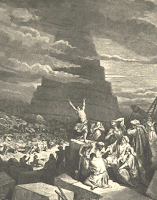 The tower is constructed to reach heaven. Historians tell us that many primitive religions see high places as the dwelling place of divinity. We will find this to be generally true whether we are discussing Sumeria or Greece. Why is this? Scripture is consistent in maintaining that God is “high and lifted up” (Is. 6:1). Since we are all made in the image of God and have the knowledge of God imprinted on our hearts, it is by constant suppression that we pretend we do not know God. This is the substance of Paul’s argument in Romans 1:18-32. His conclusion to this argument is that all humanity is “without excuse” (Rom. 1:21) and are subject to the judgment of God because they ignored their responsibilities before Him. Since all men know God it is reasonable to expect them to counterfeit true worship. True worship of God is according to His commands. Counterfeit worship flows from the heart of man and is directed at what he wants God to be like, whether this be an impersonal force or a buddy. Also at the heart of the tower is the desire from the garden to “be like God” (Gen. 3:5).
The tower represents a combination of sinful attitudes and actions on the part of humanity. It is our refusal to obey God in His commands. It is our attempt at counterfeit worship rather than authentic worship. It is also our attempt to be God. Thus the judgment of the Tower of Babel is instructive.
God communicates clearly why He acts. Do not miss how important it is that God communicates His will and reasons to us in the Bible. Many religions have gods that supposedly act in human history. However, few, if any, will give their rationale for acting in issues such as divine judgment. Here and in the Flood, we are not left to our own devices to determine why God chose to do what He did. He tells us, “Indeed the people are one and they all have one language, and this is what they begin to do; now nothing that they propose to do will be withheld from them. Come, let Us go down and there confuse their language, that they may not understand one anothers speech” (Gen. 11:6-7).
Much about history can be learned is episodes such as the Tower of Babel. Of course, the obvious piece of information is that we get all of the different languages from this event. Why do Egyptians speak differently from Greeks or Native Americans? Simply because God confused their language. The variety of languages in the world is not the result of random and cultural forces alone, it is a direct result of the God of heaven and earth acting judiciously on His creation.
The distribution of peoples can also be traced to this event. Many of the languages cataloged have families, (i.e.) they are similar. We can surmise that some of the languages created in the Tower of Babel judgment were similar and allowed the people to live in close proximity to each other. Others, however, were very different and thus people moved far away. From this, languages continued to develop and an entire history of language exists to consider the relationships they have to each other. Language is a fascinating thing and its history is incredible.
Before we get to the Tower of Babel though, we should notice the tenth chapter of Genesis. It is traditionally called the Table of Nations. In this portion of Scripture, God gives us a catalog of all the major Mediterranean nations descended from Noah and his sons. It is a fascinating study to see that the Greeks, the Arabs, and others are all carefully cataloged in the Bible for us.
The general location of Babel is pretty easy to deduce. Genesis tells us that after a while the descendants of Noah traveled east and dwelt in the land of Shinar. Shinar is the biblical term for Mesopotamia (lit. the land between the rivers). This means that Noah’s descendants came to live between the Tigris and Euphrates Rivers. It was here that they decided to dwell and to raise the mighty tower to heaven.
Most archaeologists, whether they accept the biblical narrative or not, identify the structure of the Tower of Babel with the Sumerian ziggurat. The ziggurat was a structure utilized often throughout Sumeria. We have several archaeological examples of these structures. It is not necessary for us to settle on this explanation at this time. The far more important issue, historically, surrounds the reasons why the tower was built and what the effects were rather than what it looked like. It is enough to understand the general geography of the Tower of Babel.
When God made His covenant with Noah, which was a renewal of the original covenant with Adam, He instructed Noah again to “be fruitful and multiply, populate the earth abundantly and multiply in it” (Gen. 9:7 NASB). Part of the command here is to move and spread out. However, we can see an unwillingness to obey the command of God in the Tower of Babel event because the people had not moved around. They had stayed exactly where their forefathers had dwelt. There was an inherent disobedience in the descendants of Noah here. The building of the tower was just the physical manifestation of the internal sin of this disobedience. The people even state this. “Come, let us build ourselves a city, and a tower whose top is in the heavens; let us make a name for ourselves, lest we be scattered abroad over the face of the whole earth” (Gen. 11:4).
 The tower is constructed to reach heaven. Historians tell us that many primitive religions see high places as the dwelling place of divinity. We will find this to be generally true whether we are discussing Sumeria or Greece. Why is this? Scripture is consistent in maintaining that God is “high and lifted up” (Is. 6:1). Since we are all made in the image of God and have the knowledge of God imprinted on our hearts, it is by constant suppression that we pretend we do not know God. This is the substance of Paul’s argument in Romans 1:18-32. His conclusion to this argument is that all humanity is “without excuse” (Rom. 1:21) and are subject to the judgment of God because they ignored their responsibilities before Him. Since all men know God it is reasonable to expect them to counterfeit true worship. True worship of God is according to His commands. Counterfeit worship flows from the heart of man and is directed at what he wants God to be like, whether this be an impersonal force or a buddy. Also at the heart of the tower is the desire from the garden to “be like God” (Gen. 3:5).
The tower represents a combination of sinful attitudes and actions on the part of humanity. It is our refusal to obey God in His commands. It is our attempt at counterfeit worship rather than authentic worship. It is also our attempt to be God. Thus the judgment of the Tower of Babel is instructive.
God communicates clearly why He acts. Do not miss how important it is that God communicates His will and reasons to us in the Bible. Many religions have gods that supposedly act in human history. However, few, if any, will give their rationale for acting in issues such as divine judgment. Here and in the Flood, we are not left to our own devices to determine why God chose to do what He did. He tells us, “Indeed the people are one and they all have one language, and this is what they begin to do; now nothing that they propose to do will be withheld from them. Come, let Us go down and there confuse their language, that they may not understand one anothers speech” (Gen. 11:6-7).
Much about history can be learned is episodes such as the Tower of Babel. Of course, the obvious piece of information is that we get all of the different languages from this event. Why do Egyptians speak differently from Greeks or Native Americans? Simply because God confused their language. The variety of languages in the world is not the result of random and cultural forces alone, it is a direct result of the God of heaven and earth acting judiciously on His creation.
The distribution of peoples can also be traced to this event. Many of the languages cataloged have families, (i.e.) they are similar. We can surmise that some of the languages created in the Tower of Babel judgment were similar and allowed the people to live in close proximity to each other. Others, however, were very different and thus people moved far away. From this, languages continued to develop and an entire history of language exists to consider the relationships they have to each other. Language is a fascinating thing and its history is incredible.
Wednesday, August 6, 2008
Uncle Tom's Cabin-Themes Part Two
The other major theme we need to consider when reading Uncle Tom's Cabin is Stowe's understanding of Christian Ethics. This theme goes two ways for Stowe. On the one hand, Christian ethics are lauded on the part of Tom and ultimately George Shelby. They are Christ figures in the novel. Tom accepts the humiliation of his life with the understanding that as long as he trusts his life to God he will persevere. Tom is seen reading his Bible, accepting his humiliating position in life, and taking cruel and undeserved punishment from an authority figure, much as Christ. George Shelby, though a late-comer in the novel, is seen acting out his ethical principles to find and rescue Tom from Legree.
The other way Stowe uses Christian ethics is to condemn most of the white characters in the novel and convict readers of the novel. While each person in the novel confesses Christ, they do not truly represent Christ-likeness as Stowe understands it. True Christ-likeness, as Stowe understands it, would immediately free the slaves since she holds slavery itself to be antithetical to Christian love and charity. Rather, many white characters use Christianity as a means to gain and keep power as opposed to a way of changing the world. In this respect we can see Stowe’s link to the social reform movements of Transcendentalism in America.
The other way Stowe uses Christian ethics is to condemn most of the white characters in the novel and convict readers of the novel. While each person in the novel confesses Christ, they do not truly represent Christ-likeness as Stowe understands it. True Christ-likeness, as Stowe understands it, would immediately free the slaves since she holds slavery itself to be antithetical to Christian love and charity. Rather, many white characters use Christianity as a means to gain and keep power as opposed to a way of changing the world. In this respect we can see Stowe’s link to the social reform movements of Transcendentalism in America.
Monday, August 4, 2008
Uncle Tom's Cabin-Themes Part One
The first theme we want to consider is that of slavery. It seems almost ludicrous to discuss the theme of slavery in Uncle Tom’s Cabin. Slavery would strike us as more of a subject or topic than a theme. But it is a theme. Stowe’s opinions on slavery and the institution of slavery form the very heart of this novel. As we have said before, much of Stowe’s experience with slavery came from people she met and things she saw from the North. She did not spend great amounts of time researching the various ways people kept or treated slaves. The novel itself was written from Brunswick, Maine, nearly 500 miles from Maryland, the most northern slave state in the Union.
That being said, how does slavery fit into the novel as a theme? It is obvious that Stowe thinks of slavery as an evil in the nation. Even as she recounts the gentleness of Shelby and St. Clare, she counters with the cruelty of Haley and Legree. With the exception of Tom, almost every slave we meet wants out of that circumstance in their life. They want to escape, to get to the North or Canada where they can be free. The cruelty with which Legree and Haley treat slaves overshadows the beneficence of Shelby and St. Clare because the latter are unable to make good on their intentions of freedom. Shelby and St. Clare have good intentions regarding Tom, but are incapable of carrying them out. In this way, Stowe represents every Southerner who is kind and gentle with their slaves as incompetent to do what they know should be done. No matter what good intentions a slave owner may have, the system itself is evil, and will inevitably lead to cruelty.
That being said, how does slavery fit into the novel as a theme? It is obvious that Stowe thinks of slavery as an evil in the nation. Even as she recounts the gentleness of Shelby and St. Clare, she counters with the cruelty of Haley and Legree. With the exception of Tom, almost every slave we meet wants out of that circumstance in their life. They want to escape, to get to the North or Canada where they can be free. The cruelty with which Legree and Haley treat slaves overshadows the beneficence of Shelby and St. Clare because the latter are unable to make good on their intentions of freedom. Shelby and St. Clare have good intentions regarding Tom, but are incapable of carrying them out. In this way, Stowe represents every Southerner who is kind and gentle with their slaves as incompetent to do what they know should be done. No matter what good intentions a slave owner may have, the system itself is evil, and will inevitably lead to cruelty.
Saturday, August 2, 2008
Uncle Tom's Cabin-Summary
A basic summary is all that is necessary here. The story begins at the Shelby plantation in Kentucky. Tom and Harry are the best slaves Mr. Shelby has. When Mr. Shelby cannot pay all of his debts, he is forced to sell some slaves. A slave-trader, Mr. Haley selects Tom and Harry both for selling. Harry’s mother, Eliza, cannot bear the thought of being separated from her child. Since her own husband has already made an escape, she decides to do the same. Eliza gathers Harry up and begins her escape. She stops at Tom’s cabin to try to convince him to go as well, but he decides he must be loyal to Mr. Shelby. The story then breaks into two plotlines, one following Eliza and Harry as they make their way north to Canada and another following Tom.
Eliza and Harry race up the Ohio River with Haley right behind them. They get across the Ohio River into northern territory and find shelter and sympathy from Senator Bird. Eliza and Harry are taken to a nearby Quaker community where they find Eliza’s husband George. The family finds a boat going to Canada and evades capture by men Haley has hired to find them.
Upset over losing Harry, Haley intends to sell Tom in New Orleans for the highest price he can get. Tom resigns himself to his destiny and reads his Bible as he is taken down the Mississippi River. While on the steamboat, Tom meets Eva St. Clare and becomes a guardian to her. He saves her when she falls off the ship. For this kindness, Tom is bought by Eva’s father and lives at the St. Clare plantation. Tom lives a fairly comfortable life at the St. Clare plantation, growing fonder of Eva. However, Eva becomes ill and dies leaving Mr. St. Clare in deep grief. He plans to free Tom for his many kindnesses to Eva, but never gets around to doing it legally. He is killed while trying to stop an argument between two drunken men. Once again, Tom is sold to pay debts at the St. Clare plantation.
This time he is sold to Simon Legree, a cruel plantation owner. Tom befriends Cassy, another slave on the plantation. Legree drinks heavily and beats his slaves when he is drunk. Tom often takes the worst of his beatings. Cassy and Emmeline, another slave, plan an escape from Legree’s plantation. As Tom is dying of the beatings, George Shelby, son of Tom’s original owner, appears to try to purchase Tom from Legree. Legree refuses and Tom dies in George Shelby’s arms. George buries Tom and returns to Kentucky by steamboat. There he is able to help Cassy and Emmeline, who have finally managed to escape from Legree’s plantation.
Eliza and Harry race up the Ohio River with Haley right behind them. They get across the Ohio River into northern territory and find shelter and sympathy from Senator Bird. Eliza and Harry are taken to a nearby Quaker community where they find Eliza’s husband George. The family finds a boat going to Canada and evades capture by men Haley has hired to find them.
Upset over losing Harry, Haley intends to sell Tom in New Orleans for the highest price he can get. Tom resigns himself to his destiny and reads his Bible as he is taken down the Mississippi River. While on the steamboat, Tom meets Eva St. Clare and becomes a guardian to her. He saves her when she falls off the ship. For this kindness, Tom is bought by Eva’s father and lives at the St. Clare plantation. Tom lives a fairly comfortable life at the St. Clare plantation, growing fonder of Eva. However, Eva becomes ill and dies leaving Mr. St. Clare in deep grief. He plans to free Tom for his many kindnesses to Eva, but never gets around to doing it legally. He is killed while trying to stop an argument between two drunken men. Once again, Tom is sold to pay debts at the St. Clare plantation.
This time he is sold to Simon Legree, a cruel plantation owner. Tom befriends Cassy, another slave on the plantation. Legree drinks heavily and beats his slaves when he is drunk. Tom often takes the worst of his beatings. Cassy and Emmeline, another slave, plan an escape from Legree’s plantation. As Tom is dying of the beatings, George Shelby, son of Tom’s original owner, appears to try to purchase Tom from Legree. Legree refuses and Tom dies in George Shelby’s arms. George buries Tom and returns to Kentucky by steamboat. There he is able to help Cassy and Emmeline, who have finally managed to escape from Legree’s plantation.
Thursday, July 31, 2008
Uncle Tom's Cabin-Date and Context
Like so many other novels of the time, Uncle Tom’s Cabin was published as a serial novel. It was released over the years 1851 and 1852 in installments. The first single volume publication was done in 1852 and sold 3,000 copies on its first day in print. The book is reported to have sold 50,000 copies in the first 8 weeks and within a year, sales were around 300,000 copies. Uncle Tom’s Cabin was translated into 37 different languages and made Stowe a celebrity all around the world.
Harriet Beecher Stowe wrote several other novels after Uncle Tom’s Cabin, but none were quite as popular as this one seminal work. Upon meeting Stowe, Abraham Lincoln is reputed to have said, “So this is the little lady who started this big war!” While the Civil War had many causes, Stowe’s writing had called a great amount of attention to what many in the North perceived as the great injustice of humanity, slavery.
It is no small matter to consider the context within which Stowe wrote this major work of American literature. The great Compromise of 1850 was the last major effort at conciliation between the two major sections of the country, the slaveholding South and the abolitionist North. While it is not fair to oversimplify the regions this way, it was consistent with the thought of the day in which Stowe wrote.
A major portion of the Compromise of 1850 was the Fugitive Slave Act. Passed to calm southern fears of northern plans to eradicate slavery from the South as well, the Fugitive Slave Act made it illegal for anyone to give assistance to a runaway slave and required that they be returned to their owners upon apprehension by any northerner.
Stowe’s own experiences in Cincinnati from 1832-1836 must have played a major role in her consideration of the institution of slavery. There she witnessed race riots and met people involved in the Underground Railroad. It must be remembered that Stowe only visited Kentucky once in her life. Her direct knowledge of the condition of slaves and the temperament of slave owners would have been minimal, at best.
Harriet Beecher Stowe wrote several other novels after Uncle Tom’s Cabin, but none were quite as popular as this one seminal work. Upon meeting Stowe, Abraham Lincoln is reputed to have said, “So this is the little lady who started this big war!” While the Civil War had many causes, Stowe’s writing had called a great amount of attention to what many in the North perceived as the great injustice of humanity, slavery.
It is no small matter to consider the context within which Stowe wrote this major work of American literature. The great Compromise of 1850 was the last major effort at conciliation between the two major sections of the country, the slaveholding South and the abolitionist North. While it is not fair to oversimplify the regions this way, it was consistent with the thought of the day in which Stowe wrote.
A major portion of the Compromise of 1850 was the Fugitive Slave Act. Passed to calm southern fears of northern plans to eradicate slavery from the South as well, the Fugitive Slave Act made it illegal for anyone to give assistance to a runaway slave and required that they be returned to their owners upon apprehension by any northerner.
Stowe’s own experiences in Cincinnati from 1832-1836 must have played a major role in her consideration of the institution of slavery. There she witnessed race riots and met people involved in the Underground Railroad. It must be remembered that Stowe only visited Kentucky once in her life. Her direct knowledge of the condition of slaves and the temperament of slave owners would have been minimal, at best.
Saturday, July 26, 2008
Uncle Tom's Cabin-Author

Harriet Beecher Stowe was born in Connecticut in 1811. She was the seventh of nine children born to Dr. Lyman Beecher, a renowned Congregationalist minister. Six of her brothers became ministers in the Congregational church. Her sister opened a women’s school in Connecticut. Harriet’s mother died when she was four and she was educated in her sister’s school. After graduation, Harriet became a teacher. The Beecher family moved from Connecticut to Cincinnati, Ohio when Harriet was twenty-one, as her father took a position at Lane Theological Seminary.
Harriet continued to teach while in Ohio. It was there that she first witnessed slavery and abolitionism. In Cincinnati she came into contact with race riots and heard stories of runaway slaves and of those who helped them escape slavery. Ohio’s next-door neighbor, Kentucky, was a slave state. Harriet only visited Kentucky once, but she had regular contact with men and women who helped operate the Underground Railroad.
Harriet married Calvin Stowe in 1836. Stowe was a minister and taught at the theological seminary where her father was head. In 1850, Harriet and her husband moved to Maine. Calvin Stowe had taken a position at Bowdoin College in Brunswick, Maine. While living in Maine, Harriet wrote Uncle Tom’s Cabin. She claimed that the passage of the Compromise of 1850, part of which included the Fugitive Salve Act, had prompted her to speak out in her own way on this issue that had so divided the country.
Harriet Beecher Stowe moved to Hartford, Connecticut after her husband died and lived there until her own death in 1896.

Subscribe to:
Posts (Atom)