Showing posts with label History. Show all posts
Showing posts with label History. Show all posts
Sunday, December 30, 2012
The loss of confidence
"What is really lost when a civilization wearied and grows small is confidence, a confidence built on the order and balance that leisure makes possible" Thomas Cahill - How the Irish Saved Civilization, 59


Sunday, September 26, 2010
What's good for the Goose...
In a recent history book I'm reading on the global history of the concept of the City, Joel Kotkin complains that Christianity had an "antiurban perspective." (37) He argues that Jesus himself was a homeless nomad and had no use for the urban centers of society. He states that the principal concern of Christians was "faith in a single, transcendent god." (36) Fair enough. I think Kotkin is missing the bigger picture by ignoring the fact that up until 315 AD, Christianity was a persecuted religion throughout the Roman empire and had to hide to exist. I think antiurban is hardly the term I would use to describe Christianity after Constantine.
The problem for me is that a few pages later, when discussing Islam's development, Kotkin praises Islam for being an "profoundly urban faith." (44) Kotkin asserts that the "need to gather the community of believers was a critical aspect of Islam....Islam virtually demanded cities to serve as 'the places where men pray together.'" (44) Just two pages later, however, Kotkin argues that Islam fosters "a sophisticated urban culture" while managing to not worship the city for its own sake. The city becomes a vehicle for "the integration of the daily lives of men with a transcendent God." (46)
So somehow, Christianity's emphasis, as Kotkin sees it, on a transcendent deity is antiurban while Islam fosters "a sophisticated urban culture" by having an emphasis on "the integration of the daily lives of men with a transcendent God." (46)
Go figure...
*Quotes are from Joel Kotkin, The City: A Global History (New York: Random House, 2005).
Tuesday, May 5, 2009
This Day in History
While every one else is blogging about Cinco de Mayo, I am going to write about another event that had greater ramifications but led to fewer parties and less drunkenness.
On this day, May 5, in 1640, Charles I dissolved the Short Parliament. This event has been claimed as the fuse of the English Civil War. Charles had learned from his father, James I, that kings owed their position to God. So far so good (as per Rom. 13:1-7). But James also taught his son that he was above the law and could do anything he wanted to because he owed nothing to the people. Problem! Charles repeatedly tried to rule without respect to the people of England, even though Magna Carta required certain powers be reserved for the people (represented in Parliament). When his foreign wars began costing more money than he actually had, he was forced to call Parliament into session. Only Parliament could authorize monies for war and soldier's wages.
When Parliament came into session on April 17, they refused to conduct any business until Charles recognized the authority of the people in government. After only three weeks, Charles dissolved the body and attempted to raise the money to fight his Scottish war alone. Charles was able to hold out until November of 1640 when lack of funds forced him to recall Parliament. This Parliament session lasted until 1649 and saw the outbreak of the English Civil War.
Royalists and Puritans fought each other over basic principles of government. Was the monarchy totalitarian or did it derive its power from the consent of the people? Charles fled before the Puritan Parliament and gathered his own forces. Oliver Cromwell rose as the leader of the Puritan forces and eventually Charles was captured, tried for treason against the state, and beheaded.
Issues such as religious freedom also entered the picture. Charles had appointed William Laud as Archbishop and Laud wanted to force the Anglican liturgy and form of worship on Presbyterians, Congregationalists, and others. In the period following Charles death, Parliament called together a diverse group of religious leaders, called divines, and charged them with drafting a confessional statement for the Protestant churches in England that all could assent to. The result, in 1648, was the Westminster Confession of Faith and the Larger and Shorter Catechisms.
So while I have nothing against beer and margaritas, I prefer to raise a glass in honor of the Short Parliament and the men who stood firm in their resolve against tyranny today.
On this day, May 5, in 1640, Charles I dissolved the Short Parliament. This event has been claimed as the fuse of the English Civil War. Charles had learned from his father, James I, that kings owed their position to God. So far so good (as per Rom. 13:1-7). But James also taught his son that he was above the law and could do anything he wanted to because he owed nothing to the people. Problem! Charles repeatedly tried to rule without respect to the people of England, even though Magna Carta required certain powers be reserved for the people (represented in Parliament). When his foreign wars began costing more money than he actually had, he was forced to call Parliament into session. Only Parliament could authorize monies for war and soldier's wages.
When Parliament came into session on April 17, they refused to conduct any business until Charles recognized the authority of the people in government. After only three weeks, Charles dissolved the body and attempted to raise the money to fight his Scottish war alone. Charles was able to hold out until November of 1640 when lack of funds forced him to recall Parliament. This Parliament session lasted until 1649 and saw the outbreak of the English Civil War.
Royalists and Puritans fought each other over basic principles of government. Was the monarchy totalitarian or did it derive its power from the consent of the people? Charles fled before the Puritan Parliament and gathered his own forces. Oliver Cromwell rose as the leader of the Puritan forces and eventually Charles was captured, tried for treason against the state, and beheaded.
Issues such as religious freedom also entered the picture. Charles had appointed William Laud as Archbishop and Laud wanted to force the Anglican liturgy and form of worship on Presbyterians, Congregationalists, and others. In the period following Charles death, Parliament called together a diverse group of religious leaders, called divines, and charged them with drafting a confessional statement for the Protestant churches in England that all could assent to. The result, in 1648, was the Westminster Confession of Faith and the Larger and Shorter Catechisms.
So while I have nothing against beer and margaritas, I prefer to raise a glass in honor of the Short Parliament and the men who stood firm in their resolve against tyranny today.
Saturday, December 20, 2008
Death of Bryan
In researching Donald Davidson for my thesis, I came across lots of stuff I would otherwise not have known. A good deal of it was about my hometown and state, some of which can be read in previous blog entries. One thing I haven't noted much here is how much the Dayton Trial of John T. Scopes, known commonly as the Monkey Trial, was a part of Davidson's thinking. Much of his shift to Southern Agrarianism came after the Scopes Trial was concluded. In his second volume on the history of the Tennessee River, he devotes many pages to a discussion of the trial and its effects on the culture of Tennessee and the South.
In this second volume I discovered that William Jennings Bryan, the Great Commoner who served to assist the prosecution in the case, gave his last public address in Winchester, TN (my hometown) before dying unexpectedly on July 25, 1925 on his way back to Chattanooga. According to The Truth and Herald (July 30, 1925) between 6,000 and 7,000 people attended the public address given by Bryan in Winchester.
I doubt anything Bryan said there was substantially different from what he said at any other time, but it was interesting to me that my little hometown had even been visited by someone like William Jennings Bryan, not to mention that he gave his last public address there.
In this second volume I discovered that William Jennings Bryan, the Great Commoner who served to assist the prosecution in the case, gave his last public address in Winchester, TN (my hometown) before dying unexpectedly on July 25, 1925 on his way back to Chattanooga. According to The Truth and Herald (July 30, 1925) between 6,000 and 7,000 people attended the public address given by Bryan in Winchester.
I doubt anything Bryan said there was substantially different from what he said at any other time, but it was interesting to me that my little hometown had even been visited by someone like William Jennings Bryan, not to mention that he gave his last public address there.
Saturday, September 20, 2008
Biblical Importance of Sumer
Sumer is incredibly relevant to the student of ancient history who seeks to understand the world of the Bible. According to the book of Genesis, Abraham came from Ur. There were several cities called Ur in Mesopotamia, but there are good reasons to believe that the Ur of southern Mesopotamia is the Ur of the Chaldees that Genesis speaks of. For one thing, the names are consistent not only with Akkadian/Sumerian names, but the description of Terah’s business is convincing. Another reason to identify Ur with Abraham is the polytheism on Abraham’s father Terah. Terah left Ur to go to Haran in northern Mesopotamia. Haran was known as a religious center for the worship of Nanna, the moon god. Ur shares this identity for southern Mesopotamia. Finally, according to our best reckoning, Terah fled Ur when the Gutians invaded. This helps us identify the chronology for Abraham as well.
Why is it important to know about Mesopotamia to understand Abraham? Abraham had a polytheistic past and this plays a large role in his life in Canaan. Abraham had to undergo the same sanctification that we do. Understanding this helps us understand some of the choices Abraham made and hang-ups that he had.
For example, the concept of land was very important to people from Mesopotamia. Perhaps very different from other cultures at the time, Mesopotamians like Abraham placed a heavy emphasis on land. They were a business people. Writing had been introduced there to help keep track of inventory and business transactions, and only later used for religious purposes. The cities of Mesopotamia are among the first anywhere to be true cities. The archaeological layouts allow us to see well-defined cultural centers all stationed around a center of worship. The nomadic lifestyle of the surrounding cultures would have seemed very odd to most Mesopotamians. Thus when God comes to Abraham in Haran and tells him to leave and go “to a land that I will show you” (Gen. 12:1) we must understand it in this context.
Another important issue to keep in mind is language. As already noted the reign of Sargon introduced a non-Sumerian element into this culture that would have required bilingual (Sumerian and Akkadian) language. This helps us understand how Terah could successfully travel nearly 600 miles and settle in Haran. This also helps us understand how Terah was so successful in Haran. Being from the Sumerian city of Ur, he would have understood a multiplicity of languages and so could likely have integrated into the more Akkadian culture of Haran.
How does Abraham’s pagan past help us understand his relationship to God? One way is that this was the first time a personal deity had made himself known. To Abraham all gods would have been frustratingly transcendent. Yahweh shows himself to be personal and very much desirous of Abraham’s well-being. God is very much interested in our personal well-being. This is a means for Him to bring glory to Himself, but still very different from the gods Abraham would have known. Another way his past helps us understand the richness of his life is that of the promise. Abraham follows God’s leading based on nothing more than a promise. The newness of this comes through when Sarai laughs at the thought of bearing a child in her old age, even at the promise of a god. These people would not have been used to a god who made Himself known, but the thought of making and keeping promises would have been almost ludicrous to them.
However, Abraham’s worldview does make for some issues for us as Christians. In what world does it make sense to let your wife be taken into a king’s harem, twice? In what way can we understand some of the things that Abraham does that make us cringe with disbelief? It is here that we must attribute his own struggle with his old paganism. Perhaps it has not been totally washed away.
The history of Mesopotamia holds great importance for the student of the ancient world. It helps us understand our own past as descendants of Abraham and builds connections to the world the Bible is situated in.
Why is it important to know about Mesopotamia to understand Abraham? Abraham had a polytheistic past and this plays a large role in his life in Canaan. Abraham had to undergo the same sanctification that we do. Understanding this helps us understand some of the choices Abraham made and hang-ups that he had.
For example, the concept of land was very important to people from Mesopotamia. Perhaps very different from other cultures at the time, Mesopotamians like Abraham placed a heavy emphasis on land. They were a business people. Writing had been introduced there to help keep track of inventory and business transactions, and only later used for religious purposes. The cities of Mesopotamia are among the first anywhere to be true cities. The archaeological layouts allow us to see well-defined cultural centers all stationed around a center of worship. The nomadic lifestyle of the surrounding cultures would have seemed very odd to most Mesopotamians. Thus when God comes to Abraham in Haran and tells him to leave and go “to a land that I will show you” (Gen. 12:1) we must understand it in this context.
Another important issue to keep in mind is language. As already noted the reign of Sargon introduced a non-Sumerian element into this culture that would have required bilingual (Sumerian and Akkadian) language. This helps us understand how Terah could successfully travel nearly 600 miles and settle in Haran. This also helps us understand how Terah was so successful in Haran. Being from the Sumerian city of Ur, he would have understood a multiplicity of languages and so could likely have integrated into the more Akkadian culture of Haran.
How does Abraham’s pagan past help us understand his relationship to God? One way is that this was the first time a personal deity had made himself known. To Abraham all gods would have been frustratingly transcendent. Yahweh shows himself to be personal and very much desirous of Abraham’s well-being. God is very much interested in our personal well-being. This is a means for Him to bring glory to Himself, but still very different from the gods Abraham would have known. Another way his past helps us understand the richness of his life is that of the promise. Abraham follows God’s leading based on nothing more than a promise. The newness of this comes through when Sarai laughs at the thought of bearing a child in her old age, even at the promise of a god. These people would not have been used to a god who made Himself known, but the thought of making and keeping promises would have been almost ludicrous to them.
However, Abraham’s worldview does make for some issues for us as Christians. In what world does it make sense to let your wife be taken into a king’s harem, twice? In what way can we understand some of the things that Abraham does that make us cringe with disbelief? It is here that we must attribute his own struggle with his old paganism. Perhaps it has not been totally washed away.
The history of Mesopotamia holds great importance for the student of the ancient world. It helps us understand our own past as descendants of Abraham and builds connections to the world the Bible is situated in.
Friday, September 19, 2008
Sumer to 2040 BC
Sargon’s empire was strong and powerful, but no human kingdom lasts forever. Around 2274 BC, Gutians invaded from the Zagros Mountains to the East. The Gutians shared a language with the Akkadians but not a culture. Unlike many of the other conquerors before them, they had no desire to replace the Akkadian culture with their own, they simply wanted to destroy. They were barbarians in the truest sense of the word. Oftentimes we see people referred to as barbarians, an essentially Greek word that means someone who does not speak Greek. Rarely do we see them live up to the name. Herodotus will call the Persian horde barbarians, but they are as civilized as the Greeks are. The Romans will call the Carthaginians barbarians, but they too had the form of civilization. Only the Germanic tribes much later will seem to fulfill the barbarian name as well as the Gutians.
The Gutians invaded the outskirts of Sargon’s empire first, now controlled by his son. By the time Naram-sin came to the throne, the invasion was well underway and the empire was all but doomed. Naram-sin did not help anything. He expanded the empire to the north along the river valley but left the east undefended and it was quickly overrun by Gutians. They cut the empire in half and invaded nearly every major city in the plain of Shinar. Kish fell, followed by Nippus, Uruk, Lagash, and finally Ur. Anarchy followed. The king lists suggest that no one was able to hold the empire together by asking “Who was king, who was not king?” Sargon’s great empire was gone.
All w as not lost. Around before 2280 the city of Lagash gained its freedom from the Gutians. The most famous of these rulers, Gudea, is able to begin trade again. He shows his humility in the statues he has made of himself. Rather than showing himself as a military conqueror, he is dressed in priestly garments with his hands folded.
Following Lagash, a revival of trade and strength flowed from the lower portions of Sumer and spread freedom throughout the plain. Uruk was freed next, followed by Ur and finally Nippur. The king holding most of this newly freed Sumer together was Utuhegal (2280-2277 BC). Utuhegal was not as important as his general and son-in-law, Ur-Nammu whom he left in Ur after driving the Gutians out. Utuhegal went on to continue fighting the Gutians. Ur-Nammu began to consolidate power in Ur and Uruk and amassed his own army. In 2278 he slaughtered his former master and father-in-law and became king of Sumer. He initiated the Third Dynasty of Ur (2278-2170 BC).
The Third Dynasty of Ur was a kind of cultural renaissance for Sumer. Ur-Nammu rebuilt roads and cities and revitalized the land. This renaissance lasted until 2040 BC with the center of influence changing a couple of times. In 2040 BC, the first dynasty of Babylon came to power over Mesopotamia.
The Gutians invaded the outskirts of Sargon’s empire first, now controlled by his son. By the time Naram-sin came to the throne, the invasion was well underway and the empire was all but doomed. Naram-sin did not help anything. He expanded the empire to the north along the river valley but left the east undefended and it was quickly overrun by Gutians. They cut the empire in half and invaded nearly every major city in the plain of Shinar. Kish fell, followed by Nippus, Uruk, Lagash, and finally Ur. Anarchy followed. The king lists suggest that no one was able to hold the empire together by asking “Who was king, who was not king?” Sargon’s great empire was gone.
All w
 as not lost. Around before 2280 the city of Lagash gained its freedom from the Gutians. The most famous of these rulers, Gudea, is able to begin trade again. He shows his humility in the statues he has made of himself. Rather than showing himself as a military conqueror, he is dressed in priestly garments with his hands folded.
Following Lagash, a revival of trade and strength flowed from the lower portions of Sumer and spread freedom throughout the plain. Uruk was freed next, followed by Ur and finally Nippur. The king holding most of this newly freed Sumer together was Utuhegal (2280-2277 BC). Utuhegal was not as important as his general and son-in-law, Ur-Nammu whom he left in Ur after driving the Gutians out. Utuhegal went on to continue fighting the Gutians. Ur-Nammu began to consolidate power in Ur and Uruk and amassed his own army. In 2278 he slaughtered his former master and father-in-law and became king of Sumer. He initiated the Third Dynasty of Ur (2278-2170 BC).
The Third Dynasty of Ur was a kind of cultural renaissance for Sumer. Ur-Nammu rebuilt roads and cities and revitalized the land. This renaissance lasted until 2040 BC with the center of influence changing a couple of times. In 2040 BC, the first dynasty of Babylon came to power over Mesopotamia.
Wednesday, September 3, 2008
Sargon the Great (2335-2279 BC)
While the Sumerians fought among each other for cultural and political dominance, the city-state model was changing around them. Semites from the mountains of Zagros and the plains of Elam had been invading for centuries, but had never managed to gain a strong foothold in the southern river valley of Sumer. One location that Semites had controlled was Akkad, to the north of Sumer.
The ancient world is full of myths and stories that are retold over and over again. Over the course of this year we will see the same stories many times. Many of these stories will be familiar to us from biblical accounts. For instance, the narrative of the Flood in Genesis has similar stories from all over Mesopotamia, like the one in the Epic of Gilgamesh. This should not cause us to question the authenticity of the biblical story, but to confirm it. If, as the Bible insists, we are all descended from the sons of Noah every nation should have some collective memory of the Flood. That these stories are similar proves their veracity. That they are different, shows us how man corrupts the things of God when he does not focus his attention on God’s character and worship.
Sargon the Great provides one of the first examples of the river narrative in antiquity. The stories of antiquity are full of this imagery. According to legend, Sargon was set adrift on the Euphrates River shortly after his birth. The goddess Inanna guided his basket to the shores of the city of Kish. Sargon was raised there and eventually given the role of cupbearer to the king of Kish, Ur-Zababa. This river narrative will remind us immediately of Moses, but we see it in many other narratives as well. It becomes a standard narrative for divine providence in the overthrow of a civilization or kingship.
In course of time Sargon overthrew Ur-Zababa and declared himself King of Universal Dominion. Sargon invaded many of the southern Sumerian cities and conquered almost all of them. He joined the disparate Sumerian city-states into an empire of great size. He moved the capital of his empire to Akkad (Agade). In the fifty-five years of his rule he amassed an empire that stretched from the Persian Gulf to the mountains of southern Turkey. The entire river valley of Mesopotamia was his. The new kingdom was called the Akkadian Empire (sometimes called the kingdom of Agade). Sargon established Sumerian culture throughout his kingdom, though he was of Semitic origins himself. Cuneiform became the dominant writing in the empire and would remain so for a thousand years. Three of his descendants reigned after him. The last was Naram-sin who ruled from 2255-2219
The ancient world is full of myths and stories that are retold over and over again. Over the course of this year we will see the same stories many times. Many of these stories will be familiar to us from biblical accounts. For instance, the narrative of the Flood in Genesis has similar stories from all over Mesopotamia, like the one in the Epic of Gilgamesh. This should not cause us to question the authenticity of the biblical story, but to confirm it. If, as the Bible insists, we are all descended from the sons of Noah every nation should have some collective memory of the Flood. That these stories are similar proves their veracity. That they are different, shows us how man corrupts the things of God when he does not focus his attention on God’s character and worship.
Sargon the Great provides one of the first examples of the river narrative in antiquity. The stories of antiquity are full of this imagery. According to legend, Sargon was set adrift on the Euphrates River shortly after his birth. The goddess Inanna guided his basket to the shores of the city of Kish. Sargon was raised there and eventually given the role of cupbearer to the king of Kish, Ur-Zababa. This river narrative will remind us immediately of Moses, but we see it in many other narratives as well. It becomes a standard narrative for divine providence in the overthrow of a civilization or kingship.
In course of time Sargon overthrew Ur-Zababa and declared himself King of Universal Dominion. Sargon invaded many of the southern Sumerian cities and conquered almost all of them. He joined the disparate Sumerian city-states into an empire of great size. He moved the capital of his empire to Akkad (Agade). In the fifty-five years of his rule he amassed an empire that stretched from the Persian Gulf to the mountains of southern Turkey. The entire river valley of Mesopotamia was his. The new kingdom was called the Akkadian Empire (sometimes called the kingdom of Agade). Sargon established Sumerian culture throughout his kingdom, though he was of Semitic origins himself. Cuneiform became the dominant writing in the empire and would remain so for a thousand years. Three of his descendants reigned after him. The last was Naram-sin who ruled from 2255-2219
Tuesday, September 2, 2008
Sumer to 2335 BC
This section of our text will focus on the historical development of Sumer during what is called the Early Dynastic period. This period is complicated by the lack of written records as we discussed above. There is also a lack of internal cohesion among the city-states in Sumer. Some scholars refer to this period as a era of civil war and territorial conflict. From around 2900 BC through  2335 BC, the center of power in Sumer shifted often and with much bloodshed.
The map shows several important cities in Sumer. These cities were largely independent of each other and most of them were the center of Sumer at one time or another.
During the Early Dynastic period, these cities rivaled each other for cultural and political dominance. They would conquer each other often. We know this because at this time in the archaeological record, city walls begin to show up. The city-state paradigm is not one known for promoting peace. We will see how the city-state is an evolutionary model in political theory that either advances to imperialism or to republicanism, or is subject to civil war and self-destruction. We see the former in Rome and later European countries and the latter in the Greek cities of Athens and Sparta.
 2335 BC, the center of power in Sumer shifted often and with much bloodshed.
The map shows several important cities in Sumer. These cities were largely independent of each other and most of them were the center of Sumer at one time or another.
During the Early Dynastic period, these cities rivaled each other for cultural and political dominance. They would conquer each other often. We know this because at this time in the archaeological record, city walls begin to show up. The city-state paradigm is not one known for promoting peace. We will see how the city-state is an evolutionary model in political theory that either advances to imperialism or to republicanism, or is subject to civil war and self-destruction. We see the former in Rome and later European countries and the latter in the Greek cities of Athens and Sparta.
Monday, September 1, 2008
Sumerian Religion
We will take a moment here to give a short introduction to the gods and goddesses of the Sumerians. Before we deal with them particularly, let us spend a moment on the topic of polytheism. Polytheism is the belief in multiple gods. It should be seen as antithetical to monotheism, the belief in one god. Christianity, Judaism and Islam to a lesser extent, are monotheistic religions. Most cultures in the ancient world were polytheistic.
Polytheistic religions have a multitude of gods and goddesses to perform various functions. Many of us are already aware of this in Greek or Roman mythology. Zeus and Jupiter were the chief gods and all others had positions below them in some way. There were messenger gods and gods of war and other such functions. In Sumerian religion, the gods tended to be a little more territorial. There were gods that performed natural or cosmological functions, but they were almost always tied to a city or cities in the region as well. The following chart should give us an idea of some of the more important deities in the Sumerian pantheon.
Polytheistic religions have a multitude of gods and goddesses to perform various functions. Many of us are already aware of this in Greek or Roman mythology. Zeus and Jupiter were the chief gods and all others had positions below them in some way. There were messenger gods and gods of war and other such functions. In Sumerian religion, the gods tended to be a little more territorial. There were gods that performed natural or cosmological functions, but they were almost always tied to a city or cities in the region as well. The following chart should give us an idea of some of the more important deities in the Sumerian pantheon.
Deity Name | Patron City | Function |
An (Anu) | Erech (Uruk) | Chief god |
Enki | Eridu | god of water, wisdom and fertility |
Enkil | Nippur | god of rain, wind, and air |
Inanna | Erech (Uruk) | goddess of love, fertility, and war |
Nanna | Ur | god of the moon |
Utu | Larsa | god of justice and the sun |
Marduk | Babylon | god of storms and lightning |
The layout of Sumerian cities is actually important when the question of religion comes up. Sumerians laid their cities out around the central temple of whatever god or goddess was home to that city. The ziggurat would be in the center of the city and everything radiated from that central point. Coupled with the raised elevation of the ziggurat, we can begin to see how the idea of a “high place” was shared by Sumerians as well as others.
Tuesday, August 26, 2008
Early Sumer
The first glimmers of what we call civilization began in the Near East, which we now call the Middle East. The Near East of Mesopotamia, or the land between the rivers, is the cradle of the earliest civilization and a fountain for much of our biblical culture. The Tigris and Euphrates Rivers flow out of the Causasus Mountains and toward the Indian Ocean. They form a delta at the Persian Gulf and lay down a tremendous amount of silt (nutrient-rich sediment) along the way. Using the Flood-based Ice Age hypothesis laid down in chapter one, we can surmise that the deep trench of the Persian Gulf was not covered with water at this early period. In fact, some historians have suggested that the land extended as far as modern Qatar in the Arabian Peninsula. As the ice receded, water levels began to rise. It rarely rained on the plain, but rainwater and melting ice would come from the mountains once a year flooding the plain and leaving behind the muddy silt that dried into baked earth.
Sometime between 3500 and 3000 BC people began to settle here and developed techniques of animal husbandry and agriculture. The grasses that grew in the region provided excellent grazing grounds for sheep and goats gathered off the nearby mountains. The animals provided meat, milk, and cheese, as well as clothing from the skins. Soon people began cultivating the grains that grew in the area and harvested barleys and other cereals for their own nutrition. As more and more people flowed into the region, communities began to form along the rivers of the valleys. The people used the mud to bake bricks and build little huts and homes with. These communities eventually coalesced into primitive cities or city-states. Evidence suggests that major decisions were made by a council of elders and a council of adult citizens. Organized labor for canal building or other projects would have leader elected to rule at that time. Government, such as this, developed to keep order and provide protection and trade among the citizens began to allow for stratification of class and vocation. This earliest example is called Sumer.
The earliest records of Sumer are king lists written down about 2,100 BC. They record kings from before the Flood, but are not reliable at this point. For instance, King Alulim of Erech was said to have ruled for 28,000 years. This exceptional reign dwarfs even that of the biblical genealogies, and is clearly accurate.
What we know of Sumer must be drawn from both written and physical sources. We have writings from much later, but give us indications of events and social structures. We also have excavated cities and sites of interest. These give us a great amount of understanding about the buildings they built, the pottery they used, and other social structures. Pottery is fascinating because of the way it is constructed. Once the clay is fired, it really cannot break down or decay any further. The process of baking it unites the molecules in such a way that they can be shattered to dust, but cannot be destroyed or turned into anything else. Thus pottery can be a great vehicle for archaeological knowledge. Pottery was often buried with people, and in excavations, is usually found in dwellings. The styles of pottery are informative, as is the decoration on pottery. In Greek pottery, for example, we can view the way different kinds of people dressed and acted. This is not usually the case with Sumerian pottery, but as a source for ancient history, its value is still high.
From the more reliable portions of the king lists however; we can construct a partial chronology for Mesopotamia and Sumer. Why is this important? Some very important figures and events come to light in this period and it behooves us to take notice of the culture that brought these things into existence. For instance, writing begins in Sumer.
 The form of writing that we call cuneiform was invented here. It is done by pressing wedge-shaped sticks into wet wax or clay, making markings that were used as words. It is pictographic, as opposed to phonetic. Words were marked out by specific symbols, not phonetic combinations. Cuneiform writing was apparently invented because of the tremendous amount of trade done in Sumer. Merchants had to have ways to account for inventory and accounting. It is significant that economics brought forth the invention of writing, not literature or religion. Both of these were oral traditions long before writing was used to record them.
The city, or city-state, is first expressed here as well. As people began to gather together in central locations, they began to relate to each other differently than they had before. There is a remarkable difference in the way members of a single household relate as opposed to members of multiple households. As more and more people were drawn to the agricultural way of life, they built houses of mud brick and lived close to other people. This was done for protection. A single raiding party could devastate one household, but with others nearby, they were deterred from their actions. A city-state is a collection of people who voluntarily live near each other, protect each other, and provide for each other with goods and materials. Evidence suggests that “an assembly of free adult male citizens … convened on an ad hoc basis to make decisions for the good of the community.” Some historians suggest that the choosing of ruler was initially only done to assist with large defense efforts or public work projects. This origin of political organization in Sumer is part of its claim as well.
Sometime between 3500 and 3000 BC people began to settle here and developed techniques of animal husbandry and agriculture. The grasses that grew in the region provided excellent grazing grounds for sheep and goats gathered off the nearby mountains. The animals provided meat, milk, and cheese, as well as clothing from the skins. Soon people began cultivating the grains that grew in the area and harvested barleys and other cereals for their own nutrition. As more and more people flowed into the region, communities began to form along the rivers of the valleys. The people used the mud to bake bricks and build little huts and homes with. These communities eventually coalesced into primitive cities or city-states. Evidence suggests that major decisions were made by a council of elders and a council of adult citizens. Organized labor for canal building or other projects would have leader elected to rule at that time. Government, such as this, developed to keep order and provide protection and trade among the citizens began to allow for stratification of class and vocation. This earliest example is called Sumer.
The earliest records of Sumer are king lists written down about 2,100 BC. They record kings from before the Flood, but are not reliable at this point. For instance, King Alulim of Erech was said to have ruled for 28,000 years. This exceptional reign dwarfs even that of the biblical genealogies, and is clearly accurate.
What we know of Sumer must be drawn from both written and physical sources. We have writings from much later, but give us indications of events and social structures. We also have excavated cities and sites of interest. These give us a great amount of understanding about the buildings they built, the pottery they used, and other social structures. Pottery is fascinating because of the way it is constructed. Once the clay is fired, it really cannot break down or decay any further. The process of baking it unites the molecules in such a way that they can be shattered to dust, but cannot be destroyed or turned into anything else. Thus pottery can be a great vehicle for archaeological knowledge. Pottery was often buried with people, and in excavations, is usually found in dwellings. The styles of pottery are informative, as is the decoration on pottery. In Greek pottery, for example, we can view the way different kinds of people dressed and acted. This is not usually the case with Sumerian pottery, but as a source for ancient history, its value is still high.
From the more reliable portions of the king lists however; we can construct a partial chronology for Mesopotamia and Sumer. Why is this important? Some very important figures and events come to light in this period and it behooves us to take notice of the culture that brought these things into existence. For instance, writing begins in Sumer.

The city, or city-state, is first expressed here as well. As people began to gather together in central locations, they began to relate to each other differently than they had before. There is a remarkable difference in the way members of a single household relate as opposed to members of multiple households. As more and more people were drawn to the agricultural way of life, they built houses of mud brick and lived close to other people. This was done for protection. A single raiding party could devastate one household, but with others nearby, they were deterred from their actions. A city-state is a collection of people who voluntarily live near each other, protect each other, and provide for each other with goods and materials. Evidence suggests that “an assembly of free adult male citizens … convened on an ad hoc basis to make decisions for the good of the community.” Some historians suggest that the choosing of ruler was initially only done to assist with large defense efforts or public work projects. This origin of political organization in Sumer is part of its claim as well.
Saturday, August 23, 2008
Agrarianism
The more I read of Davidson, the more I get the impression that to him, Agrarianism meant a balance life. He didn't say it very well, all the time, but as I read more and more of what he wrote, he doesn't have a beef with machines per se. He has a problem with a messianic faith in machines. He doesn't have a problem with industry per se, he has a problem with a messianic faith in industrialism to relieve all our woes.
Davidson seems to hold on to Agrarianism as the best way to bring everything back into balance. A clear harmony between the life of the land and the life of the city seems to be in view with him. Now if I can just prove it.
Davidson seems to hold on to Agrarianism as the best way to bring everything back into balance. A clear harmony between the life of the land and the life of the city seems to be in view with him. Now if I can just prove it.
Tuesday, August 19, 2008
The Fertile Crescent
The first chapter of this book was devoted to the period we sometimes refer to as “prehistory.” This means that there are no contemporary records from that period. The period itself took place before people wrote things down about it. Contemporary records are other writings that can complement the history record we have. If you were to write a biography of Winston Churchill and you used his own diary and documents that he wrote for official business, they would be considered contemporary records. If you mentioned that he began working at the Office of the Admiralty in 1911 and you used either of these sources, you would have contemporary records for the assertion. There are no lists of anything from before the Flood and no catalogs of animals on the ark. The only source of information we have is the book of Genesis and other works that parallel the account given there. For instance, the Babylonian Epic of Gilgamesh, presents a parallel flood narrative that can be instructive if given the proper place.
However, after the Tower of Babel, we begin a new phase of history. Many history books, even those written by Christians, begin here. This is partly because writing about the period prior to this takes a lot of speculation, even if we follow the book of Genesis completely. It is difficult to know exactly when and where things took place. After the Tower of Babel, we have better knowledge of these things. We can focus our attention on a specific region and location, the Fertile Crescent.
The Fertile Crescent is known as the birthplace of civilization. Civilization is a very difficult word to define. It has typically been used to describe a city-dwelling culture. This is an unsatisfactory definition. We will not present a full-blown definition here, but we will begin to construct a definition in which civilization has to do with the transmission of culture from one generation to the next. For now, we will accept part of the traditional definition and acknowledge that civilization involves cities. Cities first spring up in the Fertile Crescent, a band of irrigated land stretching from the Persian Gulf in modern Iraq, up through the Tigris and Euphrates River valleys of Assyria and down through Palestine into Lower Egypt (see map below).
It is easy to see why civilization first began to develop in this region once we begin to understand the region. The Fertile Crescent is made up of river valleys. The basic geography of the Fertile Crescent is important to understand.
Rivers are formed when water runs down out of mountains on its way to sea. The Fertile Crescent is surrounded by mountains. To the north in Turkey and Armenia we find the Causasus and Taurus ranges. To the west we have the Zagros range. Deep in the south of central Africa the Ruwenzori range feeds the Nile River. Mountains also run through Palestine, the ranges of Lebanon and Hermon are particularly important. As water runs out of mountains it inevitably picks up sediment from the mountain and carries it down to the sea. However, as water flows rapidly it often overflows its traditional bed and lays this sediment down along its path. This sediment is often mineral-rich and suitable for growing.
The more important information though is the human side of this equation. All the sediment in the world would do nothing valuable if it were not for people. We learned from the Bible that after the Flood, Noah’s descendants traveled down the river valley and settled in the land of Shinar (cf. Gen. 11:1). Here they built the Tower of Babel and here God’s judgment came upon them. Humanity was forced to travel more and we see various groups of people develop different patterns of civilization all around the region of the Fertile Crescent.
In the immediate Persian Gulf area we find the Sumerians and the Akkadians, who we will look at carefully soon. To the east we find the Egyptians settled in the Nile River valley. Between both of these major groups we find a whole host of smaller groups filling in the lands. This first unit of this book will focus mostly on this region of the Fertile Crescent. The Fertile Crescent represents the foundational geography we will be concerned with for a while.
However, after the Tower of Babel, we begin a new phase of history. Many history books, even those written by Christians, begin here. This is partly because writing about the period prior to this takes a lot of speculation, even if we follow the book of Genesis completely. It is difficult to know exactly when and where things took place. After the Tower of Babel, we have better knowledge of these things. We can focus our attention on a specific region and location, the Fertile Crescent.
The Fertile Crescent is known as the birthplace of civilization. Civilization is a very difficult word to define. It has typically been used to describe a city-dwelling culture. This is an unsatisfactory definition. We will not present a full-blown definition here, but we will begin to construct a definition in which civilization has to do with the transmission of culture from one generation to the next. For now, we will accept part of the traditional definition and acknowledge that civilization involves cities. Cities first spring up in the Fertile Crescent, a band of irrigated land stretching from the Persian Gulf in modern Iraq, up through the Tigris and Euphrates River valleys of Assyria and down through Palestine into Lower Egypt (see map below).
It is easy to see why civilization first began to develop in this region once we begin to understand the region. The Fertile Crescent is made up of river valleys. The basic geography of the Fertile Crescent is important to understand.
Rivers are formed when water runs down out of mountains on its way to sea. The Fertile Crescent is surrounded by mountains. To the north in Turkey and Armenia we find the Causasus and Taurus ranges. To the west we have the Zagros range. Deep in the south of central Africa the Ruwenzori range feeds the Nile River. Mountains also run through Palestine, the ranges of Lebanon and Hermon are particularly important. As water runs out of mountains it inevitably picks up sediment from the mountain and carries it down to the sea. However, as water flows rapidly it often overflows its traditional bed and lays this sediment down along its path. This sediment is often mineral-rich and suitable for growing.
The more important information though is the human side of this equation. All the sediment in the world would do nothing valuable if it were not for people. We learned from the Bible that after the Flood, Noah’s descendants traveled down the river valley and settled in the land of Shinar (cf. Gen. 11:1). Here they built the Tower of Babel and here God’s judgment came upon them. Humanity was forced to travel more and we see various groups of people develop different patterns of civilization all around the region of the Fertile Crescent.
In the immediate Persian Gulf area we find the Sumerians and the Akkadians, who we will look at carefully soon. To the east we find the Egyptians settled in the Nile River valley. Between both of these major groups we find a whole host of smaller groups filling in the lands. This first unit of this book will focus mostly on this region of the Fertile Crescent. The Fertile Crescent represents the foundational geography we will be concerned with for a while.
Monday, August 18, 2008
The Tower of Babel
After the flood subsided, Genesis tells us that Noah and his children left the ark and made a sacrifice to God on the top of the mountain. There God made a covenant with Noah. This covenant is important because it parallels very closely the original covenant made with Adam. In both covenants God tells humanity to “be fruitful and multiply, and fill the earth” (Gen. 9:1; cf. Gen. 1:28). This tells us that the command to control the earth and subdue it (cf. Gen. 1:28) is still in force after the fall. It also sets us an interesting context for the next significant event in human history, the Tower of Babel.
Before we get to the Tower of Babel though, we should notice the tenth chapter of Genesis. It is traditionally called the Table of Nations. In this portion of Scripture, God gives us a catalog of all the major Mediterranean nations descended from Noah and his sons. It is a fascinating study to see that the Greeks, the Arabs, and others are all carefully cataloged in the Bible for us.
The general location of Babel is pretty easy to deduce. Genesis tells us that after a while the descendants of Noah traveled east and dwelt in the land of Shinar. Shinar is the biblical term for Mesopotamia (lit. the land between the rivers). This means that Noah’s descendants came to live between the Tigris and Euphrates Rivers. It was here that they decided to dwell and to raise the mighty tower to heaven.
Most archaeologists, whether they accept the biblical narrative or not, identify the structure of the Tower of Babel with the Sumerian ziggurat. The ziggurat was a structure utilized often throughout Sumeria. We have several archaeological examples of these structures. It is not necessary for us to settle on this explanation at this time. The far more important issue, historically, surrounds the reasons why the tower was built and what the effects were rather than what it looked like. It is enough to understand the general geography of the Tower of Babel.
When God made His covenant with Noah, which was a renewal of the original covenant with Adam, He instructed Noah again to “be fruitful and multiply, populate the earth abundantly and multiply in it” (Gen. 9:7 NASB). Part of the command here is to move and spread out. However, we can see an unwillingness to obey the command of God in the Tower of Babel event because the people had not moved around. They had stayed exactly where their forefathers had dwelt. There was an inherent disobedience in the descendants of Noah here. The building of the tower was just the physical manifestation of the internal sin of this disobedience. The people even state this. “Come, let us build ourselves a city, and a tower whose top is in the heavens; let us make a name for ourselves, lest we be scattered abroad over the face of the whole earth” (Gen. 11:4).
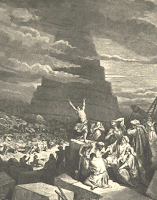 The tower is constructed to reach heaven. Historians tell us that many primitive religions see high places as the dwelling place of divinity. We will find this to be generally true whether we are discussing Sumeria or Greece. Why is this? Scripture is consistent in maintaining that God is “high and lifted up” (Is. 6:1). Since we are all made in the image of God and have the knowledge of God imprinted on our hearts, it is by constant suppression that we pretend we do not know God. This is the substance of Paul’s argument in Romans 1:18-32. His conclusion to this argument is that all humanity is “without excuse” (Rom. 1:21) and are subject to the judgment of God because they ignored their responsibilities before Him. Since all men know God it is reasonable to expect them to counterfeit true worship. True worship of God is according to His commands. Counterfeit worship flows from the heart of man and is directed at what he wants God to be like, whether this be an impersonal force or a buddy. Also at the heart of the tower is the desire from the garden to “be like God” (Gen. 3:5).
The tower represents a combination of sinful attitudes and actions on the part of humanity. It is our refusal to obey God in His commands. It is our attempt at counterfeit worship rather than authentic worship. It is also our attempt to be God. Thus the judgment of the Tower of Babel is instructive.
God communicates clearly why He acts. Do not miss how important it is that God communicates His will and reasons to us in the Bible. Many religions have gods that supposedly act in human history. However, few, if any, will give their rationale for acting in issues such as divine judgment. Here and in the Flood, we are not left to our own devices to determine why God chose to do what He did. He tells us, “Indeed the people are one and they all have one language, and this is what they begin to do; now nothing that they propose to do will be withheld from them. Come, let Us go down and there confuse their language, that they may not understand one anothers speech” (Gen. 11:6-7).
Much about history can be learned is episodes such as the Tower of Babel. Of course, the obvious piece of information is that we get all of the different languages from this event. Why do Egyptians speak differently from Greeks or Native Americans? Simply because God confused their language. The variety of languages in the world is not the result of random and cultural forces alone, it is a direct result of the God of heaven and earth acting judiciously on His creation.
The distribution of peoples can also be traced to this event. Many of the languages cataloged have families, (i.e.) they are similar. We can surmise that some of the languages created in the Tower of Babel judgment were similar and allowed the people to live in close proximity to each other. Others, however, were very different and thus people moved far away. From this, languages continued to develop and an entire history of language exists to consider the relationships they have to each other. Language is a fascinating thing and its history is incredible.
Before we get to the Tower of Babel though, we should notice the tenth chapter of Genesis. It is traditionally called the Table of Nations. In this portion of Scripture, God gives us a catalog of all the major Mediterranean nations descended from Noah and his sons. It is a fascinating study to see that the Greeks, the Arabs, and others are all carefully cataloged in the Bible for us.
The general location of Babel is pretty easy to deduce. Genesis tells us that after a while the descendants of Noah traveled east and dwelt in the land of Shinar. Shinar is the biblical term for Mesopotamia (lit. the land between the rivers). This means that Noah’s descendants came to live between the Tigris and Euphrates Rivers. It was here that they decided to dwell and to raise the mighty tower to heaven.
Most archaeologists, whether they accept the biblical narrative or not, identify the structure of the Tower of Babel with the Sumerian ziggurat. The ziggurat was a structure utilized often throughout Sumeria. We have several archaeological examples of these structures. It is not necessary for us to settle on this explanation at this time. The far more important issue, historically, surrounds the reasons why the tower was built and what the effects were rather than what it looked like. It is enough to understand the general geography of the Tower of Babel.
When God made His covenant with Noah, which was a renewal of the original covenant with Adam, He instructed Noah again to “be fruitful and multiply, populate the earth abundantly and multiply in it” (Gen. 9:7 NASB). Part of the command here is to move and spread out. However, we can see an unwillingness to obey the command of God in the Tower of Babel event because the people had not moved around. They had stayed exactly where their forefathers had dwelt. There was an inherent disobedience in the descendants of Noah here. The building of the tower was just the physical manifestation of the internal sin of this disobedience. The people even state this. “Come, let us build ourselves a city, and a tower whose top is in the heavens; let us make a name for ourselves, lest we be scattered abroad over the face of the whole earth” (Gen. 11:4).
 The tower is constructed to reach heaven. Historians tell us that many primitive religions see high places as the dwelling place of divinity. We will find this to be generally true whether we are discussing Sumeria or Greece. Why is this? Scripture is consistent in maintaining that God is “high and lifted up” (Is. 6:1). Since we are all made in the image of God and have the knowledge of God imprinted on our hearts, it is by constant suppression that we pretend we do not know God. This is the substance of Paul’s argument in Romans 1:18-32. His conclusion to this argument is that all humanity is “without excuse” (Rom. 1:21) and are subject to the judgment of God because they ignored their responsibilities before Him. Since all men know God it is reasonable to expect them to counterfeit true worship. True worship of God is according to His commands. Counterfeit worship flows from the heart of man and is directed at what he wants God to be like, whether this be an impersonal force or a buddy. Also at the heart of the tower is the desire from the garden to “be like God” (Gen. 3:5).
The tower represents a combination of sinful attitudes and actions on the part of humanity. It is our refusal to obey God in His commands. It is our attempt at counterfeit worship rather than authentic worship. It is also our attempt to be God. Thus the judgment of the Tower of Babel is instructive.
God communicates clearly why He acts. Do not miss how important it is that God communicates His will and reasons to us in the Bible. Many religions have gods that supposedly act in human history. However, few, if any, will give their rationale for acting in issues such as divine judgment. Here and in the Flood, we are not left to our own devices to determine why God chose to do what He did. He tells us, “Indeed the people are one and they all have one language, and this is what they begin to do; now nothing that they propose to do will be withheld from them. Come, let Us go down and there confuse their language, that they may not understand one anothers speech” (Gen. 11:6-7).
Much about history can be learned is episodes such as the Tower of Babel. Of course, the obvious piece of information is that we get all of the different languages from this event. Why do Egyptians speak differently from Greeks or Native Americans? Simply because God confused their language. The variety of languages in the world is not the result of random and cultural forces alone, it is a direct result of the God of heaven and earth acting judiciously on His creation.
The distribution of peoples can also be traced to this event. Many of the languages cataloged have families, (i.e.) they are similar. We can surmise that some of the languages created in the Tower of Babel judgment were similar and allowed the people to live in close proximity to each other. Others, however, were very different and thus people moved far away. From this, languages continued to develop and an entire history of language exists to consider the relationships they have to each other. Language is a fascinating thing and its history is incredible.
Tuesday, August 12, 2008
Paternalism in Southern History
I find it very interesting that, in Southern historiography, no white southerner can have any concern for an African-American without it being paternalistic. There is no room for generosity, love, compassion, or genuine fellowship. Every attempt by a white southerner to reach out to the African-American is dubbed "paternalism" which means that they are reaching down, not out.
To a large degree I suppose we have brought this on ourselves, but it ticks me off.
To a large degree I suppose we have brought this on ourselves, but it ticks me off.
Saturday, July 26, 2008
The Flood
Chapters four through ten of the book of Genesis tell us what happened between the time that Cain was exiled from Eden and the great Flood was sent upon the earth. It is a short portion of the book, but packed with much that must be explained from a historical point of view. We begin with the family of Adam. Cain’s family has begun a new life away from Adam and Eve. Abel has been replaced with Seth. The family of Adam as recorded in Genesis chapter five is meant to show us God’s faithful and providential care of His people down to the time of Noah. The entire genealogy focuses on this task. It begins with Adam (Gen. 5:1) and ends with Noah and his sons (Gen. 5:32).
Chapter six of Genesis begins to set up the world before the Flood. We refer to this as the ante-diluvian period. We see the very fast and very real corruption of sin in the lives of the people of the earth. Adam and Eve and their offspring have been faithful to procreate and fill the earth, but they have not been so careful to teach the ways of God to their generations. Certainly the offspring of Cain can be held partly responsible for this as well. We are told that the condition of humanity at this stage of history was on in which “every intent of the thoughts of his heart was only evil continually” (Gen. 6:5). God reached out with righteous judgment and destroyed the world He had so carefully made.
But God did not destroy every one. Noah found favor with God. Noah and his family were spared because of the righteousness of Noah. Noah was told to prepare an ark and store animals and food and his own family in it that they might be spared before the judgment of God. Then God sent rain. It had never rained before (Gen. 2:5) and Noah acted solely on faith that God was telling him the truth. You can bet Noah and his family persevered under tremendous ridicule while they built the ark and gathered all the animals into it. I often tell students that they should remember Noah and how his faith was vindicated by God the next time they suffer ridicule because of a biblical stance your parents have chosen for them (not watching certain types of TV or movies, not wearing certain clothes).
There is much to discuss about the event of the Flood because it is such a touchstone in history. The idea of a worldwide flood that destroyed every person except Noah and his family and most animals has come under great scrutiny in the last two hundred years. Geologists claim that the rock layers and formation cannot have resulted from a flood like the one described in Genesis. They claim that there is no evidence for such a flood. Many ideas have crept into our thinking over the past two hundred years that seem to argue against such a catastrophic phenomenon. Where do the dinosaurs fit in with a biblical chronology of history? How about all the evidence for the Ice Age? How about continental drift and Pangaea? What about cave paintings and the bones they keep finding that are neither human nor animal?
Let us begin with a total cosmology of the earth as it was created. The Bible indicates that when God separated the land from the ocean, he gathered all the water into one place, leaving a single mass of land. We cannot know the exact size of this landmass, but we can guess that since our continents do fit together somewhat, that all the land we now see was once part of a large landmass. Now let us fit this into the biblical details. According to Genesis 7:11 water not only fell from above but burst forth from “the fountains of the deep.” Some biblical scientists have attempted to explain this by suggesting that there was a dense canopy of moisture that essentially made the entire earth like a tropical rain forest. This helps explain several things. It is often surprising and difficult to understand how Adam lived 930 years. Some scientists suggest that a canopy of this kind would prevent the sunlight from aging the body in the way it does today. A longer lifespan can possible be attributed to this situation.
If there were such a canopy of water above the earth and this canopy condensed and fell as rain all of a sudden, the force of it would no doubt be tremendous. Scientists at the Institute for Creation Research have posited that the force of the water falling, combined with that of the “fountains of the deep” breaking open would be sufficient to explain the shattering of a landmass like Pangaea. Imagine carefully placing a broken plate in a large fish tank and then dumping several gallons of water on it at one time. When you stopped pouring water on it you would see that the plate had scattered around the fish tank, not stayed in one place.
It rained for forty days, according to Genesis. The flood waters stayed upon the earth for about three months after it had stopped raining. It took Noah two weeks for his dove to find land. He stayed in the ark an additional month and a half or so before he exited with all the animals and people. Noah immediately made a sacrifice to God and received a covenant bond signed by the rainbow. If the earth were covered by a dense canopy that made it feel like a tropical rain forest before the Flood, what must it have felt like afterward? Scientists have surmised that the much of the water would have frozen instantly at the poles. Even today, scientists tell us that if the poles were to melt, there would be enough water to cover the earth. Where did the rain go after falling for forty days? It froze and receded to the polar ice caps. Much of the earth would have been covered by ice for a while yet. Interestingly, we see that Noah and his family stay in the region of Ararat where the ark came to rest for a while still. However, the frozen landscape would offer evidence of an Ice Age and allow animals to migrate from one continent to the other after the Flood.
What about the problem of the technology of the ante-diluvian peoples? Why do we have no evidence of iron working or bronze working until much later than the Flood? Imagine what it would feel like to wake up tomorrow and find out that there were only a handful of people left on earth. It would be scary, but stay with me a moment. What would you do for breakfast? Well, you would likely still be able to stick a piece of bread in the toaster and toast it. Your refrigerator would likely still be operational and so you could still put butter or jam on it and be fine. But what about the next day? When the power finally did go out, where would you be? What about when things started breaking? Would you be able to repair or duplicate an incandescent light bulb?
I suspect this is the situation Noah and his children found themselves in right after the Flood. While the descendants of Cain did discover how to make things with iron and bronze; that knowledge perished with them in the Flood. Noah’s was a carpenter, or so it would seem. He and his children would have known how to use tools made of iron, but not how to create them. The simple explanation for why the Bronze Age does not begin until 3500 BC and why iron is not found in abundance until 1200 BC is that after the Flood, people had to relearn a lost technology. Artifacts surely exist from before the Flood, but they would be almost impossible to identify.
Chapter six of Genesis begins to set up the world before the Flood. We refer to this as the ante-diluvian period. We see the very fast and very real corruption of sin in the lives of the people of the earth. Adam and Eve and their offspring have been faithful to procreate and fill the earth, but they have not been so careful to teach the ways of God to their generations. Certainly the offspring of Cain can be held partly responsible for this as well. We are told that the condition of humanity at this stage of history was on in which “every intent of the thoughts of his heart was only evil continually” (Gen. 6:5). God reached out with righteous judgment and destroyed the world He had so carefully made.
But God did not destroy every one. Noah found favor with God. Noah and his family were spared because of the righteousness of Noah. Noah was told to prepare an ark and store animals and food and his own family in it that they might be spared before the judgment of God. Then God sent rain. It had never rained before (Gen. 2:5) and Noah acted solely on faith that God was telling him the truth. You can bet Noah and his family persevered under tremendous ridicule while they built the ark and gathered all the animals into it. I often tell students that they should remember Noah and how his faith was vindicated by God the next time they suffer ridicule because of a biblical stance your parents have chosen for them (not watching certain types of TV or movies, not wearing certain clothes).
There is much to discuss about the event of the Flood because it is such a touchstone in history. The idea of a worldwide flood that destroyed every person except Noah and his family and most animals has come under great scrutiny in the last two hundred years. Geologists claim that the rock layers and formation cannot have resulted from a flood like the one described in Genesis. They claim that there is no evidence for such a flood. Many ideas have crept into our thinking over the past two hundred years that seem to argue against such a catastrophic phenomenon. Where do the dinosaurs fit in with a biblical chronology of history? How about all the evidence for the Ice Age? How about continental drift and Pangaea? What about cave paintings and the bones they keep finding that are neither human nor animal?
Let us begin with a total cosmology of the earth as it was created. The Bible indicates that when God separated the land from the ocean, he gathered all the water into one place, leaving a single mass of land. We cannot know the exact size of this landmass, but we can guess that since our continents do fit together somewhat, that all the land we now see was once part of a large landmass. Now let us fit this into the biblical details. According to Genesis 7:11 water not only fell from above but burst forth from “the fountains of the deep.” Some biblical scientists have attempted to explain this by suggesting that there was a dense canopy of moisture that essentially made the entire earth like a tropical rain forest. This helps explain several things. It is often surprising and difficult to understand how Adam lived 930 years. Some scientists suggest that a canopy of this kind would prevent the sunlight from aging the body in the way it does today. A longer lifespan can possible be attributed to this situation.
If there were such a canopy of water above the earth and this canopy condensed and fell as rain all of a sudden, the force of it would no doubt be tremendous. Scientists at the Institute for Creation Research have posited that the force of the water falling, combined with that of the “fountains of the deep” breaking open would be sufficient to explain the shattering of a landmass like Pangaea. Imagine carefully placing a broken plate in a large fish tank and then dumping several gallons of water on it at one time. When you stopped pouring water on it you would see that the plate had scattered around the fish tank, not stayed in one place.
It rained for forty days, according to Genesis. The flood waters stayed upon the earth for about three months after it had stopped raining. It took Noah two weeks for his dove to find land. He stayed in the ark an additional month and a half or so before he exited with all the animals and people. Noah immediately made a sacrifice to God and received a covenant bond signed by the rainbow. If the earth were covered by a dense canopy that made it feel like a tropical rain forest before the Flood, what must it have felt like afterward? Scientists have surmised that the much of the water would have frozen instantly at the poles. Even today, scientists tell us that if the poles were to melt, there would be enough water to cover the earth. Where did the rain go after falling for forty days? It froze and receded to the polar ice caps. Much of the earth would have been covered by ice for a while yet. Interestingly, we see that Noah and his family stay in the region of Ararat where the ark came to rest for a while still. However, the frozen landscape would offer evidence of an Ice Age and allow animals to migrate from one continent to the other after the Flood.
What about the problem of the technology of the ante-diluvian peoples? Why do we have no evidence of iron working or bronze working until much later than the Flood? Imagine what it would feel like to wake up tomorrow and find out that there were only a handful of people left on earth. It would be scary, but stay with me a moment. What would you do for breakfast? Well, you would likely still be able to stick a piece of bread in the toaster and toast it. Your refrigerator would likely still be operational and so you could still put butter or jam on it and be fine. But what about the next day? When the power finally did go out, where would you be? What about when things started breaking? Would you be able to repair or duplicate an incandescent light bulb?
I suspect this is the situation Noah and his children found themselves in right after the Flood. While the descendants of Cain did discover how to make things with iron and bronze; that knowledge perished with them in the Flood. Noah’s was a carpenter, or so it would seem. He and his children would have known how to use tools made of iron, but not how to create them. The simple explanation for why the Bronze Age does not begin until 3500 BC and why iron is not found in abundance until 1200 BC is that after the Flood, people had to relearn a lost technology. Artifacts surely exist from before the Flood, but they would be almost impossible to identify.
Wednesday, June 25, 2008
Orthodoxy
I just finished listening to G.K. Chesterton's Orthodoxy (via LibriVox). It is part of a project to work my way through the Bannockburn reading list.
Anyway, it is a book with amazing application. Several points struck me as I listened to it. I used an online version to read back through some that were especially striking. Near the end, Chesterton makes a comment that I have been saying for some time now.
Anyway, it is a book with amazing application. Several points struck me as I listened to it. I used an online version to read back through some that were especially striking. Near the end, Chesterton makes a comment that I have been saying for some time now.
Science knows nothing whatever about pre-historic man; for the excellent reason that he is pre-historic. A few professors choose to conjecture that such things as human sacrifice were once innocent and general and that they gradually dwindled; but there is no direct evidence of it, and the small amount of indirect evidence is very much the other way. In the earliest legends we have, such as the tales of Isaac and of Iphigenia, human sacrifice is not introduced as something old, but rather as something new; as a strange and frightful exception darkly demanded by the gods. History says nothing; and legends all say that the earth was kinder in its earliest time. There is no tradition of progress; but the whole human race has a tradition of the Fall. Amusingly enough, indeed, the very dissemination of this idea is used against its authenticity. Learned men literally say that this pre-historic calamity cannot be true because every race of mankind remembers it. I cannot keep pace with these paradoxes.I have been telling my students for years that the very fact that almost every ancient civilization on record has a flood narrative is evidence that the thing happened, not evidence it did not. But the modernist would rather believe that every ancient civilization was involved in a mass conspiracy than accept that the Bible could be right about something.
Friday, June 13, 2008
The Pattern of Rome
Along with Angels in the Architecture I've been reading the Southern Agrarians, hoping to find a Masters thesis idea in there. It has been enjoyable reading and has confirmed some thoughts I've had for a little while now. One of these thoughts has to do with modern parallels to the collapse of the Roman Empire.
Beginning just after the death of Domitian (AD 51-96) the Roman Empire entered into a crisis from which it would never fully recover. Diocletian (AD 244-311) and Constantine (AD 272-337) made some needed improvements that kept the Empire afloat for a while longer but nothing could really halt the building disintegration of Rome. Scholars have debated the cause of the fall of the Roman Empire for centuries. Some have, of course, located the cause in the invasions of the German tribes in the fourth century. Others have seen an economic problem as central to the collapse of Rome; a failing agrarian economy and rising unemployment. Still others have seen the collapse of the currency as essential to the demise of the imperial power.
As I've been reading the agrarians I have seen that it was not any one of these issues that finally caused the fall of Rome, but a mixture of them. Certainly barbarian invasions were the most obvious event in the 200 years of the fall of Rome. However, we must understand what created a situation where the barbarians could invade. For all intents and purposes the fall of Rome can be attributed to three sources. Failure to protect their borders. Failure to develop a balanced economy, namely agriculture and industry. Failure to stop inflation.
These three issues, working together created a collapsing situation from which even the mighty Roman Empire could not escape. Sadly, 1500 years later we have not learned these lessons. An article from the Economist several years ago showed a scary parallel between American troop dispersement throughout the world and Roman troop placement near the end of the empire. Our troops are so far flung that we can not address our own national borders we are too busy fighting little brush fires in other nations, while our own borders are overrun. However, please understand I am not against immigration, just against illegal immigration. Agriculture continues to be one of the most ignored problem spots in the American economy. The idea of the family farm has largely disappeared from the American landscape, an idea that Tiberius and Gaius Gracchus literally died for in 133-129 BC. Our current currency crisis is a direct result of inflation. The dollar buys less because the supply is too large. A old story from pre-WWII Germany can show where this can lead. The story goes that an old woman was walking down the street with a basket full of money. She stopped to look at something in a store window and when she turned around again she found that her basket had been stolen and the pile of money was left lying in the street. It can get that bad right here as well. If we don't curb some of these alarming trends, we could easily be facing the same collapse that Rome faced. And I doubt we will fare much better.
Beginning just after the death of Domitian (AD 51-96) the Roman Empire entered into a crisis from which it would never fully recover. Diocletian (AD 244-311) and Constantine (AD 272-337) made some needed improvements that kept the Empire afloat for a while longer but nothing could really halt the building disintegration of Rome. Scholars have debated the cause of the fall of the Roman Empire for centuries. Some have, of course, located the cause in the invasions of the German tribes in the fourth century. Others have seen an economic problem as central to the collapse of Rome; a failing agrarian economy and rising unemployment. Still others have seen the collapse of the currency as essential to the demise of the imperial power.
As I've been reading the agrarians I have seen that it was not any one of these issues that finally caused the fall of Rome, but a mixture of them. Certainly barbarian invasions were the most obvious event in the 200 years of the fall of Rome. However, we must understand what created a situation where the barbarians could invade. For all intents and purposes the fall of Rome can be attributed to three sources. Failure to protect their borders. Failure to develop a balanced economy, namely agriculture and industry. Failure to stop inflation.
These three issues, working together created a collapsing situation from which even the mighty Roman Empire could not escape. Sadly, 1500 years later we have not learned these lessons. An article from the Economist several years ago showed a scary parallel between American troop dispersement throughout the world and Roman troop placement near the end of the empire. Our troops are so far flung that we can not address our own national borders we are too busy fighting little brush fires in other nations, while our own borders are overrun. However, please understand I am not against immigration, just against illegal immigration. Agriculture continues to be one of the most ignored problem spots in the American economy. The idea of the family farm has largely disappeared from the American landscape, an idea that Tiberius and Gaius Gracchus literally died for in 133-129 BC. Our current currency crisis is a direct result of inflation. The dollar buys less because the supply is too large. A old story from pre-WWII Germany can show where this can lead. The story goes that an old woman was walking down the street with a basket full of money. She stopped to look at something in a store window and when she turned around again she found that her basket had been stolen and the pile of money was left lying in the street. It can get that bad right here as well. If we don't curb some of these alarming trends, we could easily be facing the same collapse that Rome faced. And I doubt we will fare much better.
Tuesday, April 15, 2008
The Titanic (April 15, 1912)
It is funny to me how much of my love of history actually was spawned by Heavy Metal music. I learned of Coleridge's great poem, the Rime of the Ancient Mariner, from the Iron Maiden song of the same name. My interest in the Titanic actually came through a song by the band Metal Church who did a song called Rest in Pieces (April 15, 1912) about the Titanic.
Today marks the 96th anniversary of the sinking of the poor ship that was supposed to be unsinkable. I remember watching James Cameron's Marxist film about the boat and hating all the social commentary and the ridiculous love story, but loving the imagery of the ship and the collision and sinking of the boat.
I also listened relatively recently to George Grant's stunning lecture "Why the Scots?" from his Modernity lectures done by Gileskirk. In it he explained that the men who staffed the boat had a solid grounding in the legend and history of seamanship inherited from Scotland. The rule of the sea, "Women and children first" was a lived commitment to them. How utterly ridiculous such a notion would sound to us today. I teach young girls who are offended when chivalry rears its head in the school. They feel looked down upon, not elevated. How backwards we have become. Over 1,500 people died in the wee hours of the morning.
This post feels a little rambled to me, but I just wanted to commemorate the Titanic today. There are very few times in history where chivalry and Christian virtue are able to show themselves so objectively as on the deck of the Titanic as men watched their beloved wives and children float to safety while they sunk into the icy Atlantic ocean.
Today marks the 96th anniversary of the sinking of the poor ship that was supposed to be unsinkable. I remember watching James Cameron's Marxist film about the boat and hating all the social commentary and the ridiculous love story, but loving the imagery of the ship and the collision and sinking of the boat.
I also listened relatively recently to George Grant's stunning lecture "Why the Scots?" from his Modernity lectures done by Gileskirk. In it he explained that the men who staffed the boat had a solid grounding in the legend and history of seamanship inherited from Scotland. The rule of the sea, "Women and children first" was a lived commitment to them. How utterly ridiculous such a notion would sound to us today. I teach young girls who are offended when chivalry rears its head in the school. They feel looked down upon, not elevated. How backwards we have become. Over 1,500 people died in the wee hours of the morning.
This post feels a little rambled to me, but I just wanted to commemorate the Titanic today. There are very few times in history where chivalry and Christian virtue are able to show themselves so objectively as on the deck of the Titanic as men watched their beloved wives and children float to safety while they sunk into the icy Atlantic ocean.
Saturday, April 5, 2008
Recession, Depression, and our Stimulus Package.
I was listening to Dr. George Grant's Gileskirk lecture on the Great Depression the other day (the 2001 edition, available from WordMP3.com) and was struck by his list of the steps taken by the Federal government to avoid or stave off depression.
According to Grant, first the Federal Reserve expanded the money supply in the US 62 times from 1920 to 1929. When the inflation caused a downturn in the market, Hoover tried some interference strategies to hold off the stock market crash. This was designed to prop up the market. It resulted in a massive loss of confidence in the market and sped up the depression instead of thwarting it. In 1931 Hoover launched a massive spending program to try to "outspend" the depression. Finally, when all this caught up with the treasury, Hoover had to put a very large tax hike in place to stop the bleeding. This obviously did not help, as we all know from our parents, grandparents, and the history books.
I wonder how much inflation has been happening in the last decade. The reason this concerns me is that our current stimulus package reminds me an awful lot of Hoover's spending program to try to revitalize the economy in the 1930's.
We apparently learned nothing from the Great Depression. But then, when do we?
According to Grant, first the Federal Reserve expanded the money supply in the US 62 times from 1920 to 1929. When the inflation caused a downturn in the market, Hoover tried some interference strategies to hold off the stock market crash. This was designed to prop up the market. It resulted in a massive loss of confidence in the market and sped up the depression instead of thwarting it. In 1931 Hoover launched a massive spending program to try to "outspend" the depression. Finally, when all this caught up with the treasury, Hoover had to put a very large tax hike in place to stop the bleeding. This obviously did not help, as we all know from our parents, grandparents, and the history books.
I wonder how much inflation has been happening in the last decade. The reason this concerns me is that our current stimulus package reminds me an awful lot of Hoover's spending program to try to revitalize the economy in the 1930's.
We apparently learned nothing from the Great Depression. But then, when do we?
Monday, March 17, 2008
The Ides of March
I can't believe I let the 15th of March slip by without a little tribute to Julius Caesar. Julius Caesar was murdered by the Senate on the 15th of March in 44 BC so that he would not attain to the status of king or empoeror in the Roman State. This murder set off a chain of events that led directly to that very thing taking place. Octavius Caesar, Julius' adopted grand-nephew was made the sole ruler of the Roman world in 27 BC. Why did Julius Caesar die?
The whole saga has been so immortalized by Shakespeare that we can hardly think of the death without dear Brutus and Caesar's dying words "Et tu, Brute." Yet in all liklihood this phrase was never uttered (that's OK though, Washington never cut down a cherry tree either). The sentiment is the same. Caesar died because of what others were afraid of. Caesar was simply about twenty years ahead of his time. He was unable to grasp what his grand-nephew took hold of and weilded with expert skill, the people of Rome. Caesar thought he could man-handle the people. Augustus knew they had to be worked like clay. Caesar thought he could do whatever he wanted to and with the Senate. Augustus knew he had to make them think they needed him. In the end, Caesar died because he wanted too much, too fast.
Augustus was successful because he handled the situation with far more prudence and care.
We are all political playthings, at least it feels that way. As long as the leaders give us rebate stimulus packages, we won't revolt. Actually we would eb unlikely to revolt even if they didn't give us stimulus packages. We are way too lazy for anything as difficult and trying as a revolt.
The whole saga has been so immortalized by Shakespeare that we can hardly think of the death without dear Brutus and Caesar's dying words "Et tu, Brute." Yet in all liklihood this phrase was never uttered (that's OK though, Washington never cut down a cherry tree either). The sentiment is the same. Caesar died because of what others were afraid of. Caesar was simply about twenty years ahead of his time. He was unable to grasp what his grand-nephew took hold of and weilded with expert skill, the people of Rome. Caesar thought he could man-handle the people. Augustus knew they had to be worked like clay. Caesar thought he could do whatever he wanted to and with the Senate. Augustus knew he had to make them think they needed him. In the end, Caesar died because he wanted too much, too fast.
Augustus was successful because he handled the situation with far more prudence and care.
We are all political playthings, at least it feels that way. As long as the leaders give us rebate stimulus packages, we won't revolt. Actually we would eb unlikely to revolt even if they didn't give us stimulus packages. We are way too lazy for anything as difficult and trying as a revolt.
Subscribe to:
Comments (Atom)