The countries of the West are committed to universal, free, compulsory education. The United States first made this commitment and has extended it further than any other. In this country 92.5 percent of the children who are fourteen years old and 71.3 percent of those between fourteen and seventeen are in school. It will not be suggested that they are receiving the education that the democratic ideal requires. The West has not accepted the proposition that the democratic ideal demands liberal education for all. In the United States, at least, the prevailing opinion seems to be that the demands of that ideal are met by universal schooling, rather than by universal liberal education. What goes on in school is regarded as of relatively minor importance. The object appears to be to keep the child off the labor market and to detain him in comparatively sanitary surroundings until we are ready to have him go to work.
The results of universal, free, compulsory education in America can be acceptable only on the theory that the object of the schools is something other than education, that it is, for example, to keep the young from cluttering up homes and factories during a difficult period of their lives, or that it is to bring them together for social or recreational purposes.
These last purposes, those which are social and recreational, the American educational system, on a very low level, achieves. It throws young people together. Since this does not take any greater effort than is required to pass compulsory school laws and build buildings, the accomplishment of this purpose would not at first blush seem to be a matter for boasting. Yet we often hear of it as something we should be proud of, and even as something that should suggest to us the main line of a sound educational policy. We often hear that bringing young people together, having them work and play together, and having them organize themselves “democratically” are the great contributions to democracy that the educational system can make. This is an expansion of the doctrine that was popular in my youth about the moral benefits conferred on everybody through intercollegiate athletics, which was, in turn, an adaptation of the remark dubiously imputed to the Duke of Wellington about the relationship between the battle of Waterloo and the playing fields of Eton.
No one can deny the value of getting together, of learning to get along with others, of coming to appreciate the methods of organization and the duties of membership in an organization any more than one can deny the importance of physical health and sportsmanship. It seems on the face of it a trifle absurd, however, to go to the trouble of training and engaging teachers, of erecting laboratories and libraries, and of laying out a program of instruction and learning if, in effect, the curriculum is extra and the extracurriculum is the heart of the matter.
It seems doubtful whether the purposes of the educational system can be found in the pursuit of objects that the Boy Scouts, the Y.M.C.A., and the local country club, to say nothing of the family and the church, purport to be pursuing. The unique function of the educational system would appear to have something to do with the mind. No other agency in the community sets itself up, or is set up, to train the mind. To the extent to which the educational system is diverted to other objects, to that extent the mind of the community is neglected.
This is not to say that the educational system should not contribute to the physical, social, and moral development of those committed to its charge. But the method of its contribution, apart from the facilities for extra-curriculum activities that it provides, is through the mind. The educational system seeks to establish the rational foundations for good physical, moral, and social behavior.
Education is supposed to have something to do with intelligence. It was because of this connection that it was always assumed that if the people were to have political power they would have to have education. They would have to have it if they were to use their power intelligently. This was the basis of the Western commitment to universal, free, compulsory education. I have suggested that the kind of education that will develop the requisite intelligence for democratic citizenship is liberal education, education through great books and the liberal arts, a kind of education that has all but disappeared from the schools, colleges, and universities of the United States.
Why did this education disappear? It was the education of the Founding Fathers. It held sway until fifty years ago. Now it is almost gone. I attribute this phenomenon to two factors, internal decay and external confusion.
By the end of the first quarter of this century great books and the liberal arts had been destroyed by their teachers. The books had become the private domain of scholars. The word “classics” came to be limited to those works which were written in Greek and Latin. Whitehead refers to Wordsworth’s remark about men of science who “murder to dissect” and properly observes: “In the past, classical scholars have been veritable assassins compared to them.” The classical books, it was thought, could be studied only in the original languages, and a student might attend courses in Plato and Lucretius for years without discovering that they had any ideas. His professors were unlikely to be interested in ideas. They were interested in philological details. The liberal arts in their hands degenerated into meaningless drill.
Their reply to criticism and revolt was to demand, forgetting that interest is essential in education, that their courses be required. By the end of the first quarter of this century the great Greek and Latin writers were studied only to meet requirements for entrance to or graduation from college. Behind these tariff walls the professors who had many of the great writers and much of the liberal arts in their charge contentedly sat, oblivious of the fact that they were depriving the rising generation of an important part of their cultural heritage and the training needed to understand it, and oblivious also of the fact that they were depriving themselves of the reason for their existence.
Philosophy, history, and literature, and the disciplines that broke away from philosophy—political science, sociology, and psychology—suffered from another kind of decay, which resulted from a confusion that I shall refer to later, a confusion about the nature and scope of the scientific method. This confusion widened the break between those disciplines that split off from philosophy; it led professors of these disciplines up many blind alleys; and it produced profound changes in philosophical study. The same influences cut the heart out of the study of history and literature.
In general the professors of the humanities and the social sciences and history, fascinated by the marvels of experimental natural science, were overpowered by the idea that similar marvels could be produced in their own fields by the use of the same methods. They also seemed convinced that any results obtained in these fields by any other methods were not worth achieving. This automatically ruled out writers previously thought great who had had the misfortune to live before the method of empirical natural science had reached its present predominance and who had never thought of applying it to problems and subject matters outside the range of empirical natural science. The insights of these writers were at once out of date; for they could, in the nature of the case, represent little but prejudice or guesswork, which it would be the object of the scientific method to sweep out of the way of progress.
Since the aim of philosophers, historians, and critics of literature and art, to say nothing of social scientists, was to be as “scientific” as possible, they could not concern themselves much with ideas or with the “unscientific” tradition of the West. Nor could they admit the utility of the liberal arts, apart from those associated with mathematics.
Meanwhile the idea of education for all became firmly established in the United States. The school-leaving age steadily rose. An unprecedented flood of pupils and students overwhelmed the schools, colleges, and universities, a flood that has gone on growing, with minor fluctuations, to this day. Merely to house and staff the educational enterprise was an undertaking that would have put a strain on the wealth and intelligence of any country.
The triumphs of industrialization, which made this educational expansion possible, resulted from triumphs of technology, which rested on triumphs of science, which were promoted by specialization. Specialization, experimental science, technology, and industrialization were new. Great books and the liberal arts were identified in the public mind with dead languages, arid routines, and an archaic, prescientific past. The march of progress could be speeded by getting rid of them, the public thought, and using scientific method and specialization for the double purpose of promoting technological advance and curing the social maladjustments that industrialization brought with it. This program would have the incidental value of restoring interest to its place in education and of preparing the young to take part in the new, specialized, scientific, technological, industrial, democratic society that was emerging, to join in raising the standard of living and in solving the dreadful problems that the effort to raise it was creating.
The revolt against the classical dissectors and drillmasters was justified. So was the new interest in experimental science. The revolt against liberal education was not justified. Neither was the belief that the method of experimental science could replace the methods of history, philosophy, and the arts. As is common in educational discussion, the public had confused names and things. The dissectors and drillmasters had no more to do with liberal education than the ordinary college of liberal arts has to do with those arts today. And the fact that a method obtains sensational results in one field is no guarantee that it will obtain any results whatever in another.
Do science, technology, industrialization, and specialization render the Great Conversation irrelevant?
We have seen that industrialization makes liberal education more necessary than ever, and that the leisure it provides makes liberal education possible, for the first time, for everybody.
We have observed that the reorganization of the educational system would enable everybody to get a liberal education and to become a specialist as well.
I should like to add that specialization, instead of making the Great Conversation irrelevant, makes it more pertinent than ever. Specialization makes it harder to carry on any kind of conversation; but this calls for greater effort, not the abandonment of the attempt.
There can be little argument about the proposition that the task of the future is the creation of a community. Community seems to depend on communication. This requirement is not met by improvements in transportation or in mail, telegraph, telephone, or radio services. These technological advances are frightening, rather than reassuring, and disruptive, rather than unifying, in such a world as we have today. They are the means of bringing an enemy’s bombs or propaganda into our homes.
The effectiveness of modern methods of communication in promoting a community depends on whether there is something intelligible and human to communicate. This, in turn, depends on a common language, a common stock of ideas, and common human standards. These the Great Conversation affords. Reading these books should make a man feel himself a member of the species and tradition that these books come from. He should recognize the ties that bind him to his fellow members of the species and tradition. He should be able to communicate, in a real sense, with other men.
Must the specialist be excluded from the community? If so, there can hardly be one; for increasingly in the West everybody is a specialist. The task is to have a community nevertheless, and to discover means of using specialties to promote it. This can be done through the Great Conversation. Through it the expert can discover the great common principles that underlie the specialties. Through it he can bring ideas to bear upon his experience. In the light of the Great Conversation his special brand of knowledge loses its particularistic vices and becomes a means of penetrating the great books. The mathematical specialist, for example, can get further faster into the great mathematicians than a reader who is without his specialized training. With the help of great books, specialized knowledge can radiate out into a genuine interfiltration of common learning and common life.
Imagine the younger generation studying great books and learning the liberal arts. Imagine an adult population continuing to turn to the same sources of strength, inspiration, and communication. We could talk to one another then. We should be even better specialists than we are today because we could understand the history of our specialty and its relation to all the others. We would be better citizens and better men. We might turn out to be the nucleus of the world community.
Monday, September 9, 2013
Sunday, September 8, 2013
An unofficial PhD
Who needs a PhD?
I mean, it would be nice to have those letters behind my name. It would be nice to indicate that I possessed the drive to become a Doctor of Philosophy about a particular subject. In my case, I imagine, history would have to be the area I would focus. I do have a Clemson University approved Masters degree in that subject. I'll admit, pursuing the advanced degree has called to me on several occasions and it has been fairly difficult to think of reasons not to do it. My wife jokes that I would be a professional student if I could. If I could just find someone to pay me to take university courses - now that would be a dream job, I think.


But I do come back to the question over time, do I need a PhD? What benefit would it give me in my current, or future endeavors? I am no longer a full-time faculty member of the school I had taught at since graduation from the University of TN in Chattanooga. I have resigned myself to the proposition that neither that school, nor any other than I would wish to teach at, could afford me the luxury of supporting my family on salary alone. That is simply a fact of private education.
What is a PhD?
A PhD, or Doctor of Philosophy, is a post-graduate degree indicating a love of the subject matter one chooses to pursue and a desire to better oneself personally and professionally. Originally, it came in to existence as part of the Liberal Arts, as can be seen here. However, today you can be awarded a PhD, or doctorate, of just about any discipline (e.g. Physics, Biology, Economics, Marketing, etc.).
How do you get one?
The PhD would traditionally be obtained through more coursework at the post-graduate level and intense, focused research on a specific topic about which a book-length essay, called a dissertation, would be written, presented, and then defended before a panel of peers. It would take a full-time student two years, at minimum, to complete this process, at least in the Liberal Arts subjects I am familiar with. I cannot pretend to speak for scientific or other fields. A PhD from Vanderbilt University, a place I have considered for further studies, would require 72 hours of graduate work, of which 24 semester hours would be in formal courses.1 This would run, as of today, $125,784 just in the fees for the courses. There is no way I could justify spending that. I know that there would be options of financial aid along the way that may offset a great amount of this, but it just isn't possible given my personal situation. For one thing, I would never receive a satisfactory return on that investment. While being a comic, the October 20, 2008 PhD Comics image relied on real documented sources to show what academic salaries look like.2
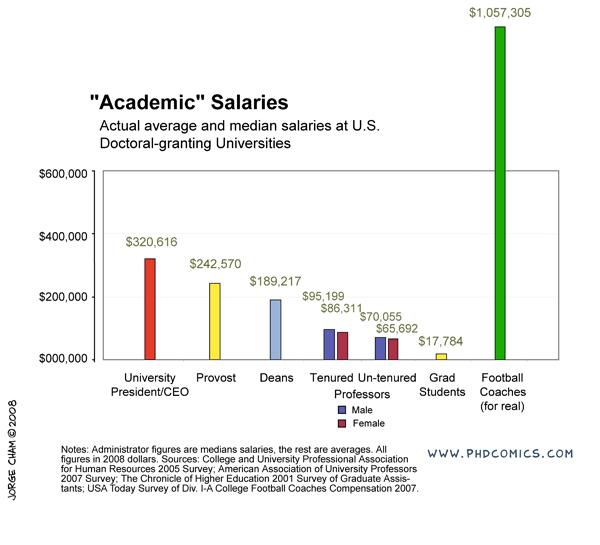
As you can see, professors don't make a ton, and with other life expenses it would take about three generations to pay off the mortgage that would be a school bill for a PhD.
I'm not whining
I know it sounds like it, but really I'm just establishing data that helped me mentally get to my real point. It isn't anyone's fault that I have made the educational, financial, and personal choices that I have. Well, I mean, it is my fault, not some external person coercing me into it. So I'm not whining about this, but rather establishing the rules of the system so I can work around it.
A Plan
Given the realities documented above and the desire that I truly have to continue to better myself as a person, I have developed a plan to get an "unofficial PhD" in Western culture. Working off of my recent posts on Hutchins's Great Conversation essay for the Great Books of the Western World, I have decided to modify slightly and follow a reading plan over the next several years (likely ten) and read the list offered by Hutchins and Adler.
I'm gong to start by finishing Hutchins's essay on the Great Conversation and then begin with Plato as suggested in the reading list. I hope to blog my way through each book, or excerpt, with impressions and thoughts. I will try to be as applicable as possible to the world we live in now. I learn best that way and I imagine others do as well.
Saturday, September 7, 2013
The Great Conversation IV: Education and Economics
**Note: Continuing this series on Richard Hutchins's book length essay that forms a large part of the first volume of the Britannica Great Books set.
A part from John Dewey and those few of his followers who understand him, most writers on education hold that, though education through great books and the liberal arts is still the best education for the few, it cannot be the best education for the many, because the many have not the capacity to acquire it.
It would seem that this education is the best for everybody, if it is the best for the best, provided everybody can get it. The question, then, is: Can everybody get it? This is the most important question in education. Perhaps it is the most important question in the world.
Nobody knows the answer to this question. There has never been a time in history when everybody has had a chance to get a liberal education. We can, however, examine the alternatives, and the consequences of each.
If leisure and political power are a reason for liberal education, then everybody in America now has this reason, and everybody where democracy and industrialization penetrate will ultimately have it. If leisure and political power require this education, everybody in America now requires it, and everybody where democracy and industrialization penetrate will ultimately require it. If the people are not capable of acquiring this education, they should be deprived of political power and probably of leisure. Their uneducated political power is dangerous, and their uneducated leisure is degrading and will be dangerous. If the people are incapable of achieving the education that responsible democratic citizenship demands, then democracy is doomed, Aristotle rightly condemned the mass of mankind to natural slavery, and the sooner we set about reversing the trend toward democracy the better it will be for the world.
On the other hand, the conclusion that everybody should have the chance to have that education which will fit him for responsible democratic citizenship and which will develop his human powers to the fullest degree does not require the immediate adoption in any given country of universal liberal education. This conclusion states the ideal toward which the society should strive. Any number of practical reasons may prevent the society from moving rapidly toward this ideal. But this does not mean that the statement of and devotion to the ideal are without value. On the contrary, the educational policy of a country will depend on the clarity and enthusiasm with which its educational ideal is stated and believed.
The poverty of a country may seem to prevent it from rapid approximation of its educational ideal. In the past the education of the few rested on the labor of the many. It was assumed, perhaps rightly, that the few could not have education unless the many were deprived of it. Thomas Jefferson’s proposal of three years of education for all could have been, and probably was, opposed on the ground that the economy of Virginia could not survive it. Whatever may have been the case in that state 150 years ago, and whatever may be the case today in underdeveloped countries, it can no longer be claimed that liberal education for all, from childhood to the grave, is beyond the economic powers of the United States.
The economic question can arise in another way. It can be suggested that liberal education is no good to a man who is starving, that the first duty of man is to earn a living, and that learning to earn a living and then earning it will absorb the time that might be devoted to liberal education in youth and maturity.
This argument is persuasive in countries where people are actually starving and where the economic system is at so rudimentary a stage that all a man’s waking hours must be dedicated to extracting a meager livelihood from the soil. Undoubtedly the first task of the statesman in such countries is to raise the standard of living to such a point that the people may be freed from economic slavery and given the time to get the education appropriate to free men. Millions of men throughout the world are living in economic slavery. They are condemned to subhuman lives. We should do everything we can to strike the shackles from them. Even while we are doing so, we must remember that economic independence is not an end in itself; it is only a means, though an absolutely necessary one, to leading a human life. Even here, the clarity of the educational ideal that the society holds before itself, and the tenacity with which that ideal is pursued, are likely to be decisive of the fate of the society.
I have no doubt that a hundred years ago we thought of dear, little, far-off, feudal Japan in the same way in which we think of the underdeveloped countries today. With our assistance Japan became a full-fledged, industrialized world power in the space of forty years. We and the Japanese thought, in the 1860s, how wonderful it would be if this result could be achieved. We and they fixed our minds on the economic development of Japan and modified the educational system of that country on “American lines” to promote this economic development. So the rich got richer, the poor got poorer, the powerful got more bellicose; and Japan became a menace to the world and to itself.
No one can question the desirability of technical training in underdeveloped countries. No one can be satisfied with technical training as an ideal. The ideal is liberal education, and technical training can be justified only because it may help to supply the economic base that will make universal liberal education possible.
In developed countries technical training is also necessary, just as work is necessary in such countries. But the West has already achieved such a standard of living that it cannot use economic backwardness as an excuse for failing to face the task of making liberal education available to all. As far as the United States is concerned, the reorganization of the educational system would make it possible for the system to make its contribution to the liberal education of the young by the time they reached the age of eighteen.
Think of the time that could be saved by the simple process of squeezing the waste, water, and frivolity out of American education. The American scheme of an eight-year elementary school, a four-year high school, and a four-year college, with graduate and professional work on top of that, is unique in the world, and we cannot congratulate ourselves on its uniqueness. No other country could afford the duplication that occurs in passing from one unit in the American system to another, or the inordinate length of time that is consumed by each unit. The tremendous waste of time in the American educational system must result in part from the fact that there is so much time to waste. A six-year elementary school, a three- or four-year high school, and a three- or four-year college would eliminate from two to four years of lost motion and leave plenty of time for liberal education.
The degree of leisure now enjoyed by the whole American people is such as to open liberal education to all adults if they knew where to find it. The industrial worker now has twenty hours of free time a week that his grandfather did not have. Neither in youth nor in his adult life does he need much training in order to learn how to make a living. The constant drive to simplify industrial operations will eventually mean—and means in many industries today—that only a few hours will be required to give the worker all the training he can use.
If we assume that the object of concentration on vocational training in the schools is what John Dewey’s mistaken followers think it is, to help young people to achieve economic independence, then we must admit that under present conditions in the United States the effort is disproportionate to the results. And the effort to do something that is not worth doing drives out of education the kind of activity that should characterize it. This effort diverts our attention from the enormously difficult task of discovering what education should be and then introducing it into the schools.
Even before mechanization had gone as far as it has now, one factor prevented vocational training, or any other form of ad hoc instruction, from accomplishing what was expected of it, and that factor was the mobility of the American population. This was a mobility of every kind—in space, in occupation, and in economic position. Training given in one place for work in that place was thrown away because the persons trained were almost certain to live and work in another place, or in several other places. Training given in one kind of work was equally useless because the persons trained usually did several other kinds of work rather than the kind they were trained to do. The failure of ad hoc instruction is so obvious that it has contributed to the notion that education, or schooling, is really irrelevant to any important activities of life and is merely a period through which the young must pass because we do not know what else to do with them. Actually the failure of ad hoc instruction shows nothing but the failure of ad hoc instruction. It does not show that education is unimportant or that in a mobile, industrial society there is no education that can meet the needs of the people.
If we are to take the assembly line as the characteristic feature of Western industry, we must regard industrialization as at best a mixed blessing. The monotony, impersonality, and uncreativeness of such work supply strong justification for the movement toward a steady reduction in the hours of labor. But what if the time that is gained for life off the assembly line is wasted, as much of it is today, in pursuits that can only be described as subhuman? What if the man as he works on the line has nothing in his head?
As the business of earning a living has become easier and simpler, it has also become less interesting and significant; and all personal problems have become more perplexing. This fact, plus the fact of the disappearance of any education adequate to deal with it, has led to the development of all kinds of cults, through which the baffled worker seeks some meaning for his life, and to the extension on an unprecedented scale of the most trivial recreations, through which he may hope to forget that his human problems are unsolved.
Adam Smith stated the case long ago: “A man without the proper use of the intellectual faculties of a man, is, if possible, more contemptible than even a coward, and seems to be mutilated and deformed in a still more essential part of the character of human nature.” He points out that this is the condition of “the great body of the people,” who, by the division of labor are confined in their employment “to a few very simple operations” in which the worker “has no occasion to exert his understanding, or to exercise his invention in finding out expedients for removing difficulties which never occur.” The result, according to Smith, is that “the torpor of his mind renders him, not only incapable of relishing or bearing a part in any rational conversation, but of conceiving any generous, noble, or tender sentiment, and consequently of forming any just judgment concerning many even of the ordinary duties of private life.”
Yet the substitution of machines for slaves gives us an opportunity to build a civilization as glorious as that of the Greeks, and far more lasting because far more just. I do not concede that torpor of mind is the natural and normal condition of the mass of mankind, or that these people are necessarily incapable of relishing or bearing a part in any rational conversation, or of conceiving generous, noble, and tender sentiments, or of forming just judgments concerning the affairs of private and public life. If they are so, and if they are so as a result of the division of labor, then industrialization and democracy are fundamentally opposed; for people in this condition are not qualified to govern themselves. I do not believe that industrialization and democracy are inherently opposed. But they are in actual practice opposed unless the gap between them is bridged by liberal education for all. That mechanization which tends to reduce a man to a robot also supplies the economic base and the leisure that will enable him to get a liberal education and to become truly a man.
A part from John Dewey and those few of his followers who understand him, most writers on education hold that, though education through great books and the liberal arts is still the best education for the few, it cannot be the best education for the many, because the many have not the capacity to acquire it.
It would seem that this education is the best for everybody, if it is the best for the best, provided everybody can get it. The question, then, is: Can everybody get it? This is the most important question in education. Perhaps it is the most important question in the world.
Nobody knows the answer to this question. There has never been a time in history when everybody has had a chance to get a liberal education. We can, however, examine the alternatives, and the consequences of each.
If leisure and political power are a reason for liberal education, then everybody in America now has this reason, and everybody where democracy and industrialization penetrate will ultimately have it. If leisure and political power require this education, everybody in America now requires it, and everybody where democracy and industrialization penetrate will ultimately require it. If the people are not capable of acquiring this education, they should be deprived of political power and probably of leisure. Their uneducated political power is dangerous, and their uneducated leisure is degrading and will be dangerous. If the people are incapable of achieving the education that responsible democratic citizenship demands, then democracy is doomed, Aristotle rightly condemned the mass of mankind to natural slavery, and the sooner we set about reversing the trend toward democracy the better it will be for the world.
On the other hand, the conclusion that everybody should have the chance to have that education which will fit him for responsible democratic citizenship and which will develop his human powers to the fullest degree does not require the immediate adoption in any given country of universal liberal education. This conclusion states the ideal toward which the society should strive. Any number of practical reasons may prevent the society from moving rapidly toward this ideal. But this does not mean that the statement of and devotion to the ideal are without value. On the contrary, the educational policy of a country will depend on the clarity and enthusiasm with which its educational ideal is stated and believed.
The poverty of a country may seem to prevent it from rapid approximation of its educational ideal. In the past the education of the few rested on the labor of the many. It was assumed, perhaps rightly, that the few could not have education unless the many were deprived of it. Thomas Jefferson’s proposal of three years of education for all could have been, and probably was, opposed on the ground that the economy of Virginia could not survive it. Whatever may have been the case in that state 150 years ago, and whatever may be the case today in underdeveloped countries, it can no longer be claimed that liberal education for all, from childhood to the grave, is beyond the economic powers of the United States.
The economic question can arise in another way. It can be suggested that liberal education is no good to a man who is starving, that the first duty of man is to earn a living, and that learning to earn a living and then earning it will absorb the time that might be devoted to liberal education in youth and maturity.
This argument is persuasive in countries where people are actually starving and where the economic system is at so rudimentary a stage that all a man’s waking hours must be dedicated to extracting a meager livelihood from the soil. Undoubtedly the first task of the statesman in such countries is to raise the standard of living to such a point that the people may be freed from economic slavery and given the time to get the education appropriate to free men. Millions of men throughout the world are living in economic slavery. They are condemned to subhuman lives. We should do everything we can to strike the shackles from them. Even while we are doing so, we must remember that economic independence is not an end in itself; it is only a means, though an absolutely necessary one, to leading a human life. Even here, the clarity of the educational ideal that the society holds before itself, and the tenacity with which that ideal is pursued, are likely to be decisive of the fate of the society.
I have no doubt that a hundred years ago we thought of dear, little, far-off, feudal Japan in the same way in which we think of the underdeveloped countries today. With our assistance Japan became a full-fledged, industrialized world power in the space of forty years. We and the Japanese thought, in the 1860s, how wonderful it would be if this result could be achieved. We and they fixed our minds on the economic development of Japan and modified the educational system of that country on “American lines” to promote this economic development. So the rich got richer, the poor got poorer, the powerful got more bellicose; and Japan became a menace to the world and to itself.
No one can question the desirability of technical training in underdeveloped countries. No one can be satisfied with technical training as an ideal. The ideal is liberal education, and technical training can be justified only because it may help to supply the economic base that will make universal liberal education possible.
In developed countries technical training is also necessary, just as work is necessary in such countries. But the West has already achieved such a standard of living that it cannot use economic backwardness as an excuse for failing to face the task of making liberal education available to all. As far as the United States is concerned, the reorganization of the educational system would make it possible for the system to make its contribution to the liberal education of the young by the time they reached the age of eighteen.
Think of the time that could be saved by the simple process of squeezing the waste, water, and frivolity out of American education. The American scheme of an eight-year elementary school, a four-year high school, and a four-year college, with graduate and professional work on top of that, is unique in the world, and we cannot congratulate ourselves on its uniqueness. No other country could afford the duplication that occurs in passing from one unit in the American system to another, or the inordinate length of time that is consumed by each unit. The tremendous waste of time in the American educational system must result in part from the fact that there is so much time to waste. A six-year elementary school, a three- or four-year high school, and a three- or four-year college would eliminate from two to four years of lost motion and leave plenty of time for liberal education.
The degree of leisure now enjoyed by the whole American people is such as to open liberal education to all adults if they knew where to find it. The industrial worker now has twenty hours of free time a week that his grandfather did not have. Neither in youth nor in his adult life does he need much training in order to learn how to make a living. The constant drive to simplify industrial operations will eventually mean—and means in many industries today—that only a few hours will be required to give the worker all the training he can use.
If we assume that the object of concentration on vocational training in the schools is what John Dewey’s mistaken followers think it is, to help young people to achieve economic independence, then we must admit that under present conditions in the United States the effort is disproportionate to the results. And the effort to do something that is not worth doing drives out of education the kind of activity that should characterize it. This effort diverts our attention from the enormously difficult task of discovering what education should be and then introducing it into the schools.
Even before mechanization had gone as far as it has now, one factor prevented vocational training, or any other form of ad hoc instruction, from accomplishing what was expected of it, and that factor was the mobility of the American population. This was a mobility of every kind—in space, in occupation, and in economic position. Training given in one place for work in that place was thrown away because the persons trained were almost certain to live and work in another place, or in several other places. Training given in one kind of work was equally useless because the persons trained usually did several other kinds of work rather than the kind they were trained to do. The failure of ad hoc instruction is so obvious that it has contributed to the notion that education, or schooling, is really irrelevant to any important activities of life and is merely a period through which the young must pass because we do not know what else to do with them. Actually the failure of ad hoc instruction shows nothing but the failure of ad hoc instruction. It does not show that education is unimportant or that in a mobile, industrial society there is no education that can meet the needs of the people.
If we are to take the assembly line as the characteristic feature of Western industry, we must regard industrialization as at best a mixed blessing. The monotony, impersonality, and uncreativeness of such work supply strong justification for the movement toward a steady reduction in the hours of labor. But what if the time that is gained for life off the assembly line is wasted, as much of it is today, in pursuits that can only be described as subhuman? What if the man as he works on the line has nothing in his head?
As the business of earning a living has become easier and simpler, it has also become less interesting and significant; and all personal problems have become more perplexing. This fact, plus the fact of the disappearance of any education adequate to deal with it, has led to the development of all kinds of cults, through which the baffled worker seeks some meaning for his life, and to the extension on an unprecedented scale of the most trivial recreations, through which he may hope to forget that his human problems are unsolved.
Adam Smith stated the case long ago: “A man without the proper use of the intellectual faculties of a man, is, if possible, more contemptible than even a coward, and seems to be mutilated and deformed in a still more essential part of the character of human nature.” He points out that this is the condition of “the great body of the people,” who, by the division of labor are confined in their employment “to a few very simple operations” in which the worker “has no occasion to exert his understanding, or to exercise his invention in finding out expedients for removing difficulties which never occur.” The result, according to Smith, is that “the torpor of his mind renders him, not only incapable of relishing or bearing a part in any rational conversation, but of conceiving any generous, noble, or tender sentiment, and consequently of forming any just judgment concerning many even of the ordinary duties of private life.”
Yet the substitution of machines for slaves gives us an opportunity to build a civilization as glorious as that of the Greeks, and far more lasting because far more just. I do not concede that torpor of mind is the natural and normal condition of the mass of mankind, or that these people are necessarily incapable of relishing or bearing a part in any rational conversation, or of conceiving generous, noble, and tender sentiments, or of forming just judgments concerning the affairs of private and public life. If they are so, and if they are so as a result of the division of labor, then industrialization and democracy are fundamentally opposed; for people in this condition are not qualified to govern themselves. I do not believe that industrialization and democracy are inherently opposed. But they are in actual practice opposed unless the gap between them is bridged by liberal education for all. That mechanization which tends to reduce a man to a robot also supplies the economic base and the leisure that will enable him to get a liberal education and to become truly a man.


Listening
Lately I've been enjoying listening to some of the music out of the Ultimae catalog. The various artists that have contributed to the Fahrenheit Project are excellent. I've only really listened to volume 1 and 2, but they are very good. Give them a listen if you enjoy Ambient, Psybient, or Shoegazing electronica.


If you give it a listen and like it, even if you don't buy it, let me know.
If you give it a listen and like it, even if you don't buy it, let me know.
Thursday, September 5, 2013
The Great Conversation III: Modern Times
Until recently great books were central in liberal education; but liberal education was limited to an elite. So great books were limited to an elite and to those few of the submerged classes who succeeded in breaking into them in spite of the barriers that society threw up around them. Where anybody bothered to defend this exclusion, it was done on the basis that only those with exceptional intelligence and leisure could understand these books, and that only those who had political power needed to understand them.
As the masses were admitted to political activity, it was assumed that, though they must be educated, they could not be educated in this way. They had to learn to read the newspaper and to write a business letter and to make change; but how could they be expected to study Plato or Dante or Newton? All that they needed to know about great writers could be translated for them in textbooks that did not suffer from the embarrassment of being either difficult or great.
The people now have political power and leisure. If they have not always used them wisely, it may be because they have not had the kind of education that would enable them to do so.
It is not argued that education through great books and the liberal arts was a poor education for the elite. It is argued that times have changed and that such an education would be a poor education for anybody today, since it is outmoded. It is remote from real life and today’s problems. Many of the books were written when men held slaves. Many were written in a prescientific and preindustrial age. What can they have to say to us, free, democratic citizens of a scientific, industrial era?
This is a kind of sociological determinism. As economic determinism holds that all activity is guided and regulated by the conditions of production, so sociological determinism claims that intellectual activity, at least, is always relative to a particular society, so that, if the society changes in an important way, the activity becomes irrelevant. Ideas originating in one state of society can have no bearing on another state of society. If they seem to have a bearing, this is only seeming. Ideas are the rationalizations of the social conditions that exist at any given time. If we seek to use in our own time the ideas of another, we shall deceive ourselves, because by definition these ideas have no application to any other time than that which produced them.
History and common sense explode sociological determinism, and economic determinism, too. There is something called man on this earth. He wrestles with his problems and tries to solve them. These problems change from epoch to epoch in certain respects; they remain the same in others. What is the good life? What is a good state? Is there a God? What is the nature and destiny of man? Such questions and a host of others persist because man persists, and they will persist as long as he does. Through the ages great men have written down their discussion of these persistent questions. Are we to disdain the light they offer us on the ground that they lived in primitive, far-off times? As someone has remarked, “The Greeks could not broadcast the Aeschylean tragedy; but they could write it.”
This set of books explodes sociological determinism, because it shows that no age speaks with a single voice. No society so determines intellectual activity that there can be no major intellectual disagreements in it. The conservative and the radical, the practical man and the theoretician, the idealist and the realist will be found in every society, many of them conducting the same kind of arguments that are carried on today. Although man has progressed in many spectacular respects, I suppose it will not be denied that he is today worse off in many respects, some of them more important than the respects in which he has improved. We should not reject the help of the sages of former times. We need all the help we can get.
The chief exponent of the view that times have changed and that our conception of the best education must change with them is that most misunderstood of all philosophers of education, John Dewey. It is one of the ironies of fate that his followers who have misunderstood him have carried all before them in American education; whereas the plans he proposed have never been tried. The notion that is perhaps most popular in the United States, that the object of education is to adjust the young to their environment, and in particular to teach them to make a living, John Dewey roundly condemned; yet it is usually advanced in his name.
Dewey was first of all a social reformer. He could not advocate adjustment to an environment the brutality and injustice of which repelled him. He believed in his own conception of liberal education for all and looked upon any kind of training directed to learning a trade, solely to make a living at it, as narrowing and illiberal. He would especially repudiate those who seek to differentiate among the young on the basis of their capacity in order to say that only some are capable of acquiring a liberal education, in Dewey’s conception of it or any other. . .
Democracy and Education was written before the assembly line had achieved its dominant position in the industrial world and before mechanization had depopulated the farms of America. The signs of these processes were already at hand; and Dewey saw the necessity of facing the social problems they would raise. One of these is the humanization of work. His book is a noble, generous effort to solve this and other social problems through the educational system. Unfortunately, the methods he proposed would not solve these problems; they would merely destroy the educational system.
The humanization of work is one of the most baffling issues of our time. We cannot hope to get rid of work altogether. We cannot say that we have dealt adequately with work when we have urged the prolongation of leisure.
Whatever work there is should have as much meaning as possible. Wherever possible, workmen should be artists; their work should be the application of knowledge or science and known and enjoyed by them as such. They should, if possible, know what they are doing, why what they are doing has the results it has, why they are doing it, and what constitutes the goodness of the things produced. They should understand what happens to what they produce, why it happens in that way, and how to improve what happens. They should understand their relations to others cooperating in a given process, the relation of that process to other processes, the pattern of them all as constituting the economy of the nation, and the bearing of the economy on the social, moral, and political life of the nation and the world. Work would be humanized if understanding of all these kinds were in it and around it.
To have these kinds of understanding the man who works must have a good mind. The purpose of education is to develop a good mind. Everybody should have equal access to the kind of education most likely to develop such a mind and should have it for as long as it takes to acquire enough intellectual excellence to fix once and for all the vision of the continuous need for more and more intellectual excellence.
This is the educational path to the humanization of work. The man who acquires some intellectual excellence and intends to go on acquiring more will, to borrow a phrase from Dewey, “reconstruct and reorganize his experience.” We need have few fears that he will not be able to learn how to make a living. In addition to performing this indispensable task, he will inquire critically about the kind of life he leads while making a living. He will seek to understand the manner in which the life of all is affected by the way he and his fellow workers are making a living. He will develop all the meaning there is in his work and go on to see to it that it has more and better meaning. This set of books is offered not merely as an object upon which leisure may be expended, but also as a means to the humanization of work through understanding.
As the masses were admitted to political activity, it was assumed that, though they must be educated, they could not be educated in this way. They had to learn to read the newspaper and to write a business letter and to make change; but how could they be expected to study Plato or Dante or Newton? All that they needed to know about great writers could be translated for them in textbooks that did not suffer from the embarrassment of being either difficult or great.
The people now have political power and leisure. If they have not always used them wisely, it may be because they have not had the kind of education that would enable them to do so.
It is not argued that education through great books and the liberal arts was a poor education for the elite. It is argued that times have changed and that such an education would be a poor education for anybody today, since it is outmoded. It is remote from real life and today’s problems. Many of the books were written when men held slaves. Many were written in a prescientific and preindustrial age. What can they have to say to us, free, democratic citizens of a scientific, industrial era?
This is a kind of sociological determinism. As economic determinism holds that all activity is guided and regulated by the conditions of production, so sociological determinism claims that intellectual activity, at least, is always relative to a particular society, so that, if the society changes in an important way, the activity becomes irrelevant. Ideas originating in one state of society can have no bearing on another state of society. If they seem to have a bearing, this is only seeming. Ideas are the rationalizations of the social conditions that exist at any given time. If we seek to use in our own time the ideas of another, we shall deceive ourselves, because by definition these ideas have no application to any other time than that which produced them.
History and common sense explode sociological determinism, and economic determinism, too. There is something called man on this earth. He wrestles with his problems and tries to solve them. These problems change from epoch to epoch in certain respects; they remain the same in others. What is the good life? What is a good state? Is there a God? What is the nature and destiny of man? Such questions and a host of others persist because man persists, and they will persist as long as he does. Through the ages great men have written down their discussion of these persistent questions. Are we to disdain the light they offer us on the ground that they lived in primitive, far-off times? As someone has remarked, “The Greeks could not broadcast the Aeschylean tragedy; but they could write it.”
This set of books explodes sociological determinism, because it shows that no age speaks with a single voice. No society so determines intellectual activity that there can be no major intellectual disagreements in it. The conservative and the radical, the practical man and the theoretician, the idealist and the realist will be found in every society, many of them conducting the same kind of arguments that are carried on today. Although man has progressed in many spectacular respects, I suppose it will not be denied that he is today worse off in many respects, some of them more important than the respects in which he has improved. We should not reject the help of the sages of former times. We need all the help we can get.
The chief exponent of the view that times have changed and that our conception of the best education must change with them is that most misunderstood of all philosophers of education, John Dewey. It is one of the ironies of fate that his followers who have misunderstood him have carried all before them in American education; whereas the plans he proposed have never been tried. The notion that is perhaps most popular in the United States, that the object of education is to adjust the young to their environment, and in particular to teach them to make a living, John Dewey roundly condemned; yet it is usually advanced in his name.
Dewey was first of all a social reformer. He could not advocate adjustment to an environment the brutality and injustice of which repelled him. He believed in his own conception of liberal education for all and looked upon any kind of training directed to learning a trade, solely to make a living at it, as narrowing and illiberal. He would especially repudiate those who seek to differentiate among the young on the basis of their capacity in order to say that only some are capable of acquiring a liberal education, in Dewey’s conception of it or any other. . .
Democracy and Education was written before the assembly line had achieved its dominant position in the industrial world and before mechanization had depopulated the farms of America. The signs of these processes were already at hand; and Dewey saw the necessity of facing the social problems they would raise. One of these is the humanization of work. His book is a noble, generous effort to solve this and other social problems through the educational system. Unfortunately, the methods he proposed would not solve these problems; they would merely destroy the educational system.
The humanization of work is one of the most baffling issues of our time. We cannot hope to get rid of work altogether. We cannot say that we have dealt adequately with work when we have urged the prolongation of leisure.
Whatever work there is should have as much meaning as possible. Wherever possible, workmen should be artists; their work should be the application of knowledge or science and known and enjoyed by them as such. They should, if possible, know what they are doing, why what they are doing has the results it has, why they are doing it, and what constitutes the goodness of the things produced. They should understand what happens to what they produce, why it happens in that way, and how to improve what happens. They should understand their relations to others cooperating in a given process, the relation of that process to other processes, the pattern of them all as constituting the economy of the nation, and the bearing of the economy on the social, moral, and political life of the nation and the world. Work would be humanized if understanding of all these kinds were in it and around it.
To have these kinds of understanding the man who works must have a good mind. The purpose of education is to develop a good mind. Everybody should have equal access to the kind of education most likely to develop such a mind and should have it for as long as it takes to acquire enough intellectual excellence to fix once and for all the vision of the continuous need for more and more intellectual excellence.
This is the educational path to the humanization of work. The man who acquires some intellectual excellence and intends to go on acquiring more will, to borrow a phrase from Dewey, “reconstruct and reorganize his experience.” We need have few fears that he will not be able to learn how to make a living. In addition to performing this indispensable task, he will inquire critically about the kind of life he leads while making a living. He will seek to understand the manner in which the life of all is affected by the way he and his fellow workers are making a living. He will develop all the meaning there is in his work and go on to see to it that it has more and better meaning. This set of books is offered not merely as an object upon which leisure may be expended, but also as a means to the humanization of work through understanding.
Tuesday, September 3, 2013
On reading in Narnia
As a fan of Lewis's Chronicles of Narnia
(I prefer the separate volumes, not a fan of massive one-volume bricks), it is humorous to me to see the different ways people will choose to read the books. The way you order your reading of the travels in Narnia seem to say a lot about you (or me). My wife and I have had this discussion several times as I grew up with a different order than she did. Even now, as we read and reread the books to our kids, we find that we often read them in a different order still.
When the books were first published, beginning in 1950, the following sequence was how they came into being.
1. The Lion, the Witch and the Wardrobe (1950)
2. Prince Caspian(1951)
3. The Voyage of the Dawn Treader (1952)
4. The Silver Chair (1953)
5. The Horse and His Boy (1954)
6. The Magicians Nephew(1955)
7. The Last Battle (1956)
This is the order I grew up with. I read The Magician's Nephew before reading The Last Battle, for instance. To others, this would be an offense of great magnitude. The Magician's Nephew should be read first, they argue. It seems modern publishers agree with them. Newer editions of the books, like those found here, order the books as follows:
1. The Magicians Nephew
2. The Lion the Witch and the Wardrobe
3. The Horse and His Boy
4. Prince Caspian
5. The Voyage of the Dawn Treader
6. The Silver Chair
7. The Last Battle
Lewis, himself, seems to have weighed in on the argument in 1957. He wrote to a child who reported the argument his mother and he had been having about what order the books should be read. He stated,
Those who choose one of the orders listed above tend to be invested in the narrative Lewis is unveiling and wish to revisit that narrative in a certain way each time. This could be a nostalgia-thing or it could be a purist way of viewing story.
Then again, there could be something else at work as some I know tend to make up their own sequence based on what they perceive to be important about the Narnia narrative. Some in my family refuse to read The Magician's Nephew first and also insist that the Last Battle be read at the very end. I personally liked the idea of going back to the very beginning of the whole tale to hear how it "really" began before reading the way it all ended. My own order of the novels would be the same as the published order listed first in this post. I find it interesting that there is debate at all here, but also find it invigorating that there is room for debate here among all those who like to visit Narnia from time to time.
When the books were first published, beginning in 1950, the following sequence was how they came into being.
1. The Lion, the Witch and the Wardrobe (1950)
2. Prince Caspian(1951)
3. The Voyage of the Dawn Treader (1952)
4. The Silver Chair (1953)
5. The Horse and His Boy (1954)
6. The Magicians Nephew(1955)
7. The Last Battle (1956)
This is the order I grew up with. I read The Magician's Nephew before reading The Last Battle, for instance. To others, this would be an offense of great magnitude. The Magician's Nephew should be read first, they argue. It seems modern publishers agree with them. Newer editions of the books, like those found here, order the books as follows:
1. The Magicians Nephew
2. The Lion the Witch and the Wardrobe
3. The Horse and His Boy
4. Prince Caspian
5. The Voyage of the Dawn Treader
6. The Silver Chair
7. The Last Battle
Lewis, himself, seems to have weighed in on the argument in 1957. He wrote to a child who reported the argument his mother and he had been having about what order the books should be read. He stated,
I think I agree with your [chronological] order for reading the books more than with your mother's. The series was not planned beforehand as she thinks. When I wrote The Lion I did not know I was going to write any more. Then I wrote P. Caspian as a sequel and still didn't think there would be any more, and when I had done The Voyage I felt quite sure it would be the last, but I found I was wrong. So perhaps it does not matter very much in which order anyone read them. I’m not even sure that all the others were written in the same order in which they were published. C.S. Lewis - Letters to Children
Those who choose one of the orders listed above tend to be invested in the narrative Lewis is unveiling and wish to revisit that narrative in a certain way each time. This could be a nostalgia-thing or it could be a purist way of viewing story.
Then again, there could be something else at work as some I know tend to make up their own sequence based on what they perceive to be important about the Narnia narrative. Some in my family refuse to read The Magician's Nephew first and also insist that the Last Battle be read at the very end. I personally liked the idea of going back to the very beginning of the whole tale to hear how it "really" began before reading the way it all ended. My own order of the novels would be the same as the published order listed first in this post. I find it interesting that there is debate at all here, but also find it invigorating that there is room for debate here among all those who like to visit Narnia from time to time.
Monday, September 2, 2013
Specialization is for Insects
A human being should be able to change a diaper, plan an invasion, butcher a hog, conn a ship, design a building, write a sonnet, balance accounts, build a wall, set a bone, comfort the dying, take orders, give orders, cooperate, act alone, solve equations, analyze a new problem, pitch manure, program a computer, cook a tasty meal, fight efficiently, die gallantly. Specialization is for insects.
- Robert A. Heinlein, Time Enough for Love, 1973
- Robert A. Heinlein, Time Enough for Love, 1973
The Great Conversation II: The Tradition of the West
The tradition of the West is embodied in the Great Conversation that began in the dawn of history and that continues to the present day. Whatever the merits of other civilizations in other respects, no civilization is like that of the West in this respect. No other civilization can claim that its defining characteristic is a dialogue of this sort. No dialogue in any other civilization can compare with that of the West in the number of great works of the mind that have contributed to this dialogue. The goal toward which Western society moves is the Civilization of the Dialogue. The spirit of Western civilization is the spirit of inquiry. Its dominant element is the Logos. Nothing is to remain undiscussed. Everybody is to speak his mind. No proposition is to be left unexamined. The exchange of ideas is held to be the path to the realization of the potentialities of the race.
At a time when the West is most often represented by its friends as the source of that technology for which the whole world yearns and by its enemies as the fountainhead of selfishness and greed, it is worth remarking that, though both elements can be found in the Great Conversation, the Western ideal is not one or the other strand in the Conversation, but the Conversation itself. It would be an exaggeration to say that Western civilization means these books. The exaggeration would lie in the omission of the plastic arts and music, which have quite as important a part in Western civilization as the great productions included in this set. But to the extent to which books can present the idea of a civilization, the idea of Western civilization is here presented.
These books are the means of understanding our society and ourselves. They contain the great ideas that dominate us without our knowing it. There is no comparable repository of our tradition.
To put an end to the spirit of inquiry that has characterized the West it is not necessary to burn the books. All we have to do is to leave them unread for a few generations. On the other hand, the revival of interest in these books from time to time throughout history has provided the West with new drive and creativeness. Great books have salvaged, preserved, and transmitted the tradition on many occasions similar to our own.
The books contain not merely the tradition, but also the great exponents of the tradition. Their writings are models of the fine and liberal arts. They hold before us what Whitehead called “the habitual vision of greatness.” These books have endured because men in every era have been lifted beyond themselves by the inspiration of their example. Sir Richard Livingstone said: “We are tied down, all our days and for the greater part of our days, to the commonplace. That is where contact with great thinkers, great literature helps. In their company we are still in the ordinary world, but it is the ordinary world transfigured and seen through the eyes of wisdom and genius. And some of their vision becomes our own.”
Until very recently these books have been central in education in the West. They were the principal instrument of liberal education, the education that men acquired as an end in itself, for no other purpose than that it would help them to be men, to lead human lives, and better lives than they would otherwise be able to lead.
The aim of liberal education is human excellence, both private and public (for man is a political animal). Its object is the excellence of man as man and man as citizen. It regards man as an end, not as a means; and it regards the ends of life, and not the means to it. For this reason it is the education of free men. Other types of education or training treat men as means to some other end, or are at best concerned with the means of life, with earning a living, and not with its ends.
The substance of liberal education appears to consist in the recognition of basic problems, in knowledge of distinctions and interrelations in subject matter, and in the comprehension of ideas.
Liberal education seeks to clarify the basic problems and to understand the way in which one problem bears upon another. It strives for a grasp of the methods by which solutions can be reached and the formulation of standards for testing solutions proposed. The liberally educated man understands, for example, the relation between the problem of the immortality of the soul and the problem of the best form of government; he understands that the one problem cannot be solved by the same method as the other, and that the test that he will have to bring to bear upon solutions proposed differs from one problem to the other.
The liberally educated man understands, by understanding the distinctions and interrelations of the basic fields of subject matter, the differences and connections between poetry and history, science and philosophy, theoretical and practical science; he understands that the same methods cannot be applied in all these fields; he knows the methods appropriate to each.
The liberally educated man comprehends the ideas that are relevant to the basic problems and that operate in the basic fields of subject matter. He knows what is meant by soul, state, God, beauty, and by the other terms that are basic to the discussion of fundamental issues. He has some notion of the insights that these ideas, singly or in combination, provide concerning human experience.
The liberally educated man has a mind that can operate well in all fields. He may be a specialist in one field. But he can understand anything important that is said in any field and can see and use the light that it sheds upon his own. The liberally educated man is at home in the world of ideas and in the world of practical affairs, too, because he understands the relation of the two. He may not be at home in the world of practical affairs in the sense of liking the life he finds about him; but he will be at home in that world in the sense that he understands it. He may even derive from his liberal education some conception of the difference between a bad world and a good one and some notion of the ways in which one might be turned into the other.
The method of liberal education is the liberal arts, and the result of liberal education is discipline in those arts. The liberal artist learns to read, write, speak, listen, understand, and think. He learns to reckon, measure, and manipulate matter, quantity, and motion in order to predict, produce, and exchange. As we live in the tradition, whether we know it or not, so we are all liberal artists, whether we know it or not. We all practice the liberal arts, well or badly, all the time every day. As we should understand the tradition as well as we can in order to understand ourselves, so we should be as good liberal artists as we can in order to become as fully human as we can.
The liberal arts are not merely indispensable; they are unavoidable. Nobody can decide for himself whether he is going to be a human being. The only question open to him is whether he will be an ignorant, undeveloped one or one who has sought to reach the highest point he is capable of attaining. The question, in short, is whether he will be a poor liberal artist or a good one.
The tradition of the West in education is the tradition of the liberal arts. Until very recently nobody took seriously the suggestion that there could be any other ideal. The educational ideas of John Locke, for example, which were directed to the preparation of the pupil to fit conveniently into the social and economic environment in which he found himself, made no impression on Locke’s contemporaries. And so it will be found that other voices raised in criticism of liberal education fell upon deaf ears until about a half-century ago.
This Western devotion to the liberal arts and liberal education must have been largely responsible for the emergence of democracy as an ideal. The democratic ideal is equal opportunity for full human development, and, since the liberal arts are the basic means of such development, devotion to democracy naturally results from devotion to them. On the other hand, if acquisition of the liberal arts is an intrinsic part of human dignity, then the democratic ideal demands that we should strive to see to it that all have the opportunity to attain to the fullest measure of the liberal arts that is possible to each.
The present crisis in the world has been precipitated by the vision of the range of practical and productive art offered by the West. All over the world men are on the move, expressing their determination to share in the technology in which the West has excelled. This movement is one of the most spectacular in history, and everybody is agreed upon one thing about it: we do not know how to deal with it. It would be tragic if in our preoccupation with the crisis we failed to hold up as a thing of value for the world, even as that which might show us a way in which to deal with the crisis, our vision of the best that the West has to offer. That vision is the range of the liberal arts and liberal education. Our determination about the distribution of the fullest measure of these arts and this education will measure our loyalty to the best in our own past and our
total service to the future of the world.
The great books were written by the greatest liberal artists. They exhibit the range of the liberal arts. The authors were also the greatest teachers. They taught one another. They taught all previous generations, up to a few years ago. The question is whether they can teach us. To this question we now turn.
At a time when the West is most often represented by its friends as the source of that technology for which the whole world yearns and by its enemies as the fountainhead of selfishness and greed, it is worth remarking that, though both elements can be found in the Great Conversation, the Western ideal is not one or the other strand in the Conversation, but the Conversation itself. It would be an exaggeration to say that Western civilization means these books. The exaggeration would lie in the omission of the plastic arts and music, which have quite as important a part in Western civilization as the great productions included in this set. But to the extent to which books can present the idea of a civilization, the idea of Western civilization is here presented.
These books are the means of understanding our society and ourselves. They contain the great ideas that dominate us without our knowing it. There is no comparable repository of our tradition.
To put an end to the spirit of inquiry that has characterized the West it is not necessary to burn the books. All we have to do is to leave them unread for a few generations. On the other hand, the revival of interest in these books from time to time throughout history has provided the West with new drive and creativeness. Great books have salvaged, preserved, and transmitted the tradition on many occasions similar to our own.
The books contain not merely the tradition, but also the great exponents of the tradition. Their writings are models of the fine and liberal arts. They hold before us what Whitehead called “the habitual vision of greatness.” These books have endured because men in every era have been lifted beyond themselves by the inspiration of their example. Sir Richard Livingstone said: “We are tied down, all our days and for the greater part of our days, to the commonplace. That is where contact with great thinkers, great literature helps. In their company we are still in the ordinary world, but it is the ordinary world transfigured and seen through the eyes of wisdom and genius. And some of their vision becomes our own.”
Until very recently these books have been central in education in the West. They were the principal instrument of liberal education, the education that men acquired as an end in itself, for no other purpose than that it would help them to be men, to lead human lives, and better lives than they would otherwise be able to lead.
The aim of liberal education is human excellence, both private and public (for man is a political animal). Its object is the excellence of man as man and man as citizen. It regards man as an end, not as a means; and it regards the ends of life, and not the means to it. For this reason it is the education of free men. Other types of education or training treat men as means to some other end, or are at best concerned with the means of life, with earning a living, and not with its ends.
The substance of liberal education appears to consist in the recognition of basic problems, in knowledge of distinctions and interrelations in subject matter, and in the comprehension of ideas.
Liberal education seeks to clarify the basic problems and to understand the way in which one problem bears upon another. It strives for a grasp of the methods by which solutions can be reached and the formulation of standards for testing solutions proposed. The liberally educated man understands, for example, the relation between the problem of the immortality of the soul and the problem of the best form of government; he understands that the one problem cannot be solved by the same method as the other, and that the test that he will have to bring to bear upon solutions proposed differs from one problem to the other.
The liberally educated man understands, by understanding the distinctions and interrelations of the basic fields of subject matter, the differences and connections between poetry and history, science and philosophy, theoretical and practical science; he understands that the same methods cannot be applied in all these fields; he knows the methods appropriate to each.
The liberally educated man comprehends the ideas that are relevant to the basic problems and that operate in the basic fields of subject matter. He knows what is meant by soul, state, God, beauty, and by the other terms that are basic to the discussion of fundamental issues. He has some notion of the insights that these ideas, singly or in combination, provide concerning human experience.
The liberally educated man has a mind that can operate well in all fields. He may be a specialist in one field. But he can understand anything important that is said in any field and can see and use the light that it sheds upon his own. The liberally educated man is at home in the world of ideas and in the world of practical affairs, too, because he understands the relation of the two. He may not be at home in the world of practical affairs in the sense of liking the life he finds about him; but he will be at home in that world in the sense that he understands it. He may even derive from his liberal education some conception of the difference between a bad world and a good one and some notion of the ways in which one might be turned into the other.
The method of liberal education is the liberal arts, and the result of liberal education is discipline in those arts. The liberal artist learns to read, write, speak, listen, understand, and think. He learns to reckon, measure, and manipulate matter, quantity, and motion in order to predict, produce, and exchange. As we live in the tradition, whether we know it or not, so we are all liberal artists, whether we know it or not. We all practice the liberal arts, well or badly, all the time every day. As we should understand the tradition as well as we can in order to understand ourselves, so we should be as good liberal artists as we can in order to become as fully human as we can.
The liberal arts are not merely indispensable; they are unavoidable. Nobody can decide for himself whether he is going to be a human being. The only question open to him is whether he will be an ignorant, undeveloped one or one who has sought to reach the highest point he is capable of attaining. The question, in short, is whether he will be a poor liberal artist or a good one.
The tradition of the West in education is the tradition of the liberal arts. Until very recently nobody took seriously the suggestion that there could be any other ideal. The educational ideas of John Locke, for example, which were directed to the preparation of the pupil to fit conveniently into the social and economic environment in which he found himself, made no impression on Locke’s contemporaries. And so it will be found that other voices raised in criticism of liberal education fell upon deaf ears until about a half-century ago.
This Western devotion to the liberal arts and liberal education must have been largely responsible for the emergence of democracy as an ideal. The democratic ideal is equal opportunity for full human development, and, since the liberal arts are the basic means of such development, devotion to democracy naturally results from devotion to them. On the other hand, if acquisition of the liberal arts is an intrinsic part of human dignity, then the democratic ideal demands that we should strive to see to it that all have the opportunity to attain to the fullest measure of the liberal arts that is possible to each.
The present crisis in the world has been precipitated by the vision of the range of practical and productive art offered by the West. All over the world men are on the move, expressing their determination to share in the technology in which the West has excelled. This movement is one of the most spectacular in history, and everybody is agreed upon one thing about it: we do not know how to deal with it. It would be tragic if in our preoccupation with the crisis we failed to hold up as a thing of value for the world, even as that which might show us a way in which to deal with the crisis, our vision of the best that the West has to offer. That vision is the range of the liberal arts and liberal education. Our determination about the distribution of the fullest measure of these arts and this education will measure our loyalty to the best in our own past and our
total service to the future of the world.
The great books were written by the greatest liberal artists. They exhibit the range of the liberal arts. The authors were also the greatest teachers. They taught one another. They taught all previous generations, up to a few years ago. The question is whether they can teach us. To this question we now turn.
Thursday, August 29, 2013
The Great Conversation I
What follows is the beginning of the essay that lies at the beginning of the Britannica Great Books of the Western World series. This set of books, edited in part by Mortimer Adler, eventually comprised 50+ volumes of material and ran the gamut of information from Antiquity to Modernity. The following essay is by Robert M. Hutchins. It may be found here and the following editorial note should be considered: Editor’s Note: Mr. Hutchins’ essay was written for the 1st edition of Great Books of the Western World in 1952, and it will be clear to the reader that some of his references to events are dated, but the Editors believe that the basic argument of this essay is as valid today—if not more so—as when it was written.
Until lately the West has regarded it as self-evident that the road to education lay through great books. No man was educated unless he was acquainted with the masterpieces of his tradition. There never was very much doubt in anybody’s mind about which the masterpieces were. They were the books that had endured and that the common voice of mankind called the finest creations, in writing, of the Western mind.
In the course of history, from epoch to epoch, new books have been written that have won their place in the list. Books once thought entitled to belong to it have been superseded; and this process of change will continue as long as men can think and write. It is the task of every generation to reassess the tradition in which it lives, to discard what it cannot use, and to bring into context with the distant and intermediate past the most recent contributions to the Great Conversation. This set of books is the result of an attempt to reappraise and re-embody the tradition of the West for our generation.
The Editors do not believe that any of the social and political changes that have taken place in the last fifty years, or any that now seem imminent, have invalidated or can invalidate the tradition or make it irrelevant for
modern men. On the contrary, they are convinced that the West needs to recapture and re-emphasize and bring to bear upon its present problems the wisdom that lies in the works of its greatest thinkers and in the discussion that they have carried on.
This set of books is offered in no antiquarian spirit. We have not seen our task as that of taking tourists on a visit to ancient ruins or to the quaint productions of primitive peoples. We have not thought of providing our readers with hours of relaxation or with an escape from the dreadful cares that are the lot of every man in the second half of the twentieth century after Christ. We are as concerned as anybody else at the headlong plunge into the abyss that Western civilization seems to be taking. We believe that the voices that may recall the West to sanity are those which have taken part in the Great Conversation. We want them to be heard again—not because we want to go back to antiquity, or the Middle Ages, or the Renaissance, or the Eighteenth Century. We are quite aware that we do not live in any time but the present, and, distressing as the present is, we would not care to live in any other time if we could. We want the voices of the Great Conversation to be heard again because we think they may help us to learn to live better now.
We believe that in the passage of time the neglect of these books in the twentieth century will be regarded as an aberration, and not, as it is sometimes called today, a sign of progress. We think that progress, and progress in education in particular, depends on the incorporation of the ideas and images included in this set in the daily lives of all of us, from childhood through old age. In this view the disappearance of great books from education and from the reading of adults constitutes a calamity. In this view education in the West has been steadily deteriorating; the rising generation has been deprived of its birthright; the mess of pottage it has received in exchange has not been nutritious; adults have come to lead lives comparatively rich in material comforts and very poor in moral, intellectual, and spiritual tone.
We do not think that these books will solve all our problems. We do not think that they are the only books worth reading. We think that these books shed some light on all our basic problems, and that it is folly to do without any light we can get. We think that these books show the origins of many of our most serious difficulties. We think that the spirit they represent and the habit of mind they teach are more necessary today than ever before. We think that the reader who does his best to understand these books will find himself led to read and helped to understand other books. We think that reading and understanding great books will give him a standard by which to judge all other books.
Though we do not recommend great books as a panacea for our ills, we must admit that we have an exceedingly high opinion of them as an educational instrument. We think of them as the best educational instrument for young people and adults today. By this we do not mean that this particular set is the last word that can be said on the subject. We may have made errors of selection. We hope that this collection may some day be revised in the light of the criticism it will receive. But the idea that liberal education is the education that everybody ought to have, and that the best way to a liberal education in the West is through the greatest works the West has produced, is still, in our view, the best educational idea there is. Examining the chronological structure of the set, the reader will also note that the Great Conversation covers more than twenty-five centuries. But he may wonder at its apparent termination with the end of the nineteenth century. With the exception of some of Freud’s writings, all the other works here assembled were written or published before 1900; and some of Freud’s important works were published before that date.
The Editors did not seek to assemble a set of books representative of various periods or countries. Antiquity and the Middle Ages, the Renaissance and modern times, are included in proportion as the great writers of these epochs contributed to the deepening, extension, or enrichment of the tradition of the West. It is worth noting that, though the period from 1500 to 1900 represents less than one-sixth of the total extent of the literary record of the Western tradition, the last four hundred years is represented in this set by more than one-half the volumes of Great Books of the Western World.
The Editors did not, in short, allot a certain space to a certain epoch in terms of the amount of time in human history that it consumed. Nor did we arbitrarily allot a certain space to a certain country. We tried to find the most important voices in the Conversation, without regard to the language they spoke. We did encounter some difficulties with language that we thought insurmountable. Where the excellence of a book depended principally on the excellence of its language, and where no adequate translation could be found or made, we were constrained reluctantly to omit it.
Since the set was conceived of as a great conversation, it is obvious that the books could not have been chosen with any dogma or even with any point of view in mind. In a conversation that has gone on for twenty-five centuries, all dogmas and points of view appear. Here are the great errors as well as the great truths. The reader has to determine which are the errors and which the truths. The task of interpretation and conclusion is his. This is the machinery and life of the Western tradition in the hands of free men.
The conversation presented in this set is peculiar to the West. We believe that everybody, Westerners and Easterners, should understand it, not because it is better than anything the East can show, but because it is important to understand the West. We hope that editors who understand the tradition of the East will do for that part of the world what we have attempted for our own tradition in Great Books of the Western World and the Syntopicon. With that task accomplished for both the West and the East, it should be possible to put together the common elements in the traditions and to present Great Books of the World. Few things could do as much to advance the unity of mankind.
Subscribe to:
Posts (Atom)